Vi använder cookies för att ge dig bästa möjliga upplevelse. Välj vilka cookies du tillåter.
Läs mer i vår integritetspolicy
Jörgen Thornberg
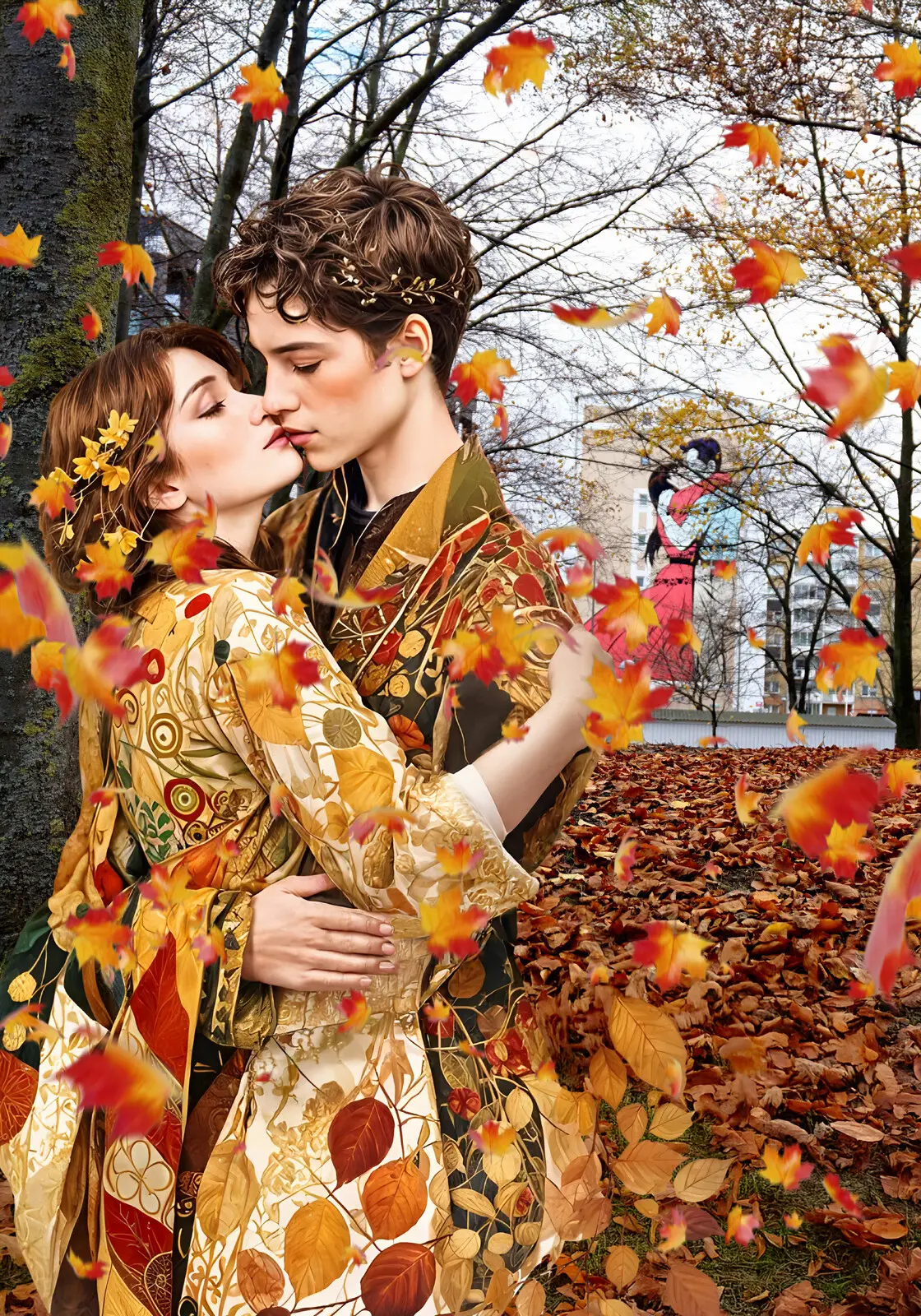
Last Embrace Before Departure - Autumn Kiss, 2024
Digital
50 x 70 cm
3 200 kr
Ode to the Kiss
“On a wall where colours blend and play,
A kiss captured in vibrant display—
Two figures entwined, a lasting goodbye,
A mural for lovers who part with a sigh.
It holds the warmth of a final embrace,
A kiss like a promise, frozen in space.
Yet kisses come in forms not so sweet,
They fill our lives on repeat.
A quick peck here, a greeting there,
So many lips meet without true care.
Cheapened in haste, affection's lost,
A kiss given freely can come at a cost.
Then there’s the kiss cloaked in deceit,
A gentle betrayal, subtle yet fleet—
Judas’ kiss, with whispered lies,
A chilling touch, a dark disguise.
A kiss meant to mark, not console,
A signal, a dagger, a toll on the soul.
For every kiss that aches and yearns,
There’s one that twists and bitterly burns.
Some are sacred, some are sly,
Some are given to say goodbye.
So be careful with each kiss you share,
For lips hold secrets beyond compare.
Malmö, October 2024
Last Embrace Before Departure
It's easy to be inspired. You'll find this fantastic artwork by British artist D*Face at Snödroppsgatan 26 near Holma Torg in Malmö, in the South of Sweden. This location, known for its vibrant street art scene, is a fitting place to appreciate such a piece. Go there, and don’t forget to hug someone. Whether the artist was inspired by Gustav Klimt’s famous ‘The Kiss’ remains unclear, but I certainly have been.
It can be called street art, murals, wall paintings, or public art. No matter what you call it, you'll find plenty of it in Malmö, a city with a welcoming attitude toward street art in its urban landscape. The street art festival ‘Artscape’ was founded in Malmö in 2014, bringing a wide array of murals created by artists worldwide. Over time, these artworks have grown in number, and you can find them both in the historic heart of Malmö and across the city's various neighbourhoods.
Gustav Klimt’s The Kiss is one of the most iconic and cherished paintings of the modern art era. Completed between 1907 and 1908 during his “Golden Phase,” this painting captures a passionate embrace between two figures intertwined in patterns and gilded in gold, set against a rich, dreamy background that seems to defy time and space. But like any masterpiece, The Kiss isn't merely about beauty—it's layered with stories, controversies, and the artist’s enigmatic touch. It’s a work as notorious as it is beloved, a gilded love story infused with bohemian lifestyle, creative rebellion, and a touch of scandal.
At first glance, The Kiss is a picture of tranquillity, yet its origin and reception were anything but peaceful. Klimt created the painting at the height of the Art Nouveau movement, as his unconventional methods and audacious themes challenged traditional Austrian society. Known for his rebellious spirit, Klimt co-founded the Vienna Secession, an art movement that encouraged freedom from the stuffy conventions of the Academy of Fine Arts. This breakaway was not just about style but a direct critique of bourgeois values, offering artists like Klimt a platform for personal and social expression.
The romance in The Kiss is less about two individual people and more an allegory of a universal love that swallows individual identity. The man’s face is barely visible, turned away from the viewer and hidden behind a cascade of flowers and foliage. The woman, meanwhile, leans into the kiss with an expression of surrender, her face calm yet intense. Her patterned robe flows into his, symbolising unity, though they each retain distinct patterns—a touch that speaks to Klimt’s genius at blending individual and collective harmony.
One reason The Kiss remains so fascinating is Klimt’s intricate use of symbols. The gold that envelopes the lovers is a homage to Byzantine art, which Klimt encountered on a trip to Ravenna in 1903. This golden aura gives the painting a quasi-religious reverence, elevating human love to the status of divine rapture. Yet, there’s more to the gilded brilliance; Japanese prints also influenced Klimt, as seen in the delicate flower motifs surrounding the couple. These influences lend the painting a timeless, almost mythical quality, a deliberate choice by Klimt to make his subjects feel both distant and tantalisingly close.
One of the juiciest tidbits about ‘The Kiss’ lies in the story of Gustav Klimt’s lifelong connection with Emilie Flöge, a woman who became much more than just a muse. Known for his unabashed admiration of women, Klimt was a figure who blurred the lines between artist and lover, muse and confidante. His studio was a magnet for Vienna’s most progressive women, from society ladies to intellectuals and artists, and Emilie was one of the most enduring figures in his life. Rumoured to have fathered over a dozen children, Klimt was famously elusive regarding marriage or conventional relationships, yet his relationship with Flöge was constant—equal parts companionship, collaboration, and likely romance.
Emilie Flöge was no ordinary woman for her time. A pioneering fashion designer, she was a co-owner of the avant-garde fashion salon Schwestern Flöge, known for its unconventional designs inspired by the free-flowing, reformist ideals of the Wiener Werkstätte. Unlike traditional Victorian attire, Flöge’s creations were loose, accessible, and often without corsets—a reflection of the changing attitudes toward women’s independence. In many ways, she embodied the new era of womanhood that Klimt celebrated in his paintings. Her aesthetic innovations significantly influenced Klimt, who, in turn, infused the elegance and freedom of Flöge’s designs into the flowing robes and swirling fabrics of his painted women. The synergy between them was undeniable; her influence can be seen in the luxurious, draped garments Klimt would often portray, especially in ‘The Kiss’.
Many believe that ‘The Kiss’ immortalises their bond, with Emilie as the woman in the painting. While Klimt never confirmed this, the speculation persists, adding a layer of intrigue to the work. Their relationship defied categorisation: it was romantic, unconventional, and passionate yet private. Emilie and Klimt spent summers together on the shores of Lake Attersee, where they would sail, swim, and work side-by-side. Letters between them show a deep affection and mutual respect that hints at intellectual and emotional love. But in Klimt’s typical fashion, he left their relationship ambiguous, and perhaps that’s precisely how he wanted it.
In ‘The Kiss’, Klimt shrouds the woman’s identity in mystery, rendering her an idealised figure rather than a detailed portrait. The woman tilts her head back, surrendering herself to the embrace, embodying a kind of trust and vulnerability that hints at more than a fleeting connection. Though less visible, The man’s face exudes a gentle protectiveness—a dynamic that resonates with Klimt and Flöge’s relationship. While Klimt’s other portraits were often direct and confrontational, ‘The Kiss’ captures something softer, more enduring: a testament to an intimacy that transcends time and circumstance. In this sense, ‘The Kiss’ can be seen as an homage to Emilie, a woman Klimt cherished in a way he never could anyone else.
Even beyond ‘The Kiss’, Klimt frequently painted Emilie in his portraits, always with an aura of mystery. In these works, she is more than just a subject; she’s an icon of feminine strength and style, a living embodiment of the “New Woman” of early 20th-century Europe. Their partnership symbolises an era when art, love, and freedom were beginning to intertwine, breaking down the barriers between muse and creator, woman and man. ‘The Kiss’ is not just a masterpiece of artistic achievement; it’s a window into Klimt’s most profound connections, with Emilie at the heart.
While Klimt’s passion for Emilie remains unconfirmed, this ambiguity is part of the painting’s charm. By casting her as both muse and mystery, Klimt allowed viewers to see Emilie as they might any great love: an enduring, if ethereal, presence held in reverence and wrapped in gold.
Embracing Eternity
Few paintings evoke the universal allure of love quite like Gustav Klimt's ‘The Kiss’. This dazzling 1908 masterpiece, draped in shimmering gold and rich earthy hues, captures a couple locked in an eternal embrace. But what lies beneath the surface of this artwork? Like all icons, ‘The Kiss’ holds its share of stories, whispered scandals, and mysteries—some we can confirm and others that linger tantalisingly beyond our reach.
The Man Behind the Kiss
Klimt himself was a character as complex as his gilded brushstrokes. Known for his affinity for the unconventional, Klimt sported a notorious wardrobe: a loose robe that resembled a housecoat, which he wore practically everywhere, except perhaps during his rare public appearances. He preferred this "painter’s uniform" while working in his studio, which was scattered with his sketches and covered with layers of gold leaf and varnish. His love life was equally unconventional; Klimt maintained several romantic relationships and fathered many children, all while fiercely guarding his private life. This flamboyance and secrecy added to his mystique, perhaps lending an edge to the sensual tension simmering in ‘The Kiss’.
Rumour has it that ‘The Kiss’ was inspired by Klimt's relationship with Emilie Flöge, a fashion designer and longtime companion. However, she was likely more of a muse than a lover. Flöge was forward-thinking in her own right, pioneering bohemian styles and, some say, influencing the draped, free-flowing robes in Klimt’s work. Whether Emilie was the model for ‘The Kiss’ remains debatable, but her influence on Klimt's vision is undeniable. This mystery allows viewers to project their ideals and emotions onto the painting, enhancing its universal appeal.
The Kiss and the Public’s Shocked Reaction
When Klimt unveiled ‘The Kiss’, the Vienna Secession was at its peak, yet even the progressive Viennese were taken aback by the painting’s eroticism and splendour. This was, after all, not a restrained display of affection; it was raw, golden intimacy in broad brushstrokes. Many saw ‘The Kiss’ as a defining moment in Klimt’s career and perhaps as his response to the earlier scandal surrounding his Faculty Paintings. Those works, which were commissioned to decorate the University of Vienna's Great Hall, were ultimately rejected as "pornographic" and scandalously unfit for the public eye. In ‘The Kiss’, Klimt avoided graphic nudity but maintained the sensual undertone that had become his hallmark. This blend of modesty and boldness allowed him to prevent censure while delivering an intense, deeply personal piece.
The Composition: A Gold-Dusted Embrace
Klimt’s ‘The Kiss’ draws from Byzantine mosaics, which Klimt encountered on a journey to Ravenna in 1903. Mesmerised by the intricate gold tiles and richly adorned figures, Klimt borrowed these techniques for ‘The Kiss’, elevating it to a quasi-religious experience. Gold, long associated with divine and royal beauty, adds a halo-like glow to the figures, transforming a simple embrace into a holy rite of passion. The lovers are nearly swallowed by gold; they stand at the edge of a floral cliff, almost as if they could drift off into an otherworldly realm.
And yet, despite the gilded splendour, Klimt grounds the painting in a raw, visceral connection. Notice the man’s bent posture and the woman’s tilted head, offering her cheek to his kiss. She appears lost, absorbed in the moment, her eyes closed as if surrendering to the feeling. This intimate pose contrasts the stoic gaze often seen in Klimt's portraits of women, revealing vulnerability rather than mystery.
The lovers' garments are symbolic, too. His robe is adorned with solid and rectangular motifs in masculine blacks and greys, while her dress is embellished with vibrant, organic patterns that echo the colourful flowers at their feet. This dichotomy of squares and circles—masculine and feminine—illustrates Klimt’s fascination with gender dynamics and unity within duality. In ‘The Kiss’, Klimt shows that to embrace another is, in a way, to complete oneself.
An Eternal Symbol and its Lasting Influence
Beyond its enchanting aesthetics, ‘The Kiss’ has transcended time to become a universal symbol of love and intimacy. It’s a work that defies straightforward interpretation. Some see it as a celebration of romance. In contrast, others perceive an imbalance in the figures’ relationship: the man’s firm grip and the woman’s yielding pose could hint at a power dynamic, where love becomes both an act of surrender and possession. This ambiguity allows ‘The Kiss’ to resonate across cultures, tapping into our varied interpretations of love.
The painting has found a place in popular culture, inspiring countless reproductions, homages, and parodies. You’ll find it gracing everything from postcards to tote bags, wedding cards to tattoos. In Japan, for instance, ‘The Kiss’ became popular through an art exhibit where viewers posed in golden robes to emulate the iconic embrace. Each fan adds their layer to ‘The Kiss’, demonstrating the painting’s fluidity and ability to connect across generations.
The Kiss and Modern Love
In today’s world, where love is often expressed through quick text messages and fleeting social media posts, ‘The Kiss’ reminds us of the intimacy and stillness that genuine connection requires. There is no rush in Klimt’s lovers, no distractions or external forces pulling them apart. This eternal embrace captures the purest essence of connection: a shared, unspoken understanding.
For the viewer, ‘The Kiss’ is an invitation to pause, to look beyond the surface, and to ponder the mysteries of affection, desire, and human connection. As Klimt’s lovers stand forever entwined, they remind us that, even in a world as fast-paced as ours, there is beauty in slowing down and holding on tightly to the ones we love. In ‘The Kiss’, Klimt gave us a masterpiece and a mirror—a glimpse into our desires and the timeless dance between lovers.
Jörgen Thornberg
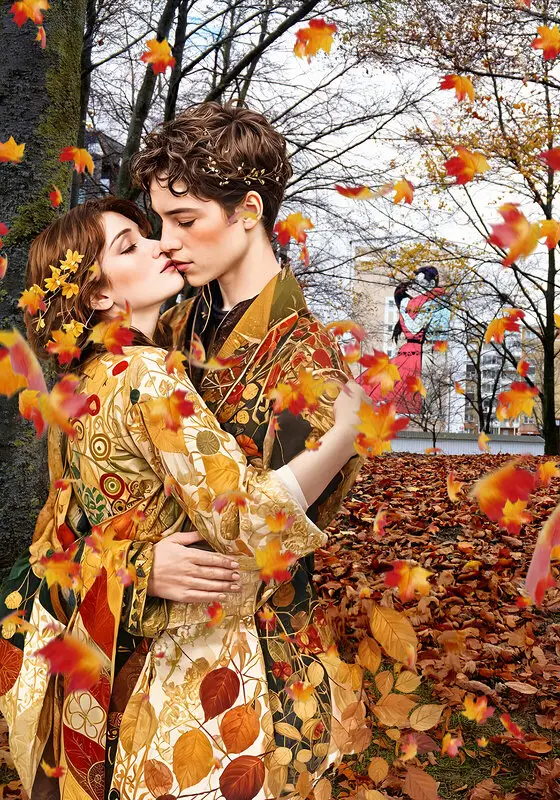
Last Embrace Before Departure - Autumn Kiss, 2024
Digital
50 x 70 cm
3 200 kr
Ode to the Kiss
“On a wall where colours blend and play,
A kiss captured in vibrant display—
Two figures entwined, a lasting goodbye,
A mural for lovers who part with a sigh.
It holds the warmth of a final embrace,
A kiss like a promise, frozen in space.
Yet kisses come in forms not so sweet,
They fill our lives on repeat.
A quick peck here, a greeting there,
So many lips meet without true care.
Cheapened in haste, affection's lost,
A kiss given freely can come at a cost.
Then there’s the kiss cloaked in deceit,
A gentle betrayal, subtle yet fleet—
Judas’ kiss, with whispered lies,
A chilling touch, a dark disguise.
A kiss meant to mark, not console,
A signal, a dagger, a toll on the soul.
For every kiss that aches and yearns,
There’s one that twists and bitterly burns.
Some are sacred, some are sly,
Some are given to say goodbye.
So be careful with each kiss you share,
For lips hold secrets beyond compare.
Malmö, October 2024
Last Embrace Before Departure
It's easy to be inspired. You'll find this fantastic artwork by British artist D*Face at Snödroppsgatan 26 near Holma Torg in Malmö, in the South of Sweden. This location, known for its vibrant street art scene, is a fitting place to appreciate such a piece. Go there, and don’t forget to hug someone. Whether the artist was inspired by Gustav Klimt’s famous ‘The Kiss’ remains unclear, but I certainly have been.
It can be called street art, murals, wall paintings, or public art. No matter what you call it, you'll find plenty of it in Malmö, a city with a welcoming attitude toward street art in its urban landscape. The street art festival ‘Artscape’ was founded in Malmö in 2014, bringing a wide array of murals created by artists worldwide. Over time, these artworks have grown in number, and you can find them both in the historic heart of Malmö and across the city's various neighbourhoods.
Gustav Klimt’s The Kiss is one of the most iconic and cherished paintings of the modern art era. Completed between 1907 and 1908 during his “Golden Phase,” this painting captures a passionate embrace between two figures intertwined in patterns and gilded in gold, set against a rich, dreamy background that seems to defy time and space. But like any masterpiece, The Kiss isn't merely about beauty—it's layered with stories, controversies, and the artist’s enigmatic touch. It’s a work as notorious as it is beloved, a gilded love story infused with bohemian lifestyle, creative rebellion, and a touch of scandal.
At first glance, The Kiss is a picture of tranquillity, yet its origin and reception were anything but peaceful. Klimt created the painting at the height of the Art Nouveau movement, as his unconventional methods and audacious themes challenged traditional Austrian society. Known for his rebellious spirit, Klimt co-founded the Vienna Secession, an art movement that encouraged freedom from the stuffy conventions of the Academy of Fine Arts. This breakaway was not just about style but a direct critique of bourgeois values, offering artists like Klimt a platform for personal and social expression.
The romance in The Kiss is less about two individual people and more an allegory of a universal love that swallows individual identity. The man’s face is barely visible, turned away from the viewer and hidden behind a cascade of flowers and foliage. The woman, meanwhile, leans into the kiss with an expression of surrender, her face calm yet intense. Her patterned robe flows into his, symbolising unity, though they each retain distinct patterns—a touch that speaks to Klimt’s genius at blending individual and collective harmony.
One reason The Kiss remains so fascinating is Klimt’s intricate use of symbols. The gold that envelopes the lovers is a homage to Byzantine art, which Klimt encountered on a trip to Ravenna in 1903. This golden aura gives the painting a quasi-religious reverence, elevating human love to the status of divine rapture. Yet, there’s more to the gilded brilliance; Japanese prints also influenced Klimt, as seen in the delicate flower motifs surrounding the couple. These influences lend the painting a timeless, almost mythical quality, a deliberate choice by Klimt to make his subjects feel both distant and tantalisingly close.
One of the juiciest tidbits about ‘The Kiss’ lies in the story of Gustav Klimt’s lifelong connection with Emilie Flöge, a woman who became much more than just a muse. Known for his unabashed admiration of women, Klimt was a figure who blurred the lines between artist and lover, muse and confidante. His studio was a magnet for Vienna’s most progressive women, from society ladies to intellectuals and artists, and Emilie was one of the most enduring figures in his life. Rumoured to have fathered over a dozen children, Klimt was famously elusive regarding marriage or conventional relationships, yet his relationship with Flöge was constant—equal parts companionship, collaboration, and likely romance.
Emilie Flöge was no ordinary woman for her time. A pioneering fashion designer, she was a co-owner of the avant-garde fashion salon Schwestern Flöge, known for its unconventional designs inspired by the free-flowing, reformist ideals of the Wiener Werkstätte. Unlike traditional Victorian attire, Flöge’s creations were loose, accessible, and often without corsets—a reflection of the changing attitudes toward women’s independence. In many ways, she embodied the new era of womanhood that Klimt celebrated in his paintings. Her aesthetic innovations significantly influenced Klimt, who, in turn, infused the elegance and freedom of Flöge’s designs into the flowing robes and swirling fabrics of his painted women. The synergy between them was undeniable; her influence can be seen in the luxurious, draped garments Klimt would often portray, especially in ‘The Kiss’.
Many believe that ‘The Kiss’ immortalises their bond, with Emilie as the woman in the painting. While Klimt never confirmed this, the speculation persists, adding a layer of intrigue to the work. Their relationship defied categorisation: it was romantic, unconventional, and passionate yet private. Emilie and Klimt spent summers together on the shores of Lake Attersee, where they would sail, swim, and work side-by-side. Letters between them show a deep affection and mutual respect that hints at intellectual and emotional love. But in Klimt’s typical fashion, he left their relationship ambiguous, and perhaps that’s precisely how he wanted it.
In ‘The Kiss’, Klimt shrouds the woman’s identity in mystery, rendering her an idealised figure rather than a detailed portrait. The woman tilts her head back, surrendering herself to the embrace, embodying a kind of trust and vulnerability that hints at more than a fleeting connection. Though less visible, The man’s face exudes a gentle protectiveness—a dynamic that resonates with Klimt and Flöge’s relationship. While Klimt’s other portraits were often direct and confrontational, ‘The Kiss’ captures something softer, more enduring: a testament to an intimacy that transcends time and circumstance. In this sense, ‘The Kiss’ can be seen as an homage to Emilie, a woman Klimt cherished in a way he never could anyone else.
Even beyond ‘The Kiss’, Klimt frequently painted Emilie in his portraits, always with an aura of mystery. In these works, she is more than just a subject; she’s an icon of feminine strength and style, a living embodiment of the “New Woman” of early 20th-century Europe. Their partnership symbolises an era when art, love, and freedom were beginning to intertwine, breaking down the barriers between muse and creator, woman and man. ‘The Kiss’ is not just a masterpiece of artistic achievement; it’s a window into Klimt’s most profound connections, with Emilie at the heart.
While Klimt’s passion for Emilie remains unconfirmed, this ambiguity is part of the painting’s charm. By casting her as both muse and mystery, Klimt allowed viewers to see Emilie as they might any great love: an enduring, if ethereal, presence held in reverence and wrapped in gold.
Embracing Eternity
Few paintings evoke the universal allure of love quite like Gustav Klimt's ‘The Kiss’. This dazzling 1908 masterpiece, draped in shimmering gold and rich earthy hues, captures a couple locked in an eternal embrace. But what lies beneath the surface of this artwork? Like all icons, ‘The Kiss’ holds its share of stories, whispered scandals, and mysteries—some we can confirm and others that linger tantalisingly beyond our reach.
The Man Behind the Kiss
Klimt himself was a character as complex as his gilded brushstrokes. Known for his affinity for the unconventional, Klimt sported a notorious wardrobe: a loose robe that resembled a housecoat, which he wore practically everywhere, except perhaps during his rare public appearances. He preferred this "painter’s uniform" while working in his studio, which was scattered with his sketches and covered with layers of gold leaf and varnish. His love life was equally unconventional; Klimt maintained several romantic relationships and fathered many children, all while fiercely guarding his private life. This flamboyance and secrecy added to his mystique, perhaps lending an edge to the sensual tension simmering in ‘The Kiss’.
Rumour has it that ‘The Kiss’ was inspired by Klimt's relationship with Emilie Flöge, a fashion designer and longtime companion. However, she was likely more of a muse than a lover. Flöge was forward-thinking in her own right, pioneering bohemian styles and, some say, influencing the draped, free-flowing robes in Klimt’s work. Whether Emilie was the model for ‘The Kiss’ remains debatable, but her influence on Klimt's vision is undeniable. This mystery allows viewers to project their ideals and emotions onto the painting, enhancing its universal appeal.
The Kiss and the Public’s Shocked Reaction
When Klimt unveiled ‘The Kiss’, the Vienna Secession was at its peak, yet even the progressive Viennese were taken aback by the painting’s eroticism and splendour. This was, after all, not a restrained display of affection; it was raw, golden intimacy in broad brushstrokes. Many saw ‘The Kiss’ as a defining moment in Klimt’s career and perhaps as his response to the earlier scandal surrounding his Faculty Paintings. Those works, which were commissioned to decorate the University of Vienna's Great Hall, were ultimately rejected as "pornographic" and scandalously unfit for the public eye. In ‘The Kiss’, Klimt avoided graphic nudity but maintained the sensual undertone that had become his hallmark. This blend of modesty and boldness allowed him to prevent censure while delivering an intense, deeply personal piece.
The Composition: A Gold-Dusted Embrace
Klimt’s ‘The Kiss’ draws from Byzantine mosaics, which Klimt encountered on a journey to Ravenna in 1903. Mesmerised by the intricate gold tiles and richly adorned figures, Klimt borrowed these techniques for ‘The Kiss’, elevating it to a quasi-religious experience. Gold, long associated with divine and royal beauty, adds a halo-like glow to the figures, transforming a simple embrace into a holy rite of passion. The lovers are nearly swallowed by gold; they stand at the edge of a floral cliff, almost as if they could drift off into an otherworldly realm.
And yet, despite the gilded splendour, Klimt grounds the painting in a raw, visceral connection. Notice the man’s bent posture and the woman’s tilted head, offering her cheek to his kiss. She appears lost, absorbed in the moment, her eyes closed as if surrendering to the feeling. This intimate pose contrasts the stoic gaze often seen in Klimt's portraits of women, revealing vulnerability rather than mystery.
The lovers' garments are symbolic, too. His robe is adorned with solid and rectangular motifs in masculine blacks and greys, while her dress is embellished with vibrant, organic patterns that echo the colourful flowers at their feet. This dichotomy of squares and circles—masculine and feminine—illustrates Klimt’s fascination with gender dynamics and unity within duality. In ‘The Kiss’, Klimt shows that to embrace another is, in a way, to complete oneself.
An Eternal Symbol and its Lasting Influence
Beyond its enchanting aesthetics, ‘The Kiss’ has transcended time to become a universal symbol of love and intimacy. It’s a work that defies straightforward interpretation. Some see it as a celebration of romance. In contrast, others perceive an imbalance in the figures’ relationship: the man’s firm grip and the woman’s yielding pose could hint at a power dynamic, where love becomes both an act of surrender and possession. This ambiguity allows ‘The Kiss’ to resonate across cultures, tapping into our varied interpretations of love.
The painting has found a place in popular culture, inspiring countless reproductions, homages, and parodies. You’ll find it gracing everything from postcards to tote bags, wedding cards to tattoos. In Japan, for instance, ‘The Kiss’ became popular through an art exhibit where viewers posed in golden robes to emulate the iconic embrace. Each fan adds their layer to ‘The Kiss’, demonstrating the painting’s fluidity and ability to connect across generations.
The Kiss and Modern Love
In today’s world, where love is often expressed through quick text messages and fleeting social media posts, ‘The Kiss’ reminds us of the intimacy and stillness that genuine connection requires. There is no rush in Klimt’s lovers, no distractions or external forces pulling them apart. This eternal embrace captures the purest essence of connection: a shared, unspoken understanding.
For the viewer, ‘The Kiss’ is an invitation to pause, to look beyond the surface, and to ponder the mysteries of affection, desire, and human connection. As Klimt’s lovers stand forever entwined, they remind us that, even in a world as fast-paced as ours, there is beauty in slowing down and holding on tightly to the ones we love. In ‘The Kiss’, Klimt gave us a masterpiece and a mirror—a glimpse into our desires and the timeless dance between lovers.
3 200 kr

Jörgen Thornberg
Malmö
Lite om bilder och mig. Translation in English at the end.
Jag är en nyfiken person som ser allt i bilder, även det jag fäster i ord, gärna tillsammans för bakom alla mina bilder finns en berättelse. Till vissa bilder hör en kortare eller längre novell som följer med bilden.
Bilder berättar historier. Jag omges av naturlig skönhet, intressanta människor och historia var jag än går. Jag använder min kamera för att dokumentera världen och blanda det jag ser med vad jag känner för att fånga den dolda magin.
Mina bilder berättar mina historier. Genom mina bilder, tryck och berättelser. Jag bjuder in dig att ta del av dessa berättelser, in i ditt liv och hem och dela min mycket personliga syn på vår värld. Mer än vad ögat ser. Jag tänker i bilder, drömmer och skriver och pratar om dem; följaktligen måste jag också skapa bilder. De blir vad jag ser, inte nödvändigtvis begränsade till verkligheten. Det finns en bild runt varje hörn. Jag hoppas att du kommer att se vad jag såg och gilla det.
Jag är också en skrivande person och till många bilder hör en kortare eller längre essay. Den följer med tavlan, tryckt på fint papper och med en personlig hälsning från mig.
Flertalet bilder startar sin resa i min kamera. Enkelt förklarat beskriver jag bilden jag ser i mitt inre, upplevd eller fantiserad. Bilden uppstår inom mig redan innan jag fått okularet till ögat. På bråkdelen av ett ögonblick ser jag vad jag vill ha och vad som kan göras med bilden. Här skall jag stoppa in en giraff, stålmannen, Titanic eller vad det är min fantasi finner ut. Ännu märkligare är att jag kommer ihåg minnesbilden långt efteråt när det blir tid att skapa verket. Om jag lyckas eller inte, är upp till betraktaren, oftast präglat av en stråk av svart humor – meningen är att man skall bli underhållen. Mina bilder blir ofta en snackis där de hänger.
Jag föredrar bilder som förmedlar ett budskap i flera lager. Vid första anblicken fylld av feel-good, en vacker utsikt, fint väder, solen skiner, blommor på ängen eller vattnet som ligger förrädiskt spegelblankt. I en sådan bild kan jag gömma min egentliga berättelse, mitt förakt för förtryckare och våldsverkare, rasister och fördomsfulla människor - ett gärna återkommande motiv mer eller mindre dolt i det vackra motivet. Jag försöker förena dem i ett gemensamt narrativ.
Bild och formgivning har löpt som en röd tråd genom livet. Fotokonst känns som en värdig final som jag gärna delar med mig.
Min genre är vid som framgår av mina bilder, temat en blandning av pop- och gatukonst i kollage som kan bestå av hundratals lager. Vissa bilder kan ta veckor, andra någon dag innan det är dags att överlämna resultatet till printverkstaden. Fine Art Prints är digitala fotocollage. I dessa kollage sker rivandet, klippandet, pusslandet, målandet, ritandet och sprayningen digitalt. Det jag monterar in kan vara hundratals år gamla bilder som jag omsorgsfullt frilägger så att de ser ut att vara en del av tavlan men också bilder skapade av mig själv efter min egen fantasi. Därefter besöks printstudion och för vissa bilder numrera en limiterad upplaga (oftast 7 exemplar) och signera för hand. Vissa bilder kan köpas i olika format. Det är bara att fråga efter vilka. Gillar man en bild som är 70x100 men inte har plats på väggen, går den kanske att få i 50x70 cm istället. Frågan är fri.
Metoden Giclée eller Fine Art Print som det också kallas är det moderna sättet för framställning av grafisk konst. Villkoret för denna typ av utskrifter är att en högkvalitativ storformatskrivare används med åldersbeständigt färgpigment och konstnärspapper eller i förekommande fall på duk. Pappret som används möter de krav på livslängd som ställs av museer och gallerier. Normalt säljer jag mina bilder oinramade så att den nya ägaren själv kan bestämma hur de skall se ut, med eller utan passepartout färg på ram, med eller utan glas etc..
Under många år ställde jag bara ut på nätet, i valda grupper och på min egen Facebooksida - https://www.facebook.com/jorgen.thornberg.9
Jag finns också på en egen hemsida som tyvärr inte alltid är uppdaterad – https://www.jth.life/ Där kan du också läsa en del av de berättelser som följer med bilden.
UTSTÄLLNINGAR
Luftkastellet, oktober 2022
Konst i Lund, november 2022
Luftkastellet, mars 2023
Engleson Galleri Caroli, april 2023
Hydra, Greece June 2023
Engleson Galleri Caroli, oktober 2023
Toppen, Höllviken december 2023
Luftkastellet, mars 2024
Torups Galleri, mars 2024
Venice, May 2024
Luftkastellet, oktober 2024
Konst i Advent, December 2024
Galleri Engleson, Caroli December 2024
Jäger & Jansson Galleri, april 2025
A bit about pictures and me.
I'm a curious person who sees everything in pictures, even what I express in words, often combining them, for behind all my pictures lies a story. These narratives, some as short as a single image and others as long as a novel, are the heart and soul of my work.
Pictures tell stories. Wherever I go, I'm surrounded by natural beauty, exciting people, and history. I use my camera to document the world and blend what I see with what I feel to capture the hidden magic.
My images tell my stories. Through my pictures, prints, and narratives, I invite you to partake in these stories in your life and home and share my deeply personal perspective of our world. More than meets the eye. I think in pictures, dream, write, and talk about them; consequently, I must create images too. They become what I see, not necessarily confined to reality. There's a picture around every corner. I hope you'll see what I saw and enjoy it.
I'm also a writer, and many images come with a shorter or longer essay. It accompanies the painting, printed on fine paper with my personal greeting.
Many pictures start their journey on my camera. Simply put, I describe the image I see in my mind, experienced or imagined. The image arises within me even before I bring the eyepiece to my eye. In a fraction of a moment, I see what I want and what can be done with the picture. Here, I'll insert a giraffe, Superman, the Titanic, or whatever my imagination conjures up. Even stranger is that I remember the mental image long after it's time to create the work. Whether I succeed is up to the observer, often imbued with a streak of black humour – the aim is to entertain. My pictures usually become a talking point wherever they hang.
I prefer pictures that convey a message in multiple layers. At first glance, they're filled with feel-good vibes, a beautiful view, lovely weather, the sun shining, flowers in the meadow, or the water lying deceptively calm. But beneath this surface beauty, I often conceal a deeper story, a narrative that challenges societal norms or explores the human condition. I invite you to delve into these hidden narratives and discover the layers of meaning within my work.
Picture and design have been a thread running through my life. Photographic art feels like a fitting finale, and I'm happy to share it.
My genre is varied, as seen in my pictures; the theme is a blend of pop and street art in collages that can consist of hundreds of layers. Some images can take weeks, others just a day before it's time to hand over the result to the print workshop. Fine Art Prints are digital photo collages. In these collages, tearing, cutting, puzzling, painting, drawing, and spraying happen digitally. What I insert can be images hundreds of years old that I carefully extract so they appear to be part of the painting, but also images created by myself, now also generated from my imagination. Next, visit the print studio and, for certain images, number a limited edition (usually 7 copies) and sign them by hand. Some images may be available in other formats. Just ask which ones. If you like an image that's 70x100 but doesn't have space on the wall, you might be able to get it in 50x70 cm instead. The question is open.
The Giclée method, or Fine Art Print as it's also called, is the modern way of producing graphic art. This method ensures the highest quality and longevity of the artwork, using a high-quality large-format printer with archival pigment inks and artist paper or, in some cases, canvas. The paper used meets the longevity requirements set by museums and galleries. I sell my pictures unframed, allowing the new owner to personalise their artwork, confident in the lasting value and quality of the piece.
For many years, I only exhibited online, in selected groups, and on my Facebook page - https://www.facebook.com/jorgen.thornberg.9. I also have my website, which unfortunately is not constantly updated - https://www.jth.life/. You can also read some of the stories accompanying the pictures there.
EXHIBITIONS
Luftkastellet, October 2022
Art in Lund, November 2022
Luftkastellet, March 2023
Engleson Gallery Caroli, April 2023
Hydra, Greece June 2023
Engleson Gallery Caroli, October 2023
Toppen, Höllviken December 2023
Luftkastellet, March 2024
Torup Gallery, March 2024
Venice, May 2024
UTSTÄLLNINGAR
Luftkastellet, oktober 2022
Konst i Lund, november 2022
Luftkastellet, mars 2023
Engleson Galleri Caroli, april 2023
Hydra, Greece June 2023
Engleson Galleri Caroli, oktober 2023
Toppen, Höllviken december 2023
Luftkastellet, mars 2024
Torups Galleri, mars 2024
Venice, May 2024
Luftkastellet, October 2024
Konst i Advent, December 2024
Galleri Engleson, Caroli December 2024
Jäger & Jansson Galleri, April 2025
Utbildning
Autodidakt
Medlem i konstnärsförening
Öppna Sinnen
Med i konstrunda
Konstrundan i Skåne
Utställningar
Luftkastellet, October 2022
Art in Lund, November 2022
Luftkastellet, March 2023
Engleson Gallery Caroli, April 2023
Hydra, Greece June 2023
Engleson Gallery Caroli, October 2023
Toppen, Höllviken December 2023
Luftkastellet, March 2024
Torup Gallery, March 2024
Venice, May 2024