Vi använder cookies för att ge dig bästa möjliga upplevelse. Välj vilka cookies du tillåter.
Läs mer i vår integritetspolicy
Jörgen Thornberg
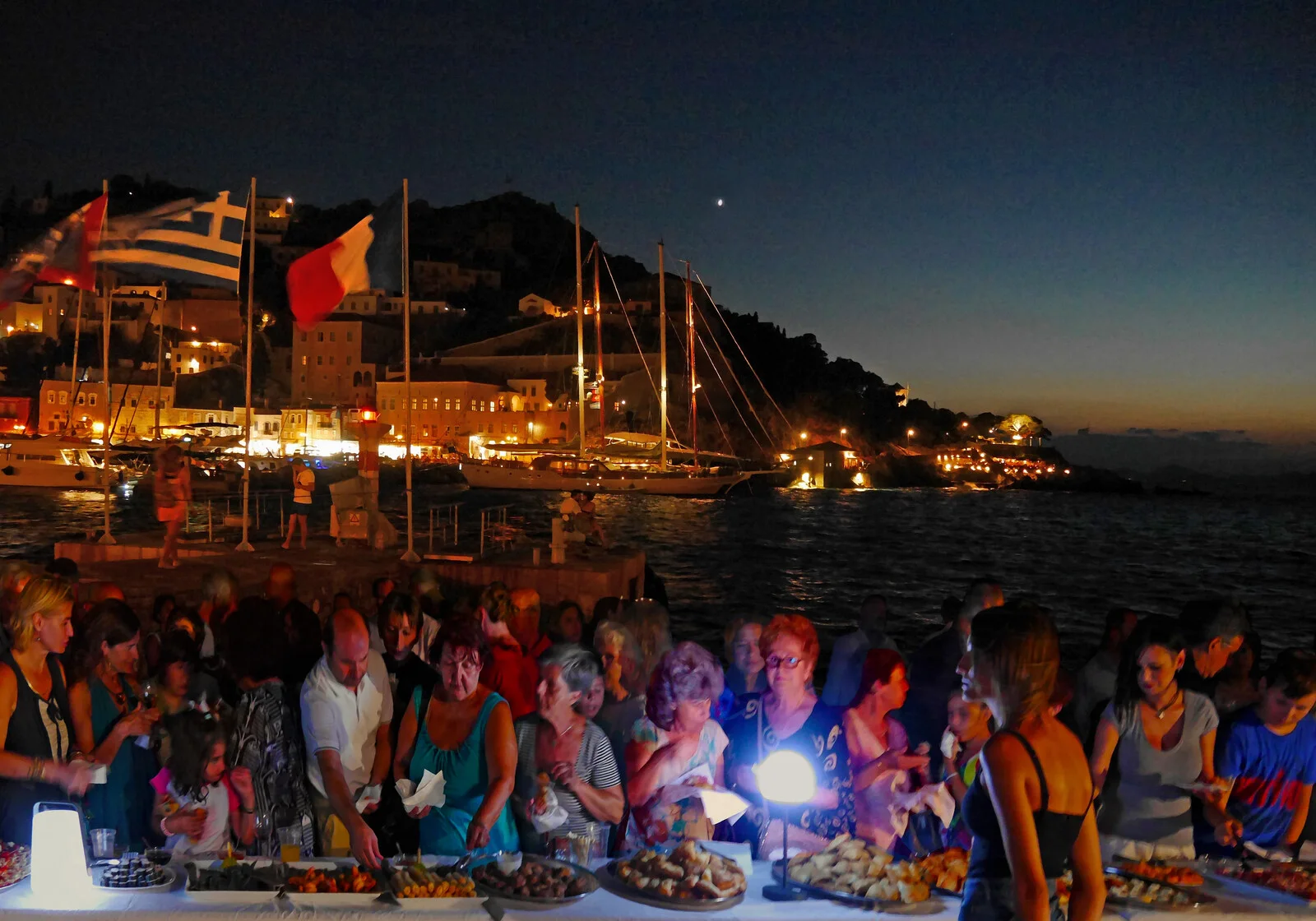
Greek Smorgasbord and Pattering Flags, 2022
Digital
100 x 70 cm
The incredible attack on the buffet happened outside Hydra's museum. The vernissage ended with a sponsored feast. Everything was free, and the Hydriots and guests stood like a pack of ravenous wolves a bit away, carefully guarding their place, ready to pounce on the delicacies laid out on a twenty-five-meter-long table in the shortest possible time.
"Greeks never cease to fascinate me," said Babis Mores, former owner of the nightclub Lagoudera, which closed in the mid-90s. His countless parties left him with no illusions about human dignity especially since the club moved to what is now Omilos, where drunk guests would throw themselves directly into the sea from where one can still enjoy good food today.
I asked Babis to explain the transformation in eating habits from ancient times to the present day.
"The eating habits of the Hydriots during the 18th and 19th centuries didn't differ much from those of the ancient Greeks," he began. "Their diet, with its unique variety, starkly contrasts our modern eating habits. One of the most intriguing differences is their significantly smaller portions than our current norms. This practice could be seen as a healthier approach to eating, inspiring us to reconsider our portion sizes."
Babis paused to let that sink in, and I nodded, encouraging him to continue.
"The ancient Greeks began their day with breakfast, which was not just about sustenance but also about cultural traditions and beliefs. This light, nourishing meal typically included a small portion of barley bread dipped in lukewarm wine and figs or a drink called 'Kykeonas,' a libation made of boiled barley flavoured with mint or thyme, believed to have healing properties."
He glanced at me, checking if I was following. I was enthralled.
"Seafood was a beloved part of the ancient Greek diet, particularly for those in Hydra and other coastal regions. Their lunchtime meals were often a celebration of the sea's bounty, with various fresh fish such as sea bream, mullet, sardines, and eels gracing their tables. For those preferring a plant-based option, a colorful array of legumes, including lentils, beans, chickpeas, peas, and broad beans, was always offered. The eternal European bread staple was always served midday, accompanied by cheese, olives, eggs, nuts, and fruits."
"Sounds delicious," I interjected, my mouth watering at the thought.
Babis smiled and continued, "Ancient Greeks held dinner in even higher regard, considering it not just a meal but a time for family and community. This shared mealtime was a cornerstone of their culture, a time for bonding and sharing stories, making it more than a meal."
"What about meat?" I asked, curious about their preferences.
"The ancients preferred pork and veal, while they rarely ate goat or lamb. They also loved hunting tiny birds such as thrush and quail, but they were not averse to taking deer, so venison was not unheard of at the ancient Greek table."
I was surprised. "I didn't know they ate snails."
"Yes," Babis nodded. "One of the most intriguing aspects of the ancient diet was their love for snails. It is recorded that Cretans had been enjoying these delicacies since the time of Minos, adding a unique and unexpected element to their culinary repertoire."
"What about fruits and vegetables?" I asked.
"Fruits and vegetables were always on the table, although not in the variety we find today. Pears, pomegranates, apples, figs, berries, cherries, and plums were always in high demand, directly picked from their garden. Hydriots were known to cultivate vegetables in their gardens, and they had a particular love for onions, garlic, lettuce, cucumbers, peas, artichokes, celery, dill, and mint. Mushrooms, fennel, asparagus, and even tender, edible nettles were to be found in abundance in the fields."
"That sounds quite diverse," I said.
"Indeed," Babis agreed. "As almost all of us still do, people also loved bread, and they baked various varieties, from flatbread to semolina bread and even a coarse type made from millet."
"And fish?" I prompted.
"Perhaps most of all, the Greeks and the Hydriots loved their fish. They frequently dined on the types of fish that lived right along the rocky shores of the Aegean, but they also enjoyed fish from the open seas, such as tuna, a much-sought-after delicacy. They also enjoyed mackerel, bonito, and anchovies, which were abundant during their season and were easy to catch with nets. Tuna and anchovies, widely consumed by all social classes, were the product of a flourishing sea trade throughout the Mediterranean and the adjacent seas."
"Wasn't there a special sauce they used?" I asked, remembering something I'd read.
"Yes," Babis said, his eyes lighting up. "Garos, a sauce made from fried, salted fatty fish, was another fundamental element of the diet along the coast in ancient Greece. High-quality Garos, made of tuna offal and blood, was quite expensive."
He went on, "The kitchen shelves of better Hydra houses were always stocked with an impressive variety of herbs and spices, each with its unique flavor and health benefits. These included oregano, basil, mint, thyme, cardamom, coriander, capers, and sesame, which they would add liberally to their dishes, enhancing the taste and nutritional value."
I nodded, fascinated by the depth of knowledge. "What about sweets?"
"Most foods were remarkably light, baked in the oven and on skewers. The same was true for sweets made from pastry, with dried or fresh fruit and honey. Of course, every meal was accompanied by wine and olive oil, always on the table, especially for Athenians, who considered it the goddess Athena's gift to their city. They believed food was intended to satisfy the palate rather than fill the stomach. In that sense, and that sense only, one can even say that they were gourmands."
Babis paused, allowing me to absorb the information. I was amazed at how much the diet had evolved while retaining some core elements.
"And what about Sparta?" I asked, curious about their unique dietary habits.
"The only exception to this overall rule was the people of Sparta, who were by far the lightest eaters. True to form, even in their diet, they followed a laconic austerity, with their daily food consisting of a bowl of 'black broth' and a piece of bread. They would have boiled pork accompanied by wine and pita bread on special occasions and feasts. But everywhere else in Greece, there was a great variety of food at every meal, and people were delighted by it."
I leaned back, trying to imagine such a feast. "What about desserts?"
"Dinner in ancient Greece was usually accompanied by desserts, such as cheesecake called 'Tragimata,' composed of fresh or dried fruit, including figs, nuts, grapes, or honey-based sweets. The first cheesecake was documented between 800 and 700 B.C. on the island of Samos; other scholars, having studied ancient cheese moulds and other findings unearthed in Greece, argued that a form of ancient cheesecake existed in the region even before 2000 B.C. This continuity of culinary practices, spanning centuries, is a testament to these ancient recipes' enduring appeal and deliciousness."
"Cheesecake?" I asked, incredulous. "They had cheesecake?"
Babis chuckled. "We know that the ancient Greeks were enamoured with the combination of cheese and honey. This makes sense when you consider that honey was the primary sweetener back then, a vital ingredient in sweet and savoury recipes and sauces. Dinner, which historians have identified as the most essential and most extended meal of the day in ancient Greece, began or ended with Tragimata, sweet treats like fresh or dried fruit, nuts, and sesame seeds, which were often served with honey or caramelised with it. Caramelised almonds and the famous Sesamis (now called pasteli, a honey and sesame bar) were both famous."
"That sounds heavenly," I said.
"Honey was also an essential ingredient in Plakountas, or pies, where it was often combined with cheese. These pies were made in various ways but were usually made from a short list of ingredients: a mix of wheat and water, cheese, honey, milk, eggs, raisins, nuts, herbs, and spices. The ancient method of making cheesecake, recorded for posterity by Athineus in 230 A.D., involved mixing the cheese with honey and soaked flour. The mixture was heated over the fire and then cooled down before serving. The Romans adopted the recipe, adding eggs and calling it placenta (Latin for 'flat cake,' the word took on its modern meaning when a 16th-century anatomist referred to the organ as placenta uterine, or 'uterine cake'). They sometimes baked the pie in a wood-burning oven and most often served it warm, unlike the Greeks who ate it cold."
"It's essentially a simplified version of the current recipe for the traditional Greek version of cheesecake, most commonly called Myzithropita," Babis explained. "The star ingredient is Myzithra, the cheese most often used in this type of cheesecake. Having been produced in Greece for thousands of years, Myzithra is most often associated with Crete (although similar cheeses are prepared in many parts of Greece, especially on the Cyclades). It's made from a mix of sheep and goat milk (depending on the region) and whey, with many using the whey of feta cheese in a production process similar to that of ricotta in Italy."
"There are two types of fresh Myzithra," he continued. "One is called xynomyzithra ('sour Myzithra') – or Pichtogalo as they call it on Crete – a fantastic creamy, white, granular cheese that is slightly salty and tangy, as its name suggests, and is often used in salads, among other things. The second version, glykia Myzithra ('sweet Myzithra'), is milder and less salty, so it features several desserts across Greece. There is also an aged and salt-dried type of Myzithra, making it harder and giving it a slightly spicier and saltier flavour that resembles Italian ricotta salata."
"Around Greece, you will find several variations of Myzithropita, some even with different names but always with fresh cheese as the base. Best known are the Cretan versions, which are commonly eaten for breakfast. These are similar in appearance (although not preparation or flavour) to pancakes, drizzled with honey and sprinkled with cinnamon, or wrapped in thick phyllo, dip-fried, and served with honey or sugar and cinnamon."
"Skepasti on Tinos and Melopita ('honey pie') on Sifnos and Mykonos are more or less the same recipe: They are made with fresh cheese, eggs, sugar, flour, and honey and baked in the oven. A lovely idea is adding Mastika, as the traditional Melitinia recipe from Santorini calls for."
"If you can't get fresh sweet Myzithra cheese, replace it with Anthotyro (a similar Greek cheese), manouri mixed with yoghurt to soften it, or Italian ricotta. If you can't get Mastika (although I recommend trying to find it at a Greek store or online), you can replace it with vanilla."
"I love this cake because it's not very sweet and can be quite refreshing. I keep it cold in the fridge, which adds to this feeling). I particularly enjoy it for breakfast, drizzled with good quality thyme honey from the island of Tinos, plenty of cinnamon, and my large cup of coffee."
Babis then shared his recipe for Myzithropita with me, which I eagerly jotted down:
Myzithropita for gourmets and gourmands
1 ½ kg fresh Myzithra cheese (or ricotta cheese)
260 gr light brown sugar
Five large eggs
Pinch of salt
One teaspoon powdered Mastika
Zest one unwaxed and preferably organic lemon
70 gr fine semolina
1 tsp baking powder
Butter for greasing the pan
One round cake tin around 27 cm in diameter
Honey and cinnamon to serve
Instructions:
Preheat your oven to 170 C. Put the cheese in a large bowl and mash it with a big fork. Mix in the sugar and stir using the same fork.
Beat the eggs in a separate bowl and add them to the cheese mix with lemon zest, mastika, and baking powder. Mix well to incorporate, and finally, start gradually adding the semolina while stirring constantly.
Grease the pan with butter and pour in the mix.
Bake on the lowest rack for 45-60 minutes until golden brown. Remove the cake from the oven and allow it to cool.
Once it has cooled, carefully remove it from the cake tin and serve it with honey and cinnamon.
"However, despite this mouth-watering array of delicacies, which no one today would scorn, ancient Greeks were still light eaters compared to us today in the modern world. They indeed consumed a great variety of foods but in relatively small quantities."
"So this proves that, even regarding food, we still have much to learn from the ancient Greeks," I concluded.
Babis nodded in agreement, and we both reflected on the wisdom and culinary heritage of the ancient Greeks.
This is an extract from my novel 'The Last Dance', which takes place on Hydra.
We were interrupted by the sound of the crowd as the buffet was about to begin. "Returning to how the buffet started," Babis said, "I will do my best to explain what happened, how it happened, and what happened afterwards. Even a nearly full moon is said to drive people to madness. Perhaps the moon prompted Babis's guests to help themselves to the buffet in the way they did. Alternatively, they may have been influenced by Greek traditions - at least, that's what Babis claimed. 'You must adopt the customs of the place you visit,' he said. Say what you will about customs, but the Time-travellers followed it until the last grain was consumed. In short, I want to skip ahead to the moment after the buffet when there was nothing left—tabula rasa. The tablecloths showed thoroughly cleaned plates, bowls, splatters, grease residues, and rings. Tears and holes in the clothes testified to the violent feast. The blissful participants carried out empty buckets and containers."
"The porcelain was so clean that one could imagine blissful souls putting the unwashed dishes back in the drawers to be returned to Babis's star. But they were washed, I must point out," I added.
Babis continued, "Back to the moment before the buffet when the air was filled with anticipation. Perhaps I wouldn't have believed the event myself if I hadn't proudly shown the set table before the horde of guests was released. The buzz was as intense as before, the sounds more expectant, even tense. The guests waited in the main hall, adjoining rooms, and on the terrace, just a few meters from a green tarp decorated with pictures of the buffet behind it. It was hung like a curtain in front of the gastronomic stage. With a tug on two ropes, it would be raised and aside, and the show could begin."
"The curtain was painted by one of the blessed, a young artist who died in an explosive combination of a car and smoking. Artists use a lot of solvents, such as turpentine and acetone. The former is self-igniting, and acetone is highly explosive with a flashpoint below 23 degrees. The soon-to-be graduate artist would never dream of being careless with fire near those fluids. Signs were warning of the danger on the wall of the art school's studio."
"The incident took place at a time when cigarette advertising was still considered acceptable. Certain brands, like the young artist's Gauloise, were considered manly to smoke. They had the right kick in the throat and smelled terrible enough to attract the '68 generation. With a cigarette in his mouth, he climbed many Paris barricades and protested against everything. Through an inheritance from an aunt, the art student could buy a used Citroen DS and become popular among the female students. The model was spacious, and the ladies appreciated the brand's unique air suspension. It was to one of them he was going when the thing happened that shouldn't have happened but still did. The car wouldn't start even though the starter motor was turning. Old cars do that when they're in that mood. The art student exclaimed inappropriate French expressions, which didn't help."
"After pulling on the loose wires in the cabin, banging on the steering wheel, opening the hood, pulling cables there, wiping the distributor cap, and checking the oil dipstick, the young man concluded that the car was probably out of gas. The gauge showed zero, but it had since he bought the car. Manual inspection remained. The fuel cap on a DS model is located at the back, on the right wing, low and close to the tank. He unscrewed the cap and pushed the car to hear if it sloshed down there. It didn't. A visual inspection was necessary."
"The artist bent over, cigarette still in his mouth, and checked if any gas was left in the tank. There was! Kaboom. The painter became a blissful soul at only 23 years old. At the party, his curtain helped admirably calm the crowds pushing forward. The paintings made the waiting easier but increased the appetite for some. There was other art—a lot of it."
Babis had placed art from above in the garden and on terraces, sculptures made of polished meteorite and slag from the sun - skillfully shaped by the renowned Henry Moore, an honorary guest. Moore, with his good friend and host Ghikas, discussed one of them - Babis resting outside Lagoudera with a stylised beer bottle in his hand. 'A masterpiece,' according to Babis, who owned about twenty of them - the result of playing tavli. Moore may be one of humanity's most significant sculptors, but a lousy backgammon player."
"I was given a guided tour behind the blessed artist's works and the grand buffet, which was mostly ready. A work of art bursting with pleasant scents and colours, waiting for its destruction. Like ice and snow sculptures, this art had its allotted time. Babis proudly showed off the creation that stretched from one end of the terrace to the other. To call it modest would be a gross lie. Like the audience, the creation was international, but above all, Greek. Many guests brought their specialities and combined them with Babis' mother's and Nagring's food into a gastronomic collage. They had managed to incorporate almost the entire palette of hues, something reminiscent of a colour explosion by Matisse - in his pulsating composition 'Open Window' because, behind the buffet, the windows were open towards the main hall where the guests mingled anxiously."
"The food landscape unfolded from icy white to the deepest red from east to west. In the east, where Aurora would peek out many hours later, there was a seafood section with fish presented on a hill of ice, in the order they eat each other in the sea. At the bottom were dishes and pickles of smaller fish like anchovies, sardines, and tiny fried Marides; higher up, mackerel with the flavours of feta, oregano, tomato, and olives, and oven-baked hake on a bed of spinach and root vegetables; grilled octopus and fried calamari Tiganito, pink lobster pasta and crab, mussels, and I didn't have time to note everything. Goldfish swam in a bowl. They belonged to the decoration and were not meant to be eaten. Dominating the scene was Hemingway's swordfish, beautifully sliced inside its skin and sprinkled with parsley and chopped tomatoes. In the far west, where the sun had settled, another mountain rose, one of vegetable dishes and salads - culminating in terraces of blazing red peppers filled with minced meat."
"I love everything that comes from my garden," Babis said. "My patch on Hydra was a piece of a vegetable garden and accommodated a few chickens and Sophia's rabbit - but no goats or sheep, and God forbid, nothing as big as an ox. Of course, I managed to devour a fillet steak, but I appreciated the marine selection more, especially things I had caught from the sea myself. But if I had to choose, it would be the garden and its delightful hues - all kinds of peppers, small green zucchinis with yellow flowers like a tie around the neck, purple swelling eggplants and greenish-yellow-red flavorful tomatoes, beefy and knobby like clenched boxer fists. Lemons gilded by the Hydra sun, which had also lacquered my oranges and mandarin bright orange; golden honey melons, speckled watermelons, orange apricots, and deepest purple cherries. I could manage a menu worthy of a royal banquet. Although this time, I didn't fare so well." Babis pointed to the dessert table, laden with fruits and pastries, Baklava, almond flakes from Tsagaris, plates upon plates of sweet desserts, Tragemata, dried fruit, sweet almonds, and honey pies, and so on."
"Some of it comes from an uninhabited planet, not unlike Earth, but more speckled than blue, where one of the master chefs made a stop. There are mushrooms, exotic fruits, and vegetables that taste different." Babis picked up a fruit that looked like a twisted candy cane, striped white and red and tasted like one.
"Delicious," I said, but I wondered how Amalia from Gränna got hold of that recipe in the 19th century. "A revelation," she is said to have said, and that might be the explanation.
"And don't miss the decoration and framing. Presentation! Presentation! Presentation! The scent of lavender is hard to beat, even though it can't be eaten. Grow your lavender sea and enjoy the lovely flower all summer long. And Jorgos - the bees also love lavender!" Babis stroked the stalks that waved up from an urn. We stepped back into the trembling hustle and bustle, and I could see from Babis's look that there was something he hadn't thought of."
"Here you have potatoes in a dozen variations, from fried or deep-fried to boiled and braised, with sauce or without, and so on. Nothing is missing!" boasted Babis. "Nowadays, Greeks eat a lot of potatoes – even among the stars – but it took time to learn. After the War of Independence, cheap food was needed, and the new root vegetable gained honour. Greece's first prime minister, Ioannis Kapodistrias, introduced potatoes to feed a growing population. When the first shipment arrived, people initially showed no interest. The statesman understood the mentality of his compatriots and placed a wall of armed guards around the potatoes. That way, Greeks assumed the potatoes were valuable and started stealing them. This quickly spread the tubers throughout Greece. Ha, ha."
"Man never denies himself," I said smugly.
"It was easy to deceive oneself watching Lagoudera's awaiting guests. There was a mix of ordinary people if I momentarily overlooked well-known people or those trying to appear as such. Many kinds. Mostly Greeks, of course, due to Hydra's proximity to Athens. Some old Hydriots were present, but not many, maybe sixty, even though it was their island. When I say ordinary people, it's with some modification. During Lagoudera's first decade, the islanders were fully occupied with making ends meet after all the wars and hardships, not partying. The working class and labourers were impoverished and destitute and would never dream of going to such a place. Furthermore, the church had already cursed Lagoudera and those who went there. Most of the Hydra guests had either been owners of larger boats, owned houses with tenants, or belonged to the group of tradesmen, such as a baker, an ironmonger, a pharmacist, a plumber, and a few younger men from what was called the better Hydra families. 'Brats,' Babis called the latter – because such individuals had been locally present since the 1960s. Otherwise, from Greece were media people, journalists, half a dozen photographers and directors, actors with more ambition than talent, and cultural workers such as painters and writers constantly facing uphill battles. Teachers and officials were scarce, and none from the healthcare sector were below the level of a doctor. Overall, distinct class boundaries still applied between those who could afford to have fun and those who couldn't. Even though the majority of those who couldn't likely be better people than many of those who had succeeded better, the sparkle was missing. They were too ordinary to make gossip enjoyable. Babis had no juicy anecdotes to deliver, or maybe I didn't care to listen."
"It was more fun to listen to Babis' whispered descriptions of some guests who were gearing up for the buffet. He identified a couple of well-groomed seducers looking for more than a good meal; man-eaters who, in turn, wanted to meet such charmers after first fortifying themselves with a substantial feast; charmers desperately trying to entertain boring people; a couple of boastful adventurers who had climbed Mount Eros during siesta time in full sunshine and were seeking an alternative to water (and giving the seducers tough competition); the usual flock of party animals and boozers; some who felt entitled to get back what they had once spent at the club, to be repaid in kind; a few teetotalers planning to concentrate on the food; their opposites with a glass in each hand and a paper plate in their mouth. In other words, there was a variety of characters. And then there was Babis and myself, returning to normalcy. Babis had stood up on a crate of beer and anxiously looked around. I could tell from his gaze that there was something he hadn't thought of."
"The silence was impenetrable, and the air was thick as glue. Everyone awaited the signal, the tables unveiling, and the curtain's fall. The guests were prepared in the starting blocks, if one can express it that way, as high and low heels tried to find their footing on the terrace's stones or against the grand hall's old carpets. People around pretended as if the buffet wasn't there, their wandering gazes showing fleeting interest in the art Babis had dragged down from the cosmos or with one eye on the view of the port whose lights glowed below - the other eye discreetly watching what others were doing."
"Food is considered worldly or temporal; culture belongs to higher values, not this evening. The atmosphere was vibrating. The situation reminded me of Hydra's annual regatta, of the start, how the sailboats spun around to position themselves as close to the starting line as possible, manoeuvring, scheming, attempting to block a competitor, trying to steal the wind so that the other would be at a disadvantage— in the Ochre villa's surroundings, waiting for the starting shot, in the form of a table fireworks display. The guests' eyes flickered feverishly between Babis on the small podium and the serving staff, the blissful souls whose faces revealed nothing. The Time-travellers' faces tried to display a poker face, hiding their intentions, tactics, level of hunger, and ambition."
"Behind strained smiles and smooth faces were picky connoisseurs, ruthless gourmands, voracious eaters, sharp elbows and hard heads, high heels and guys with a history in the school's rugby team. Some had already eaten a three-course lunch but felt they should cram in some more because it was all-inclusive. First and foremost, the hypothesis was, 'What is good for your neighbour is even better for yourself.' It was painted on their faces. So, mistakes had to be made! And to eat as if it were the last meal. For eternity. This was what Babis saw when he finally prepared himself. He glanced at me as if to gather strength."
"Welcome...!" Babis didn't get any further in the intended ceremony that was supposed to mark the opening of the buffet. A few flashes and confetti burst from the table fireworks before the tumult erupted. The Tinfoil Woman's fanfare was choked off when a hysterical horde collided with his setup. The music became an extended scraping sound as the needle swept over the record. The blissful souls were young and agile and handled the situation on the fly. Their quick reflexes saved the artwork from being mixed with the food behind it. It could have resulted in a modernistic piece, a grotesque, colourful, nonfigurative mess where some guests became a part of the composition."
"It was as if the war had broken out when too many people attacked the buffet simultaneously. People muttered, jostled, rummaged around, crossed arms, heads collided, and sweat splattered as they filled plates and napkins with delicacies. The wise tried to stay away until the worst rush was over but risked finding the goodies gone by then. Petite individuals had to avoid being trampled; tender toes avoided clumsy feet. Babis knew his Pappenheimers; no sharp knives or pointed forks were allowed, only fingers and toothpicks. He wanted to avoid unnecessary bloodshed. The buffet was nothing religious, yet the guests threw themselves at the food as if it were their last meal."
"Appetite seemed stronger than all style and manners; Star was pitted against Star. Nothing matched the old musketeers' ideals of one for all, all for one. It was like everything for me; whatever was left was for the neighbour. The ideals had to wait until after a solid meal; otherwise, there was a risk that everything would be gone, eaten by someone else, what rightfully belonged to me, so it was better to take the other person's share. Babis and I were appalled by the determination on people's faces."
"At the ends of the buffet tables stood a few blissful souls dressed in jackets or black dresses and impeccably white aprons. Their role was decorative, to look stylish, but they became an important reason why things went as well as they did. They soon had to step in and extract people stuck in the chaos. I thought of Mikado and Pick-up Sticks, the board games we loved as children, or log driving, which was considerably more violent. Somewhere between those thin sticks and thick logs, the situation on the terrace was when the blissful souls had to intervene. They were forced to pry out guests who had gotten stuck, like logs in the debris of the log drive. Carefully, carefully, to not waste food - someone else would be left without. It didn't go well. When the buffet subsided, these blissful ones' in black clothes resembled smeared palettes."
"Considering the multitude of nationalities and eras represented around the buffet, I concluded that table manners, or the lack thereof, like the seven deadly sins, are spread across our planet - apparently also in the cosmos. Babis laughed so hard he almost vomited."
"Photographer Burke had given me some advice: 'Don't bring a camera if you want to have a share of a Tabula rasa. When you're done snapping, there's nothing left.' Burke himself had managed to sneak a bite in the kitchen and could shoot without being bothered by a growling stomach. The same went for Babis and me."
"The people among the stars were not as overweight as people today. Even though the Time-travelers looked OK, they must seize the opportunity."
"Those who had something to be careful about, hairstyles, clothes, or tender toes, had to wait patiently in the back, just like those who valued their reputation. Soraya, Grace, Jacqueline O, Maria Callas, and others stood there. For many elegant ladies, missing out on a delicacy or two was no concern; they were forever trapped in some diet program. Remember that if the present is full of dieticians, health gurus, and personal trainers, earlier generations existed in the cosmos, a bunch at the party if someone needed assistance. Onassis, who always could take what he wanted, was stopped by his double female companions from jumping into the melee for the delicacies. Instead, he pretended to be appalled by others' behaviour. He sent Basil, his old pilot, in his place. He was a sharp guy who had flown Spitfires during the war and knew how to attack with the light at his back. While the opponents were blinded, Basil could help his old boss, Maria, and himself—no wonder the Allies won at El Alamein."
"A tiny fellow climbed on a woman's back, leaning over a bowl of shiny feta cheese dip, and fished out a lamb chop that he quickly dipped in a bowl of mint tzatziki. In both cases, it spoke of good taste. Delicious dishes."
"There were many techniques, one better than the other, but many were lousy. Some people's plates filled up quickly, and some were exceptional balancers. Trying to line up plates on an outstretched arm like a skilled waiter didn't work well in the crowd, and the food ended up on the ground for the benefit of wildlife. The pets from the cosmos behaved impeccably, not a meow or a bark - yet they managed everything the two-legged ones dropped."
"I saw a few individuals who didn't bother with plates; like hamsters, they stuffed goodies into their mouths as they went along. Fast and convenient. They were the exceptions and were quite plump. 'No coincidence,' whispered Babis."
"A man with a mop-like hairstyle and a linen jacket must have had a lining inside his breast pocket where he stuffed sticky spinach rolls with sun-dried tomatoes."
"A low-cut neckline was suitable for many things; for example, it easily accommodated three or four filo rolls with feta cheese and mint for a voluptuous brunette. One of the hippie girls wore hoop earrings, where she had threaded two fried cheese balls that dangled on either side."
"Politicians have spacious pockets," whispered Babis. I saw a former leader of the socialist party, Pasok, wrapping feta cheese pillows in phyllo dough flavoured with honey in paper napkins and stuffing them in his jacket. He had hooked his bread in the neatly tucked tie pin with the party's green sun logo."
"A couple of French actresses' lumpy bosoms revealed a successful round. 'C-cups can hold a lot,' chuckled Babis, but he meant something else."
"A half-open handbag as well." I discreetly pointed towards a woman with her hair braided into a crown, stuffing a couple of handfuls of crispy and delicious cheese bread among hairbrushes and lipstick.
"A bearded beatnik tilted his beret and inserted a couple of boiled eggs, which worked as long as he didn't need to greet anyone."
"Some must have tied a strap or started backwards and managed to get to the dessert tables at one end before everyone else. The group solved the challenge of limited capacity with paper plates using a Japanese trick - origami, the art of folding paper. The cover of one of the municipality's brochures for next year's election, one that touted the current mayor's greatness, was cleverly transformed into a sturdy tray with high sides, with the mayor smiling from the end. Two of those were enough for a substantial selection of delicacies. One of the couples, passing by Babis and me, had filled their trays with galaktoboureko each, a syrup-drenched pastry; baklava with walnuts, pistachios, loads of syrup, and sugar; warm powdered sugar-coated Bougatsa; a few slices of melon and cherries; three Kourabiedes each, butter cookies as white as snow; the same number of Melomakarona, Christmas cookies that were perfect even in late September; a coffee mug filled with Portokalopita dripping with orange juice, and last but not least, three tasty scoops of ice cream in a paper cup with drizzled chocolate sauce. Despite their cleverness, they had only managed to scratch the surface of the desert mountain."
"That should have been enough for a while, both Babis and I thought - regardless of what we thought, they returned with their empty trays fifteen minutes later."
"The noise level was high, and sweat was splashing. There was panting, snorting, whistling, puffing, and grunting, drowning out all the smacking. A vein of satisfaction was found in all kinds of small pies like Kotopita with chicken, Spanakotyropita filled with spinach and cheese, vegetarians' favorite hortopita, and their arch-nemesis Kreatopita with minced meat. Few could resist the giant platter of Dolmades, filled with the wildest of blanched Horta with a splash of white wine - so delicious that I saw one of the gays filling his petite shoulder bag with them."
"I noticed a well-coordinated group. Among all the types of professions Babis had encountered among his guests, a group felt right at home. Babis told me they were the remnants of Tsírko Wackos, a circus that had visited Hydra for many years while touring Athens. They had many skills that were perfect for a buffet. A double somersault by one of their agile seniors over the bread pile resulted in a hefty piece of Lagana, a Focaccia-like bread delightful to dip in fava or tzatziki. A former circus juggler colleague kept six dishes in the air on his way from the table. Strong Gus, a tall giant, took his time. Like the mountain behind the Ochre villa, he stood steady. He systematically filled his plate with moussaka made with eggplant, potatoes, and ground beef, seasoned with garlic, cumin, and wild thyme, bathing in béchamel sauce. Not even the wildest attempts from the surroundings could shake him; those who tried were bounced back."
"There was loud smacking from the section with delicious dips - skordalia, fava, and tzatziki. Such delicacies are hard to resist, and Babis and I watched, amused, as some ate spoonfuls directly from the bowls."
"The sounds from the cheese section sounded like a flock of bleating sheep and goats. Hands eagerly taking samples from piles of Greek cheeses sounded like tinkling jewels, reminiscent of the bells on the slope behind. Loudest was the Manouri from Thrace, closely followed by Myzithra from Crete; Saganaki, a fried kefalotyri cheese, elicited general admiration, just like the smoked Metsovone. I liked the hard Graviera, a cheese made from sheep's milk, or perhaps snatching pieces of Ladotyri or peppery Kopanisti. The choice was difficult, hence the bleating."
"Whatever you do, do not lean on white beans in a tomato, onion, or dill sauce. A well-known film director plunged a hand and white cuff into the bowl. One of the attentive, blissful ones quickly intervened and limited the damage."
"The feast was a meat lover's paradise. There was a cacophony of grunting, snorting, and neighing around a bastion of dishes. Rough fingers fumbled among plates of pork and beef dishes, each prepared in a different style-grilled, roasted, baked, and even as a gyro pita with pork, fries, tzatziki, and pickled tomatoes. Many preferred païdakia, grilled lamb chops served as a kind of gyro. 'Why not,' I thought as I savoured the succulent meat."
"A tall, hefty man, a real glutton, devoured three souvlaki skewers at once, his mouth stretching wide. 'One pig eats another,' mumbled Babis, his voice filled with admiration and amusement."
"Two lamb kebabs on a long skewer served as hairpins for a dark-haired madam with a bun at the nape of her neck for a while. 'She looks like a geisha,' Babis remarked."
Axel Jensen braced himself against Leonard Cohen's knee and reached far enough to snatch a Yemista, a red bell pepper filled with beef, pork, rice, and herbs. 'A good choice,' I thought, having tasted it in the kitchen. Seeing how old antagonists had found each other around the tables was terrific. Their faces lit up with delight as they tasted the various dishes, their enjoyment evident in their expressions and gestures.
"Of course, there's much clucking around the chicken in a dozen variations," I said to Babis. "How can one choose between these and veal with a lemon gravy or game dishes with deer, roe deer, wild boar, the wildest of pigs, and a small stuffed rabbit?" One needed to pay attention to the Greek sausages, too. The back of a tiara was a fantastic spot for a Loukániko, a sausage flavoured with fennel and orange. Not my favourite, but still. It was not a princess wearing the tiara, but the sausage stayed in place, a testament to its unique taste and texture in Greek cuisine."
The Greek national dish, Fasolada bean soup, is a problematic chapter; deep plates filled to the brim are not stackable. Once again, someone had used the mayor's pamphlet for help. Twenty pages in colour laid under and between the plates made it possible to carry three different soups without spilling. Hydra's taxpayers should appreciate that their money had finally found a worthy use.
It was a lively scene around a round platter of grilled tiger prawns, with laughter and conversation filling the air. Suddenly, a roar of anguish tore a hole in the otherwise cheerful atmosphere. A pale man had gotten four toothpicks stuck in his thumb after placing his whole hand over the delicious seafood when he wanted to secure more. The toothpicks were pulled out, the roar subsided, and the carved sticks made a renewed attempt at the softer prawns. The injured man went without seafood but was bandaged by a blissful one, a testament to the camaraderie and care among the attendees.
Next to them stood a woman—she was definitely no 'lady'—emptying the sweet and sour sauce bowl into a paper cup. Furthermore, she scraped the remaining sauce with a spoon. Outrageous! I thought this behaviour was Swedish and belonged to our tangled smorgasbord. Not at all. Babis told me that, on the contrary, some Greeks behave just like that when the opportunity arises—seizing the chance before a neighbour does. I recognised the woman, and she was American.
It was easier with liquid items like beverages. Several beverage stations surrounded the buffet tables, and the queues were moderate. The supply was so abundant that the fear of drought was absurd. If one had managed to get hold of the desired food and found a place to stand or sit—so to speak, quenched their thirst—it was easy to go back and satisfy wetter needs. No climate change affected that circumstance. The feast was meticulously organised, ensuring all attendees had easy access to food and beverages, enhancing their overall experience.
Babis had hired Arion from Corinth, a rhapsodist, a wandering singer and a reciter of stories and poetry in ancient Greece, to create a dignified setting for the buffet. Arion, who had sung for two and a half millennia, sounded fantastic - at times, the rhapsode's sonorous voice managed to drown out the noise around the buffet with his booming tone. He sang the works of another Rhapsode, verses from Homer's Odyssey - symbolically, with the scenes around Arion and the buffet. An odyssey often depicts temptations in the form of larger or smaller feasts. Food becomes a test - a trial for the hungry men in Odysseus' entourage. The table's delights and the desire for food and wine are enticing enough to distract them from their intended destination. The wanderings offer many such banquets. The poor men ended up farther and farther away from home. The dinner with the Cyclops was no exception, which ended with a gouged-out eye. In the presence of the goddess Circe, Odysseus' men are transformed into pigs. It was precisely the stanzas about the grunting pigs that Arion sang especially loudly and clearly, a nod to the cultural significance of the feast and its connection to ancient Greek mythology.
"The last feast in the Ochre villa on Hydra makes the turmoil in Bender appear like a quiet Menuet," claimed Arion, who had sung on that occasion on February 1, 1713. The feast, a culmination of a series of cultural events, was a testament to the region's rich cultural heritage and the importance of food in Greek culture.
But there was room for dignity and intimacy near the tables, emotions that were not only related to the food. "One cannot think, love, or sleep well if one has not dined well," Virginia Woolf once said. The author herself did not enjoy the buffet. Still, the actress playing Virginia on the movie screen did - Elizabeth Taylor, who indulged herself with her ex-husbands Eddie Fisher and Richard Burton. Their faces lit up with delight as they tasted the various dishes, their enjoyment evident in their expressions and gestures. Babis was surprised that the trio remained so calm together. In his time, Eddie had threatened to kill Burton if he didn't stop fraternising with his wife. They were all divorced from each other, Liz twice from Burton. In this way, the roles were reset, and they could concentrate on eating to their heart's content. In this context, the feast symbolised their newfound peace and the ability to enjoy each other's company without tension or conflict.
"Oysters for two," said Babis, nodding towards the moon's shadow behind a cypress column. Two individuals who had once had a brief affair on Hydra were reunited as if time had stood still. "They have picked up where they left off," Babis said, winking. They consumed as much of each other as the oysters. Steam rose from the restrained emotions of eternity as the couple slurped, flirted, laughed, and had wild eye sex. I couldn't help but think of the scene from Fielding's book about the libertine Tom Jones and the dinner with Mrs Waters. I wondered if this night's escapade would end in the same way. There were a half-dozen small rooms in the loft.
If the hashish rush from the meatballs wasn't enough, the shortage could be rectified at the dessert table. Among Greek and Hydriot specialities, there was a chocolate mousse to die for. It wasn't the mint flavour that was explosive, but rather what it concealed - delicate flakes of marijuana that made life bright and cheerful. The mousse had found its way to Hydra through a niece of Aldous Huxley. The creator of 'Brave New World' was an avid advocate of drugs in his time, and the dessert table's mousse could be considered one of his more innocent recipes. For Time-travelers, hemp was an easily accessible plant, and in the galaxy, there were dozens of planets overgrown with cannabis and blooming poppies.
Extra crowding prevailed around the giant oven-baked swordfish. Ernest was someone who wanted to secure a piece of the fillet. He knew a few tricks from his wars and skillfully parried one elbow after another. The last thing I saw was how he brought down a quarrelsome man with a well-aimed punch to his soft abdomen.
The troublemaker fell straight as a pine tree right into the fish's eye, a part most people disdain. The man probably got his fill as he crashed into the fish with his mouth wide open. Ernest managed to get a hearty piece and disappeared into the crowd with his dignity intact.
The force of the attacks on the tables diminished as the platters emptied. Some who had previously gone without or had acquired a taste for more scraped the plates clean. In the inner terraces and rooms beyond, the guests had satisfied their appetites, smacked their lips, burped, and conversed. A progressively drowsy atmosphere settled over the neighbourhood. The DJ had intentionally toned down the background music but gradually turned it up again. Even though dancing was not part of Babis' plan for a while, it was necessary to stir around full bellies and get the tapping in their legs going. The group of dressed-up blissful ones could finally change out of their stained festive clothes into their regular pastel outfits.
An ocean of paper plates spread across the terrace, disposable wooden utensils, and bioplastic glasses - all carefully licked clean by the animals. If there was anything these high-spirited cats and dogs had missed, the tiniest crumb that fell to the ground, the local ants took care of it. Everything was collected in biodegradable starch bags to be buried in the corner of the garden and turned into fertilizer. While the guests patted their bellies, the blissful ones removed disposable tablecloths and tables, letting the icebergs melt and water the grove of olive trees.
Jörgen Thornberg
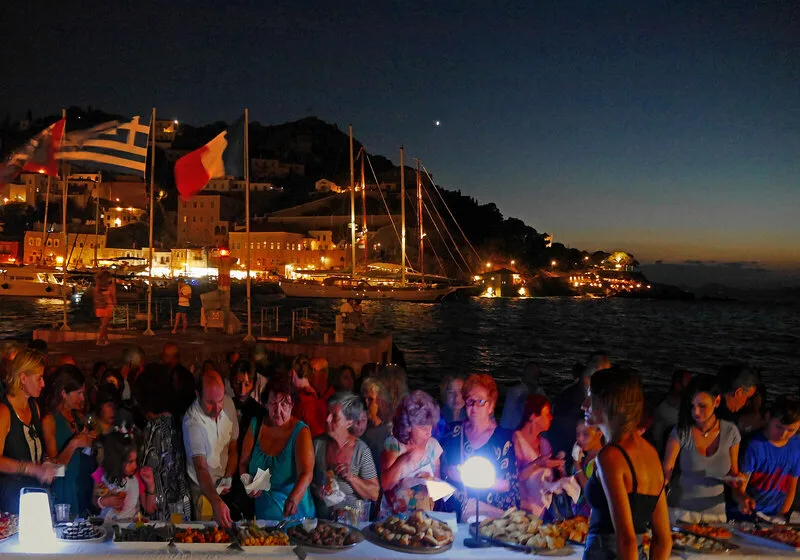
Greek Smorgasbord and Pattering Flags, 2022
Digital
100 x 70 cm
The incredible attack on the buffet happened outside Hydra's museum. The vernissage ended with a sponsored feast. Everything was free, and the Hydriots and guests stood like a pack of ravenous wolves a bit away, carefully guarding their place, ready to pounce on the delicacies laid out on a twenty-five-meter-long table in the shortest possible time.
"Greeks never cease to fascinate me," said Babis Mores, former owner of the nightclub Lagoudera, which closed in the mid-90s. His countless parties left him with no illusions about human dignity especially since the club moved to what is now Omilos, where drunk guests would throw themselves directly into the sea from where one can still enjoy good food today.
I asked Babis to explain the transformation in eating habits from ancient times to the present day.
"The eating habits of the Hydriots during the 18th and 19th centuries didn't differ much from those of the ancient Greeks," he began. "Their diet, with its unique variety, starkly contrasts our modern eating habits. One of the most intriguing differences is their significantly smaller portions than our current norms. This practice could be seen as a healthier approach to eating, inspiring us to reconsider our portion sizes."
Babis paused to let that sink in, and I nodded, encouraging him to continue.
"The ancient Greeks began their day with breakfast, which was not just about sustenance but also about cultural traditions and beliefs. This light, nourishing meal typically included a small portion of barley bread dipped in lukewarm wine and figs or a drink called 'Kykeonas,' a libation made of boiled barley flavoured with mint or thyme, believed to have healing properties."
He glanced at me, checking if I was following. I was enthralled.
"Seafood was a beloved part of the ancient Greek diet, particularly for those in Hydra and other coastal regions. Their lunchtime meals were often a celebration of the sea's bounty, with various fresh fish such as sea bream, mullet, sardines, and eels gracing their tables. For those preferring a plant-based option, a colorful array of legumes, including lentils, beans, chickpeas, peas, and broad beans, was always offered. The eternal European bread staple was always served midday, accompanied by cheese, olives, eggs, nuts, and fruits."
"Sounds delicious," I interjected, my mouth watering at the thought.
Babis smiled and continued, "Ancient Greeks held dinner in even higher regard, considering it not just a meal but a time for family and community. This shared mealtime was a cornerstone of their culture, a time for bonding and sharing stories, making it more than a meal."
"What about meat?" I asked, curious about their preferences.
"The ancients preferred pork and veal, while they rarely ate goat or lamb. They also loved hunting tiny birds such as thrush and quail, but they were not averse to taking deer, so venison was not unheard of at the ancient Greek table."
I was surprised. "I didn't know they ate snails."
"Yes," Babis nodded. "One of the most intriguing aspects of the ancient diet was their love for snails. It is recorded that Cretans had been enjoying these delicacies since the time of Minos, adding a unique and unexpected element to their culinary repertoire."
"What about fruits and vegetables?" I asked.
"Fruits and vegetables were always on the table, although not in the variety we find today. Pears, pomegranates, apples, figs, berries, cherries, and plums were always in high demand, directly picked from their garden. Hydriots were known to cultivate vegetables in their gardens, and they had a particular love for onions, garlic, lettuce, cucumbers, peas, artichokes, celery, dill, and mint. Mushrooms, fennel, asparagus, and even tender, edible nettles were to be found in abundance in the fields."
"That sounds quite diverse," I said.
"Indeed," Babis agreed. "As almost all of us still do, people also loved bread, and they baked various varieties, from flatbread to semolina bread and even a coarse type made from millet."
"And fish?" I prompted.
"Perhaps most of all, the Greeks and the Hydriots loved their fish. They frequently dined on the types of fish that lived right along the rocky shores of the Aegean, but they also enjoyed fish from the open seas, such as tuna, a much-sought-after delicacy. They also enjoyed mackerel, bonito, and anchovies, which were abundant during their season and were easy to catch with nets. Tuna and anchovies, widely consumed by all social classes, were the product of a flourishing sea trade throughout the Mediterranean and the adjacent seas."
"Wasn't there a special sauce they used?" I asked, remembering something I'd read.
"Yes," Babis said, his eyes lighting up. "Garos, a sauce made from fried, salted fatty fish, was another fundamental element of the diet along the coast in ancient Greece. High-quality Garos, made of tuna offal and blood, was quite expensive."
He went on, "The kitchen shelves of better Hydra houses were always stocked with an impressive variety of herbs and spices, each with its unique flavor and health benefits. These included oregano, basil, mint, thyme, cardamom, coriander, capers, and sesame, which they would add liberally to their dishes, enhancing the taste and nutritional value."
I nodded, fascinated by the depth of knowledge. "What about sweets?"
"Most foods were remarkably light, baked in the oven and on skewers. The same was true for sweets made from pastry, with dried or fresh fruit and honey. Of course, every meal was accompanied by wine and olive oil, always on the table, especially for Athenians, who considered it the goddess Athena's gift to their city. They believed food was intended to satisfy the palate rather than fill the stomach. In that sense, and that sense only, one can even say that they were gourmands."
Babis paused, allowing me to absorb the information. I was amazed at how much the diet had evolved while retaining some core elements.
"And what about Sparta?" I asked, curious about their unique dietary habits.
"The only exception to this overall rule was the people of Sparta, who were by far the lightest eaters. True to form, even in their diet, they followed a laconic austerity, with their daily food consisting of a bowl of 'black broth' and a piece of bread. They would have boiled pork accompanied by wine and pita bread on special occasions and feasts. But everywhere else in Greece, there was a great variety of food at every meal, and people were delighted by it."
I leaned back, trying to imagine such a feast. "What about desserts?"
"Dinner in ancient Greece was usually accompanied by desserts, such as cheesecake called 'Tragimata,' composed of fresh or dried fruit, including figs, nuts, grapes, or honey-based sweets. The first cheesecake was documented between 800 and 700 B.C. on the island of Samos; other scholars, having studied ancient cheese moulds and other findings unearthed in Greece, argued that a form of ancient cheesecake existed in the region even before 2000 B.C. This continuity of culinary practices, spanning centuries, is a testament to these ancient recipes' enduring appeal and deliciousness."
"Cheesecake?" I asked, incredulous. "They had cheesecake?"
Babis chuckled. "We know that the ancient Greeks were enamoured with the combination of cheese and honey. This makes sense when you consider that honey was the primary sweetener back then, a vital ingredient in sweet and savoury recipes and sauces. Dinner, which historians have identified as the most essential and most extended meal of the day in ancient Greece, began or ended with Tragimata, sweet treats like fresh or dried fruit, nuts, and sesame seeds, which were often served with honey or caramelised with it. Caramelised almonds and the famous Sesamis (now called pasteli, a honey and sesame bar) were both famous."
"That sounds heavenly," I said.
"Honey was also an essential ingredient in Plakountas, or pies, where it was often combined with cheese. These pies were made in various ways but were usually made from a short list of ingredients: a mix of wheat and water, cheese, honey, milk, eggs, raisins, nuts, herbs, and spices. The ancient method of making cheesecake, recorded for posterity by Athineus in 230 A.D., involved mixing the cheese with honey and soaked flour. The mixture was heated over the fire and then cooled down before serving. The Romans adopted the recipe, adding eggs and calling it placenta (Latin for 'flat cake,' the word took on its modern meaning when a 16th-century anatomist referred to the organ as placenta uterine, or 'uterine cake'). They sometimes baked the pie in a wood-burning oven and most often served it warm, unlike the Greeks who ate it cold."
"It's essentially a simplified version of the current recipe for the traditional Greek version of cheesecake, most commonly called Myzithropita," Babis explained. "The star ingredient is Myzithra, the cheese most often used in this type of cheesecake. Having been produced in Greece for thousands of years, Myzithra is most often associated with Crete (although similar cheeses are prepared in many parts of Greece, especially on the Cyclades). It's made from a mix of sheep and goat milk (depending on the region) and whey, with many using the whey of feta cheese in a production process similar to that of ricotta in Italy."
"There are two types of fresh Myzithra," he continued. "One is called xynomyzithra ('sour Myzithra') – or Pichtogalo as they call it on Crete – a fantastic creamy, white, granular cheese that is slightly salty and tangy, as its name suggests, and is often used in salads, among other things. The second version, glykia Myzithra ('sweet Myzithra'), is milder and less salty, so it features several desserts across Greece. There is also an aged and salt-dried type of Myzithra, making it harder and giving it a slightly spicier and saltier flavour that resembles Italian ricotta salata."
"Around Greece, you will find several variations of Myzithropita, some even with different names but always with fresh cheese as the base. Best known are the Cretan versions, which are commonly eaten for breakfast. These are similar in appearance (although not preparation or flavour) to pancakes, drizzled with honey and sprinkled with cinnamon, or wrapped in thick phyllo, dip-fried, and served with honey or sugar and cinnamon."
"Skepasti on Tinos and Melopita ('honey pie') on Sifnos and Mykonos are more or less the same recipe: They are made with fresh cheese, eggs, sugar, flour, and honey and baked in the oven. A lovely idea is adding Mastika, as the traditional Melitinia recipe from Santorini calls for."
"If you can't get fresh sweet Myzithra cheese, replace it with Anthotyro (a similar Greek cheese), manouri mixed with yoghurt to soften it, or Italian ricotta. If you can't get Mastika (although I recommend trying to find it at a Greek store or online), you can replace it with vanilla."
"I love this cake because it's not very sweet and can be quite refreshing. I keep it cold in the fridge, which adds to this feeling). I particularly enjoy it for breakfast, drizzled with good quality thyme honey from the island of Tinos, plenty of cinnamon, and my large cup of coffee."
Babis then shared his recipe for Myzithropita with me, which I eagerly jotted down:
Myzithropita for gourmets and gourmands
1 ½ kg fresh Myzithra cheese (or ricotta cheese)
260 gr light brown sugar
Five large eggs
Pinch of salt
One teaspoon powdered Mastika
Zest one unwaxed and preferably organic lemon
70 gr fine semolina
1 tsp baking powder
Butter for greasing the pan
One round cake tin around 27 cm in diameter
Honey and cinnamon to serve
Instructions:
Preheat your oven to 170 C. Put the cheese in a large bowl and mash it with a big fork. Mix in the sugar and stir using the same fork.
Beat the eggs in a separate bowl and add them to the cheese mix with lemon zest, mastika, and baking powder. Mix well to incorporate, and finally, start gradually adding the semolina while stirring constantly.
Grease the pan with butter and pour in the mix.
Bake on the lowest rack for 45-60 minutes until golden brown. Remove the cake from the oven and allow it to cool.
Once it has cooled, carefully remove it from the cake tin and serve it with honey and cinnamon.
"However, despite this mouth-watering array of delicacies, which no one today would scorn, ancient Greeks were still light eaters compared to us today in the modern world. They indeed consumed a great variety of foods but in relatively small quantities."
"So this proves that, even regarding food, we still have much to learn from the ancient Greeks," I concluded.
Babis nodded in agreement, and we both reflected on the wisdom and culinary heritage of the ancient Greeks.
This is an extract from my novel 'The Last Dance', which takes place on Hydra.
We were interrupted by the sound of the crowd as the buffet was about to begin. "Returning to how the buffet started," Babis said, "I will do my best to explain what happened, how it happened, and what happened afterwards. Even a nearly full moon is said to drive people to madness. Perhaps the moon prompted Babis's guests to help themselves to the buffet in the way they did. Alternatively, they may have been influenced by Greek traditions - at least, that's what Babis claimed. 'You must adopt the customs of the place you visit,' he said. Say what you will about customs, but the Time-travellers followed it until the last grain was consumed. In short, I want to skip ahead to the moment after the buffet when there was nothing left—tabula rasa. The tablecloths showed thoroughly cleaned plates, bowls, splatters, grease residues, and rings. Tears and holes in the clothes testified to the violent feast. The blissful participants carried out empty buckets and containers."
"The porcelain was so clean that one could imagine blissful souls putting the unwashed dishes back in the drawers to be returned to Babis's star. But they were washed, I must point out," I added.
Babis continued, "Back to the moment before the buffet when the air was filled with anticipation. Perhaps I wouldn't have believed the event myself if I hadn't proudly shown the set table before the horde of guests was released. The buzz was as intense as before, the sounds more expectant, even tense. The guests waited in the main hall, adjoining rooms, and on the terrace, just a few meters from a green tarp decorated with pictures of the buffet behind it. It was hung like a curtain in front of the gastronomic stage. With a tug on two ropes, it would be raised and aside, and the show could begin."
"The curtain was painted by one of the blessed, a young artist who died in an explosive combination of a car and smoking. Artists use a lot of solvents, such as turpentine and acetone. The former is self-igniting, and acetone is highly explosive with a flashpoint below 23 degrees. The soon-to-be graduate artist would never dream of being careless with fire near those fluids. Signs were warning of the danger on the wall of the art school's studio."
"The incident took place at a time when cigarette advertising was still considered acceptable. Certain brands, like the young artist's Gauloise, were considered manly to smoke. They had the right kick in the throat and smelled terrible enough to attract the '68 generation. With a cigarette in his mouth, he climbed many Paris barricades and protested against everything. Through an inheritance from an aunt, the art student could buy a used Citroen DS and become popular among the female students. The model was spacious, and the ladies appreciated the brand's unique air suspension. It was to one of them he was going when the thing happened that shouldn't have happened but still did. The car wouldn't start even though the starter motor was turning. Old cars do that when they're in that mood. The art student exclaimed inappropriate French expressions, which didn't help."
"After pulling on the loose wires in the cabin, banging on the steering wheel, opening the hood, pulling cables there, wiping the distributor cap, and checking the oil dipstick, the young man concluded that the car was probably out of gas. The gauge showed zero, but it had since he bought the car. Manual inspection remained. The fuel cap on a DS model is located at the back, on the right wing, low and close to the tank. He unscrewed the cap and pushed the car to hear if it sloshed down there. It didn't. A visual inspection was necessary."
"The artist bent over, cigarette still in his mouth, and checked if any gas was left in the tank. There was! Kaboom. The painter became a blissful soul at only 23 years old. At the party, his curtain helped admirably calm the crowds pushing forward. The paintings made the waiting easier but increased the appetite for some. There was other art—a lot of it."
Babis had placed art from above in the garden and on terraces, sculptures made of polished meteorite and slag from the sun - skillfully shaped by the renowned Henry Moore, an honorary guest. Moore, with his good friend and host Ghikas, discussed one of them - Babis resting outside Lagoudera with a stylised beer bottle in his hand. 'A masterpiece,' according to Babis, who owned about twenty of them - the result of playing tavli. Moore may be one of humanity's most significant sculptors, but a lousy backgammon player."
"I was given a guided tour behind the blessed artist's works and the grand buffet, which was mostly ready. A work of art bursting with pleasant scents and colours, waiting for its destruction. Like ice and snow sculptures, this art had its allotted time. Babis proudly showed off the creation that stretched from one end of the terrace to the other. To call it modest would be a gross lie. Like the audience, the creation was international, but above all, Greek. Many guests brought their specialities and combined them with Babis' mother's and Nagring's food into a gastronomic collage. They had managed to incorporate almost the entire palette of hues, something reminiscent of a colour explosion by Matisse - in his pulsating composition 'Open Window' because, behind the buffet, the windows were open towards the main hall where the guests mingled anxiously."
"The food landscape unfolded from icy white to the deepest red from east to west. In the east, where Aurora would peek out many hours later, there was a seafood section with fish presented on a hill of ice, in the order they eat each other in the sea. At the bottom were dishes and pickles of smaller fish like anchovies, sardines, and tiny fried Marides; higher up, mackerel with the flavours of feta, oregano, tomato, and olives, and oven-baked hake on a bed of spinach and root vegetables; grilled octopus and fried calamari Tiganito, pink lobster pasta and crab, mussels, and I didn't have time to note everything. Goldfish swam in a bowl. They belonged to the decoration and were not meant to be eaten. Dominating the scene was Hemingway's swordfish, beautifully sliced inside its skin and sprinkled with parsley and chopped tomatoes. In the far west, where the sun had settled, another mountain rose, one of vegetable dishes and salads - culminating in terraces of blazing red peppers filled with minced meat."
"I love everything that comes from my garden," Babis said. "My patch on Hydra was a piece of a vegetable garden and accommodated a few chickens and Sophia's rabbit - but no goats or sheep, and God forbid, nothing as big as an ox. Of course, I managed to devour a fillet steak, but I appreciated the marine selection more, especially things I had caught from the sea myself. But if I had to choose, it would be the garden and its delightful hues - all kinds of peppers, small green zucchinis with yellow flowers like a tie around the neck, purple swelling eggplants and greenish-yellow-red flavorful tomatoes, beefy and knobby like clenched boxer fists. Lemons gilded by the Hydra sun, which had also lacquered my oranges and mandarin bright orange; golden honey melons, speckled watermelons, orange apricots, and deepest purple cherries. I could manage a menu worthy of a royal banquet. Although this time, I didn't fare so well." Babis pointed to the dessert table, laden with fruits and pastries, Baklava, almond flakes from Tsagaris, plates upon plates of sweet desserts, Tragemata, dried fruit, sweet almonds, and honey pies, and so on."
"Some of it comes from an uninhabited planet, not unlike Earth, but more speckled than blue, where one of the master chefs made a stop. There are mushrooms, exotic fruits, and vegetables that taste different." Babis picked up a fruit that looked like a twisted candy cane, striped white and red and tasted like one.
"Delicious," I said, but I wondered how Amalia from Gränna got hold of that recipe in the 19th century. "A revelation," she is said to have said, and that might be the explanation.
"And don't miss the decoration and framing. Presentation! Presentation! Presentation! The scent of lavender is hard to beat, even though it can't be eaten. Grow your lavender sea and enjoy the lovely flower all summer long. And Jorgos - the bees also love lavender!" Babis stroked the stalks that waved up from an urn. We stepped back into the trembling hustle and bustle, and I could see from Babis's look that there was something he hadn't thought of."
"Here you have potatoes in a dozen variations, from fried or deep-fried to boiled and braised, with sauce or without, and so on. Nothing is missing!" boasted Babis. "Nowadays, Greeks eat a lot of potatoes – even among the stars – but it took time to learn. After the War of Independence, cheap food was needed, and the new root vegetable gained honour. Greece's first prime minister, Ioannis Kapodistrias, introduced potatoes to feed a growing population. When the first shipment arrived, people initially showed no interest. The statesman understood the mentality of his compatriots and placed a wall of armed guards around the potatoes. That way, Greeks assumed the potatoes were valuable and started stealing them. This quickly spread the tubers throughout Greece. Ha, ha."
"Man never denies himself," I said smugly.
"It was easy to deceive oneself watching Lagoudera's awaiting guests. There was a mix of ordinary people if I momentarily overlooked well-known people or those trying to appear as such. Many kinds. Mostly Greeks, of course, due to Hydra's proximity to Athens. Some old Hydriots were present, but not many, maybe sixty, even though it was their island. When I say ordinary people, it's with some modification. During Lagoudera's first decade, the islanders were fully occupied with making ends meet after all the wars and hardships, not partying. The working class and labourers were impoverished and destitute and would never dream of going to such a place. Furthermore, the church had already cursed Lagoudera and those who went there. Most of the Hydra guests had either been owners of larger boats, owned houses with tenants, or belonged to the group of tradesmen, such as a baker, an ironmonger, a pharmacist, a plumber, and a few younger men from what was called the better Hydra families. 'Brats,' Babis called the latter – because such individuals had been locally present since the 1960s. Otherwise, from Greece were media people, journalists, half a dozen photographers and directors, actors with more ambition than talent, and cultural workers such as painters and writers constantly facing uphill battles. Teachers and officials were scarce, and none from the healthcare sector were below the level of a doctor. Overall, distinct class boundaries still applied between those who could afford to have fun and those who couldn't. Even though the majority of those who couldn't likely be better people than many of those who had succeeded better, the sparkle was missing. They were too ordinary to make gossip enjoyable. Babis had no juicy anecdotes to deliver, or maybe I didn't care to listen."
"It was more fun to listen to Babis' whispered descriptions of some guests who were gearing up for the buffet. He identified a couple of well-groomed seducers looking for more than a good meal; man-eaters who, in turn, wanted to meet such charmers after first fortifying themselves with a substantial feast; charmers desperately trying to entertain boring people; a couple of boastful adventurers who had climbed Mount Eros during siesta time in full sunshine and were seeking an alternative to water (and giving the seducers tough competition); the usual flock of party animals and boozers; some who felt entitled to get back what they had once spent at the club, to be repaid in kind; a few teetotalers planning to concentrate on the food; their opposites with a glass in each hand and a paper plate in their mouth. In other words, there was a variety of characters. And then there was Babis and myself, returning to normalcy. Babis had stood up on a crate of beer and anxiously looked around. I could tell from his gaze that there was something he hadn't thought of."
"The silence was impenetrable, and the air was thick as glue. Everyone awaited the signal, the tables unveiling, and the curtain's fall. The guests were prepared in the starting blocks, if one can express it that way, as high and low heels tried to find their footing on the terrace's stones or against the grand hall's old carpets. People around pretended as if the buffet wasn't there, their wandering gazes showing fleeting interest in the art Babis had dragged down from the cosmos or with one eye on the view of the port whose lights glowed below - the other eye discreetly watching what others were doing."
"Food is considered worldly or temporal; culture belongs to higher values, not this evening. The atmosphere was vibrating. The situation reminded me of Hydra's annual regatta, of the start, how the sailboats spun around to position themselves as close to the starting line as possible, manoeuvring, scheming, attempting to block a competitor, trying to steal the wind so that the other would be at a disadvantage— in the Ochre villa's surroundings, waiting for the starting shot, in the form of a table fireworks display. The guests' eyes flickered feverishly between Babis on the small podium and the serving staff, the blissful souls whose faces revealed nothing. The Time-travellers' faces tried to display a poker face, hiding their intentions, tactics, level of hunger, and ambition."
"Behind strained smiles and smooth faces were picky connoisseurs, ruthless gourmands, voracious eaters, sharp elbows and hard heads, high heels and guys with a history in the school's rugby team. Some had already eaten a three-course lunch but felt they should cram in some more because it was all-inclusive. First and foremost, the hypothesis was, 'What is good for your neighbour is even better for yourself.' It was painted on their faces. So, mistakes had to be made! And to eat as if it were the last meal. For eternity. This was what Babis saw when he finally prepared himself. He glanced at me as if to gather strength."
"Welcome...!" Babis didn't get any further in the intended ceremony that was supposed to mark the opening of the buffet. A few flashes and confetti burst from the table fireworks before the tumult erupted. The Tinfoil Woman's fanfare was choked off when a hysterical horde collided with his setup. The music became an extended scraping sound as the needle swept over the record. The blissful souls were young and agile and handled the situation on the fly. Their quick reflexes saved the artwork from being mixed with the food behind it. It could have resulted in a modernistic piece, a grotesque, colourful, nonfigurative mess where some guests became a part of the composition."
"It was as if the war had broken out when too many people attacked the buffet simultaneously. People muttered, jostled, rummaged around, crossed arms, heads collided, and sweat splattered as they filled plates and napkins with delicacies. The wise tried to stay away until the worst rush was over but risked finding the goodies gone by then. Petite individuals had to avoid being trampled; tender toes avoided clumsy feet. Babis knew his Pappenheimers; no sharp knives or pointed forks were allowed, only fingers and toothpicks. He wanted to avoid unnecessary bloodshed. The buffet was nothing religious, yet the guests threw themselves at the food as if it were their last meal."
"Appetite seemed stronger than all style and manners; Star was pitted against Star. Nothing matched the old musketeers' ideals of one for all, all for one. It was like everything for me; whatever was left was for the neighbour. The ideals had to wait until after a solid meal; otherwise, there was a risk that everything would be gone, eaten by someone else, what rightfully belonged to me, so it was better to take the other person's share. Babis and I were appalled by the determination on people's faces."
"At the ends of the buffet tables stood a few blissful souls dressed in jackets or black dresses and impeccably white aprons. Their role was decorative, to look stylish, but they became an important reason why things went as well as they did. They soon had to step in and extract people stuck in the chaos. I thought of Mikado and Pick-up Sticks, the board games we loved as children, or log driving, which was considerably more violent. Somewhere between those thin sticks and thick logs, the situation on the terrace was when the blissful souls had to intervene. They were forced to pry out guests who had gotten stuck, like logs in the debris of the log drive. Carefully, carefully, to not waste food - someone else would be left without. It didn't go well. When the buffet subsided, these blissful ones' in black clothes resembled smeared palettes."
"Considering the multitude of nationalities and eras represented around the buffet, I concluded that table manners, or the lack thereof, like the seven deadly sins, are spread across our planet - apparently also in the cosmos. Babis laughed so hard he almost vomited."
"Photographer Burke had given me some advice: 'Don't bring a camera if you want to have a share of a Tabula rasa. When you're done snapping, there's nothing left.' Burke himself had managed to sneak a bite in the kitchen and could shoot without being bothered by a growling stomach. The same went for Babis and me."
"The people among the stars were not as overweight as people today. Even though the Time-travelers looked OK, they must seize the opportunity."
"Those who had something to be careful about, hairstyles, clothes, or tender toes, had to wait patiently in the back, just like those who valued their reputation. Soraya, Grace, Jacqueline O, Maria Callas, and others stood there. For many elegant ladies, missing out on a delicacy or two was no concern; they were forever trapped in some diet program. Remember that if the present is full of dieticians, health gurus, and personal trainers, earlier generations existed in the cosmos, a bunch at the party if someone needed assistance. Onassis, who always could take what he wanted, was stopped by his double female companions from jumping into the melee for the delicacies. Instead, he pretended to be appalled by others' behaviour. He sent Basil, his old pilot, in his place. He was a sharp guy who had flown Spitfires during the war and knew how to attack with the light at his back. While the opponents were blinded, Basil could help his old boss, Maria, and himself—no wonder the Allies won at El Alamein."
"A tiny fellow climbed on a woman's back, leaning over a bowl of shiny feta cheese dip, and fished out a lamb chop that he quickly dipped in a bowl of mint tzatziki. In both cases, it spoke of good taste. Delicious dishes."
"There were many techniques, one better than the other, but many were lousy. Some people's plates filled up quickly, and some were exceptional balancers. Trying to line up plates on an outstretched arm like a skilled waiter didn't work well in the crowd, and the food ended up on the ground for the benefit of wildlife. The pets from the cosmos behaved impeccably, not a meow or a bark - yet they managed everything the two-legged ones dropped."
"I saw a few individuals who didn't bother with plates; like hamsters, they stuffed goodies into their mouths as they went along. Fast and convenient. They were the exceptions and were quite plump. 'No coincidence,' whispered Babis."
"A man with a mop-like hairstyle and a linen jacket must have had a lining inside his breast pocket where he stuffed sticky spinach rolls with sun-dried tomatoes."
"A low-cut neckline was suitable for many things; for example, it easily accommodated three or four filo rolls with feta cheese and mint for a voluptuous brunette. One of the hippie girls wore hoop earrings, where she had threaded two fried cheese balls that dangled on either side."
"Politicians have spacious pockets," whispered Babis. I saw a former leader of the socialist party, Pasok, wrapping feta cheese pillows in phyllo dough flavoured with honey in paper napkins and stuffing them in his jacket. He had hooked his bread in the neatly tucked tie pin with the party's green sun logo."
"A couple of French actresses' lumpy bosoms revealed a successful round. 'C-cups can hold a lot,' chuckled Babis, but he meant something else."
"A half-open handbag as well." I discreetly pointed towards a woman with her hair braided into a crown, stuffing a couple of handfuls of crispy and delicious cheese bread among hairbrushes and lipstick.
"A bearded beatnik tilted his beret and inserted a couple of boiled eggs, which worked as long as he didn't need to greet anyone."
"Some must have tied a strap or started backwards and managed to get to the dessert tables at one end before everyone else. The group solved the challenge of limited capacity with paper plates using a Japanese trick - origami, the art of folding paper. The cover of one of the municipality's brochures for next year's election, one that touted the current mayor's greatness, was cleverly transformed into a sturdy tray with high sides, with the mayor smiling from the end. Two of those were enough for a substantial selection of delicacies. One of the couples, passing by Babis and me, had filled their trays with galaktoboureko each, a syrup-drenched pastry; baklava with walnuts, pistachios, loads of syrup, and sugar; warm powdered sugar-coated Bougatsa; a few slices of melon and cherries; three Kourabiedes each, butter cookies as white as snow; the same number of Melomakarona, Christmas cookies that were perfect even in late September; a coffee mug filled with Portokalopita dripping with orange juice, and last but not least, three tasty scoops of ice cream in a paper cup with drizzled chocolate sauce. Despite their cleverness, they had only managed to scratch the surface of the desert mountain."
"That should have been enough for a while, both Babis and I thought - regardless of what we thought, they returned with their empty trays fifteen minutes later."
"The noise level was high, and sweat was splashing. There was panting, snorting, whistling, puffing, and grunting, drowning out all the smacking. A vein of satisfaction was found in all kinds of small pies like Kotopita with chicken, Spanakotyropita filled with spinach and cheese, vegetarians' favorite hortopita, and their arch-nemesis Kreatopita with minced meat. Few could resist the giant platter of Dolmades, filled with the wildest of blanched Horta with a splash of white wine - so delicious that I saw one of the gays filling his petite shoulder bag with them."
"I noticed a well-coordinated group. Among all the types of professions Babis had encountered among his guests, a group felt right at home. Babis told me they were the remnants of Tsírko Wackos, a circus that had visited Hydra for many years while touring Athens. They had many skills that were perfect for a buffet. A double somersault by one of their agile seniors over the bread pile resulted in a hefty piece of Lagana, a Focaccia-like bread delightful to dip in fava or tzatziki. A former circus juggler colleague kept six dishes in the air on his way from the table. Strong Gus, a tall giant, took his time. Like the mountain behind the Ochre villa, he stood steady. He systematically filled his plate with moussaka made with eggplant, potatoes, and ground beef, seasoned with garlic, cumin, and wild thyme, bathing in béchamel sauce. Not even the wildest attempts from the surroundings could shake him; those who tried were bounced back."
"There was loud smacking from the section with delicious dips - skordalia, fava, and tzatziki. Such delicacies are hard to resist, and Babis and I watched, amused, as some ate spoonfuls directly from the bowls."
"The sounds from the cheese section sounded like a flock of bleating sheep and goats. Hands eagerly taking samples from piles of Greek cheeses sounded like tinkling jewels, reminiscent of the bells on the slope behind. Loudest was the Manouri from Thrace, closely followed by Myzithra from Crete; Saganaki, a fried kefalotyri cheese, elicited general admiration, just like the smoked Metsovone. I liked the hard Graviera, a cheese made from sheep's milk, or perhaps snatching pieces of Ladotyri or peppery Kopanisti. The choice was difficult, hence the bleating."
"Whatever you do, do not lean on white beans in a tomato, onion, or dill sauce. A well-known film director plunged a hand and white cuff into the bowl. One of the attentive, blissful ones quickly intervened and limited the damage."
"The feast was a meat lover's paradise. There was a cacophony of grunting, snorting, and neighing around a bastion of dishes. Rough fingers fumbled among plates of pork and beef dishes, each prepared in a different style-grilled, roasted, baked, and even as a gyro pita with pork, fries, tzatziki, and pickled tomatoes. Many preferred païdakia, grilled lamb chops served as a kind of gyro. 'Why not,' I thought as I savoured the succulent meat."
"A tall, hefty man, a real glutton, devoured three souvlaki skewers at once, his mouth stretching wide. 'One pig eats another,' mumbled Babis, his voice filled with admiration and amusement."
"Two lamb kebabs on a long skewer served as hairpins for a dark-haired madam with a bun at the nape of her neck for a while. 'She looks like a geisha,' Babis remarked."
Axel Jensen braced himself against Leonard Cohen's knee and reached far enough to snatch a Yemista, a red bell pepper filled with beef, pork, rice, and herbs. 'A good choice,' I thought, having tasted it in the kitchen. Seeing how old antagonists had found each other around the tables was terrific. Their faces lit up with delight as they tasted the various dishes, their enjoyment evident in their expressions and gestures.
"Of course, there's much clucking around the chicken in a dozen variations," I said to Babis. "How can one choose between these and veal with a lemon gravy or game dishes with deer, roe deer, wild boar, the wildest of pigs, and a small stuffed rabbit?" One needed to pay attention to the Greek sausages, too. The back of a tiara was a fantastic spot for a Loukániko, a sausage flavoured with fennel and orange. Not my favourite, but still. It was not a princess wearing the tiara, but the sausage stayed in place, a testament to its unique taste and texture in Greek cuisine."
The Greek national dish, Fasolada bean soup, is a problematic chapter; deep plates filled to the brim are not stackable. Once again, someone had used the mayor's pamphlet for help. Twenty pages in colour laid under and between the plates made it possible to carry three different soups without spilling. Hydra's taxpayers should appreciate that their money had finally found a worthy use.
It was a lively scene around a round platter of grilled tiger prawns, with laughter and conversation filling the air. Suddenly, a roar of anguish tore a hole in the otherwise cheerful atmosphere. A pale man had gotten four toothpicks stuck in his thumb after placing his whole hand over the delicious seafood when he wanted to secure more. The toothpicks were pulled out, the roar subsided, and the carved sticks made a renewed attempt at the softer prawns. The injured man went without seafood but was bandaged by a blissful one, a testament to the camaraderie and care among the attendees.
Next to them stood a woman—she was definitely no 'lady'—emptying the sweet and sour sauce bowl into a paper cup. Furthermore, she scraped the remaining sauce with a spoon. Outrageous! I thought this behaviour was Swedish and belonged to our tangled smorgasbord. Not at all. Babis told me that, on the contrary, some Greeks behave just like that when the opportunity arises—seizing the chance before a neighbour does. I recognised the woman, and she was American.
It was easier with liquid items like beverages. Several beverage stations surrounded the buffet tables, and the queues were moderate. The supply was so abundant that the fear of drought was absurd. If one had managed to get hold of the desired food and found a place to stand or sit—so to speak, quenched their thirst—it was easy to go back and satisfy wetter needs. No climate change affected that circumstance. The feast was meticulously organised, ensuring all attendees had easy access to food and beverages, enhancing their overall experience.
Babis had hired Arion from Corinth, a rhapsodist, a wandering singer and a reciter of stories and poetry in ancient Greece, to create a dignified setting for the buffet. Arion, who had sung for two and a half millennia, sounded fantastic - at times, the rhapsode's sonorous voice managed to drown out the noise around the buffet with his booming tone. He sang the works of another Rhapsode, verses from Homer's Odyssey - symbolically, with the scenes around Arion and the buffet. An odyssey often depicts temptations in the form of larger or smaller feasts. Food becomes a test - a trial for the hungry men in Odysseus' entourage. The table's delights and the desire for food and wine are enticing enough to distract them from their intended destination. The wanderings offer many such banquets. The poor men ended up farther and farther away from home. The dinner with the Cyclops was no exception, which ended with a gouged-out eye. In the presence of the goddess Circe, Odysseus' men are transformed into pigs. It was precisely the stanzas about the grunting pigs that Arion sang especially loudly and clearly, a nod to the cultural significance of the feast and its connection to ancient Greek mythology.
"The last feast in the Ochre villa on Hydra makes the turmoil in Bender appear like a quiet Menuet," claimed Arion, who had sung on that occasion on February 1, 1713. The feast, a culmination of a series of cultural events, was a testament to the region's rich cultural heritage and the importance of food in Greek culture.
But there was room for dignity and intimacy near the tables, emotions that were not only related to the food. "One cannot think, love, or sleep well if one has not dined well," Virginia Woolf once said. The author herself did not enjoy the buffet. Still, the actress playing Virginia on the movie screen did - Elizabeth Taylor, who indulged herself with her ex-husbands Eddie Fisher and Richard Burton. Their faces lit up with delight as they tasted the various dishes, their enjoyment evident in their expressions and gestures. Babis was surprised that the trio remained so calm together. In his time, Eddie had threatened to kill Burton if he didn't stop fraternising with his wife. They were all divorced from each other, Liz twice from Burton. In this way, the roles were reset, and they could concentrate on eating to their heart's content. In this context, the feast symbolised their newfound peace and the ability to enjoy each other's company without tension or conflict.
"Oysters for two," said Babis, nodding towards the moon's shadow behind a cypress column. Two individuals who had once had a brief affair on Hydra were reunited as if time had stood still. "They have picked up where they left off," Babis said, winking. They consumed as much of each other as the oysters. Steam rose from the restrained emotions of eternity as the couple slurped, flirted, laughed, and had wild eye sex. I couldn't help but think of the scene from Fielding's book about the libertine Tom Jones and the dinner with Mrs Waters. I wondered if this night's escapade would end in the same way. There were a half-dozen small rooms in the loft.
If the hashish rush from the meatballs wasn't enough, the shortage could be rectified at the dessert table. Among Greek and Hydriot specialities, there was a chocolate mousse to die for. It wasn't the mint flavour that was explosive, but rather what it concealed - delicate flakes of marijuana that made life bright and cheerful. The mousse had found its way to Hydra through a niece of Aldous Huxley. The creator of 'Brave New World' was an avid advocate of drugs in his time, and the dessert table's mousse could be considered one of his more innocent recipes. For Time-travelers, hemp was an easily accessible plant, and in the galaxy, there were dozens of planets overgrown with cannabis and blooming poppies.
Extra crowding prevailed around the giant oven-baked swordfish. Ernest was someone who wanted to secure a piece of the fillet. He knew a few tricks from his wars and skillfully parried one elbow after another. The last thing I saw was how he brought down a quarrelsome man with a well-aimed punch to his soft abdomen.
The troublemaker fell straight as a pine tree right into the fish's eye, a part most people disdain. The man probably got his fill as he crashed into the fish with his mouth wide open. Ernest managed to get a hearty piece and disappeared into the crowd with his dignity intact.
The force of the attacks on the tables diminished as the platters emptied. Some who had previously gone without or had acquired a taste for more scraped the plates clean. In the inner terraces and rooms beyond, the guests had satisfied their appetites, smacked their lips, burped, and conversed. A progressively drowsy atmosphere settled over the neighbourhood. The DJ had intentionally toned down the background music but gradually turned it up again. Even though dancing was not part of Babis' plan for a while, it was necessary to stir around full bellies and get the tapping in their legs going. The group of dressed-up blissful ones could finally change out of their stained festive clothes into their regular pastel outfits.
An ocean of paper plates spread across the terrace, disposable wooden utensils, and bioplastic glasses - all carefully licked clean by the animals. If there was anything these high-spirited cats and dogs had missed, the tiniest crumb that fell to the ground, the local ants took care of it. Everything was collected in biodegradable starch bags to be buried in the corner of the garden and turned into fertilizer. While the guests patted their bellies, the blissful ones removed disposable tablecloths and tables, letting the icebergs melt and water the grove of olive trees.

Jörgen Thornberg
Malmö
Lite om bilder och mig. Translation in English at the end.
Jag är en nyfiken person som ser allt i bilder, även det jag fäster i ord, gärna tillsammans för bakom alla mina bilder finns en berättelse. Till vissa bilder hör en kortare eller längre novell som följer med bilden.
Bilder berättar historier. Jag omges av naturlig skönhet, intressanta människor och historia var jag än går. Jag använder min kamera för att dokumentera världen och blanda det jag ser med vad jag känner för att fånga den dolda magin.
Mina bilder berättar mina historier. Genom mina bilder, tryck och berättelser. Jag bjuder in dig att ta del av dessa berättelser, in i ditt liv och hem och dela min mycket personliga syn på vår värld. Mer än vad ögat ser. Jag tänker i bilder, drömmer och skriver och pratar om dem; följaktligen måste jag också skapa bilder. De blir vad jag ser, inte nödvändigtvis begränsade till verkligheten. Det finns en bild runt varje hörn. Jag hoppas att du kommer att se vad jag såg och gilla det.
Jag är också en skrivande person och till många bilder hör en kortare eller längre essay. Den följer med tavlan, tryckt på fint papper och med en personlig hälsning från mig.
Flertalet bilder startar sin resa i min kamera. Enkelt förklarat beskriver jag bilden jag ser i mitt inre, upplevd eller fantiserad. Bilden uppstår inom mig redan innan jag fått okularet till ögat. På bråkdelen av ett ögonblick ser jag vad jag vill ha och vad som kan göras med bilden. Här skall jag stoppa in en giraff, stålmannen, Titanic eller vad det är min fantasi finner ut. Ännu märkligare är att jag kommer ihåg minnesbilden långt efteråt när det blir tid att skapa verket. Om jag lyckas eller inte, är upp till betraktaren, oftast präglat av en stråk av svart humor – meningen är att man skall bli underhållen. Mina bilder blir ofta en snackis där de hänger.
Jag föredrar bilder som förmedlar ett budskap i flera lager. Vid första anblicken fylld av feel-good, en vacker utsikt, fint väder, solen skiner, blommor på ängen eller vattnet som ligger förrädiskt spegelblankt. I en sådan bild kan jag gömma min egentliga berättelse, mitt förakt för förtryckare och våldsverkare, rasister och fördomsfulla människor - ett gärna återkommande motiv mer eller mindre dolt i det vackra motivet. Jag försöker förena dem i ett gemensamt narrativ.
Bild och formgivning har löpt som en röd tråd genom livet. Fotokonst känns som en värdig final som jag gärna delar med mig.
Min genre är vid som framgår av mina bilder, temat en blandning av pop- och gatukonst i kollage som kan bestå av hundratals lager. Vissa bilder kan ta veckor, andra någon dag innan det är dags att överlämna resultatet till printverkstaden. Fine Art Prints är digitala fotocollage. I dessa kollage sker rivandet, klippandet, pusslandet, målandet, ritandet och sprayningen digitalt. Det jag monterar in kan vara hundratals år gamla bilder som jag omsorgsfullt frilägger så att de ser ut att vara en del av tavlan men också bilder skapade av mig själv efter min egen fantasi. Därefter besöks printstudion och för vissa bilder numrera en limiterad upplaga (oftast 7 exemplar) och signera för hand. Vissa bilder kan köpas i olika format. Det är bara att fråga efter vilka. Gillar man en bild som är 70x100 men inte har plats på väggen, går den kanske att få i 50x70 cm istället. Frågan är fri.
Metoden Giclée eller Fine Art Print som det också kallas är det moderna sättet för framställning av grafisk konst. Villkoret för denna typ av utskrifter är att en högkvalitativ storformatskrivare används med åldersbeständigt färgpigment och konstnärspapper eller i förekommande fall på duk. Pappret som används möter de krav på livslängd som ställs av museer och gallerier. Normalt säljer jag mina bilder oinramade så att den nya ägaren själv kan bestämma hur de skall se ut, med eller utan passepartout färg på ram, med eller utan glas etc..
Under många år ställde jag bara ut på nätet, i valda grupper och på min egen Facebooksida - https://www.facebook.com/jorgen.thornberg.9
Jag finns också på en egen hemsida som tyvärr inte alltid är uppdaterad – https://www.jth.life/ Där kan du också läsa en del av de berättelser som följer med bilden.
UTSTÄLLNINGAR
Luftkastellet, oktober 2022
Konst i Lund, november 2022
Luftkastellet, mars 2023
Engleson Galleri Caroli, april 2023
Hydra, Greece June 2023
Engleson Galleri Caroli, oktober 2023
Toppen, Höllviken december 2023
Luftkastellet, mars 2024
Torups Galleri, mars 2024
Venice, May 2024
Luftkastellet, oktober 2024
Konst i Advent, December 2024
Galleri Engleson, Caroli December 2024
Jäger & Jansson Galleri, april 2025
A bit about pictures and me.
I'm a curious person who sees everything in pictures, even what I express in words, often combining them, for behind all my pictures lies a story. These narratives, some as short as a single image and others as long as a novel, are the heart and soul of my work.
Pictures tell stories. Wherever I go, I'm surrounded by natural beauty, exciting people, and history. I use my camera to document the world and blend what I see with what I feel to capture the hidden magic.
My images tell my stories. Through my pictures, prints, and narratives, I invite you to partake in these stories in your life and home and share my deeply personal perspective of our world. More than meets the eye. I think in pictures, dream, write, and talk about them; consequently, I must create images too. They become what I see, not necessarily confined to reality. There's a picture around every corner. I hope you'll see what I saw and enjoy it.
I'm also a writer, and many images come with a shorter or longer essay. It accompanies the painting, printed on fine paper with my personal greeting.
Many pictures start their journey on my camera. Simply put, I describe the image I see in my mind, experienced or imagined. The image arises within me even before I bring the eyepiece to my eye. In a fraction of a moment, I see what I want and what can be done with the picture. Here, I'll insert a giraffe, Superman, the Titanic, or whatever my imagination conjures up. Even stranger is that I remember the mental image long after it's time to create the work. Whether I succeed is up to the observer, often imbued with a streak of black humour – the aim is to entertain. My pictures usually become a talking point wherever they hang.
I prefer pictures that convey a message in multiple layers. At first glance, they're filled with feel-good vibes, a beautiful view, lovely weather, the sun shining, flowers in the meadow, or the water lying deceptively calm. But beneath this surface beauty, I often conceal a deeper story, a narrative that challenges societal norms or explores the human condition. I invite you to delve into these hidden narratives and discover the layers of meaning within my work.
Picture and design have been a thread running through my life. Photographic art feels like a fitting finale, and I'm happy to share it.
My genre is varied, as seen in my pictures; the theme is a blend of pop and street art in collages that can consist of hundreds of layers. Some images can take weeks, others just a day before it's time to hand over the result to the print workshop. Fine Art Prints are digital photo collages. In these collages, tearing, cutting, puzzling, painting, drawing, and spraying happen digitally. What I insert can be images hundreds of years old that I carefully extract so they appear to be part of the painting, but also images created by myself, now also generated from my imagination. Next, visit the print studio and, for certain images, number a limited edition (usually 7 copies) and sign them by hand. Some images may be available in other formats. Just ask which ones. If you like an image that's 70x100 but doesn't have space on the wall, you might be able to get it in 50x70 cm instead. The question is open.
The Giclée method, or Fine Art Print as it's also called, is the modern way of producing graphic art. This method ensures the highest quality and longevity of the artwork, using a high-quality large-format printer with archival pigment inks and artist paper or, in some cases, canvas. The paper used meets the longevity requirements set by museums and galleries. I sell my pictures unframed, allowing the new owner to personalise their artwork, confident in the lasting value and quality of the piece.
For many years, I only exhibited online, in selected groups, and on my Facebook page - https://www.facebook.com/jorgen.thornberg.9. I also have my website, which unfortunately is not constantly updated - https://www.jth.life/. You can also read some of the stories accompanying the pictures there.
EXHIBITIONS
Luftkastellet, October 2022
Art in Lund, November 2022
Luftkastellet, March 2023
Engleson Gallery Caroli, April 2023
Hydra, Greece June 2023
Engleson Gallery Caroli, October 2023
Toppen, Höllviken December 2023
Luftkastellet, March 2024
Torup Gallery, March 2024
Venice, May 2024
UTSTÄLLNINGAR
Luftkastellet, oktober 2022
Konst i Lund, november 2022
Luftkastellet, mars 2023
Engleson Galleri Caroli, april 2023
Hydra, Greece June 2023
Engleson Galleri Caroli, oktober 2023
Toppen, Höllviken december 2023
Luftkastellet, mars 2024
Torups Galleri, mars 2024
Venice, May 2024
Luftkastellet, October 2024
Konst i Advent, December 2024
Galleri Engleson, Caroli December 2024
Jäger & Jansson Galleri, April 2025
Utbildning
Autodidakt
Medlem i konstnärsförening
Öppna Sinnen
Med i konstrunda
Konstrundan i Skåne
Utställningar
Luftkastellet, October 2022
Art in Lund, November 2022
Luftkastellet, March 2023
Engleson Gallery Caroli, April 2023
Hydra, Greece June 2023
Engleson Gallery Caroli, October 2023
Toppen, Höllviken December 2023
Luftkastellet, March 2024
Torup Gallery, March 2024
Venice, May 2024