Vi använder cookies för att ge dig bästa möjliga upplevelse. Välj vilka cookies du tillåter.
Läs mer i vår integritetspolicy
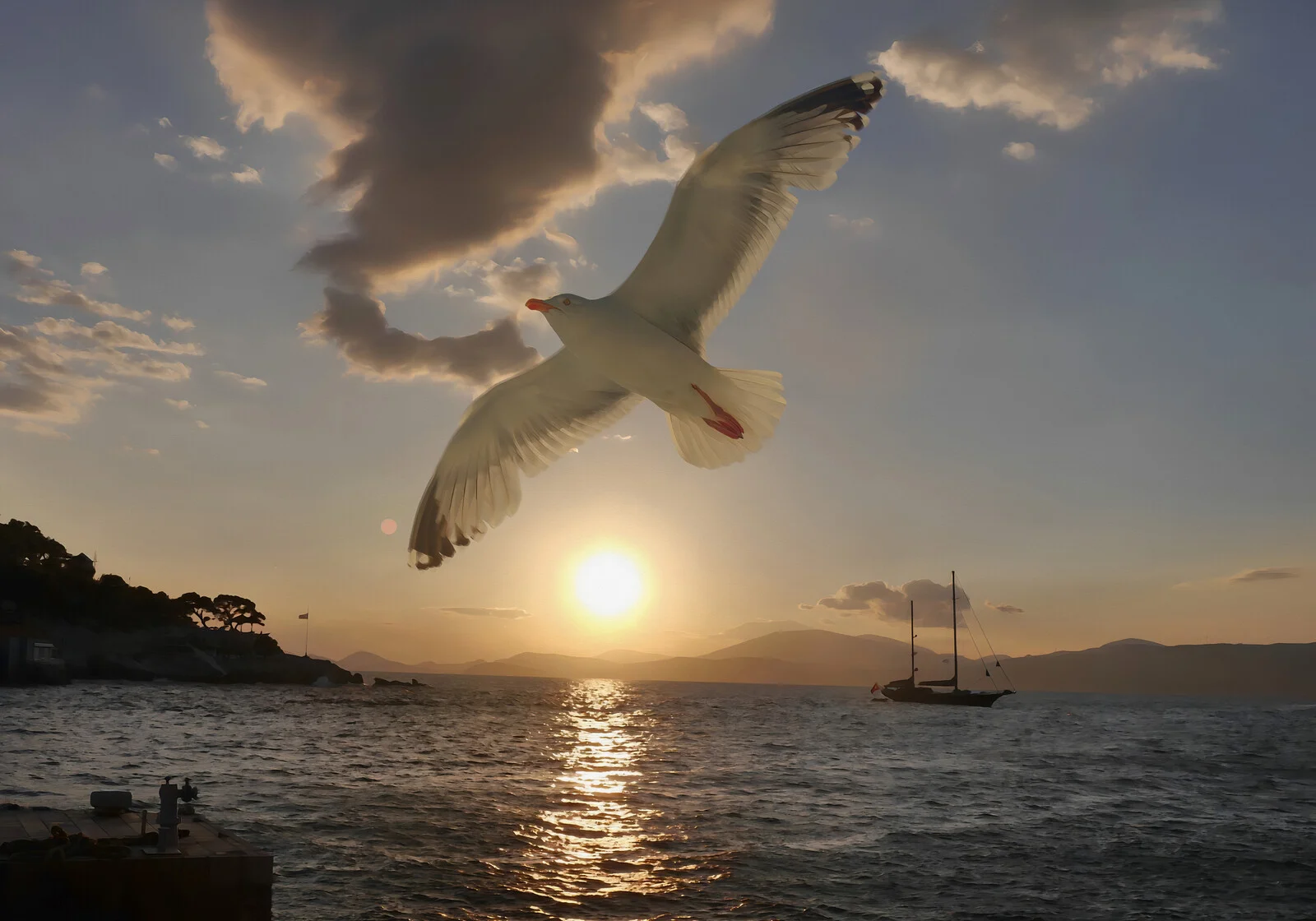
Jörgen Thornberg
Jonathan Seagull and Leonard Cohen, 2020
Digital
70 x 50 cm
Text till – Jonathan Seagull and Leonard Cohen
Hydra Colours – Jonathan Seagull and Leonard
From the cliffs of Hydra, Jonathan sets sail,
A seagull with dreams, wings white as pale.
He soars through the skies, both near and far,
Charting the heavens, a luminous star.
Around the world, in endless flight,
He observes the Earth, both day and night.
Cities and oceans, mountains and plains,
He sees all seasons, sun, and rain.
In his heart, a quest to perfect,
Each wingbeat is precise, every turn direct.
He trains and practices, with steadfast grace,
Mastering the art of aerial space.
Below, the gulls screech, they fight, and they squawk,
On beaches, they bicker and trash as they walk.
Jonathan frowns at their noisy display,
Their careless ways and their reckless fray.
"Why must they bicker? Why must they litter?
When the sky's so vast, and the world's much fitter?"
He ponders this question in silent flight,
Seeking wisdom in the quiet of the night.
Yet Hydra's call is strong and true,
His birthplace under skies so blue.
From time to time, he circles back,
To rest his wings, to stay on track.
On the rugged coast, he lands with ease,
Greeting the island with the gentle breeze.
In the rising sun, he spreads his wings,
Ready to soar as the morning sings.
Jonathan Livingston Seagull's tale,
It is one of freedom beyond the pale.
A seeker of truth in the boundless sky,
He flies with purpose, soaring high.
It was an evening in late June, the sun setting over Ermioni across the strait of Hydra. The tired sun lay its head behind the mountains of the West, spraying gold across the curly water. Leonard, Marianne, and I walked along the coastal road towards Kamini, our footsteps echoing in the quiet of the evening. The little Song Thrush fluttering just behind, its wings a blur of motion.
A two-masted ketch had anchored a stone's throw or two from Hydra harbour. Excited voices and feminine giggles rolled over the lazy waves, reaching the bastion where the old naval hero stood as a statue. It was time for supper, and the chef tossed the remnants of a dozen Sea Bass from a Lavraki Plaki, served on a bed of vegetables, into the sea. The guests on the boat devoured some delicious lobsters, accompanied by a white Greek Thea Mantinia. The words for dinner echoed through the rose-coloured sky while the seagulls of Hydra hovered in the air, searching for something delectable for the evening. Even though the day was growing late, there was always room for more delicacies. But not for Jonathan.
"Plaki" refers to a cooking method, usually involving braising or baking, and can refer to several dishes that are cooked in a sauce, typically made with onions, garlic, tomatoes, and olive oil," explained Marianne to the Song Thrush, which did not have fish dishes at the top of its menu. However, there were exceptions like Thrapsala, a shortfin squid stuffed with black couscous, a dish that brought together the best of two worlds for a little bird.
Jonathan Livingston Seagull, not participating in the fight for scraps of food, flew alone, staying behind between the yacht and the port. He had returned from his travels around the globe. Overjoyed to see Hydra again, his special place on Earth, he soared in loop after loop, radiating happiness. Despite being a true globetrotter, this was the place he called home, where he felt a sense of belonging that he couldn't find anywhere else.
Some dozens of meters over the water's surface, Jonathan lowered his webbed feet in front of my lens and greeted Hydra with his beak - Kalispéra Ýdra - turning hard towards the sun in a sharp curve. Jonathan's move was supposed to slow down his flight until the faint wind became a whisper in his face, and the water stood still beneath him and, with it, time. Slow, but was it too slow? The moment later would prove that he was in control. Jonathan narrowed his eyes in fierce concentration, held his breath not to stall, and had his feathers ruffled without lift. He fell into the water, amusing his hungry fellow seagulls. It would be such a disgrace if it happened. Would it? Could it? Not a chance! This was just a glimpse of the extraordinary life Jonathan leads, a life that transcends the boundaries of Earth.
But seagulls never falter, never stall, at least not Jonathan. To stall in the air signifies dishonour and disgrace for birds, not to mention wet wings. It was something Jonathan would never allow to happen. He suspended himself in the air before us, freezing in place. For an instant of a moment that felt like a minute, he extended his wings even further, executed a half roll, accelerated, and gradually ascended, defying all odds. Jonathan accomplished an impossible manoeuvre that others could only dream of. He was no ordinary bird, just another gull among the flock. He was Jonathan Livingston, the seagull above all seagulls.
In his characteristic humility, Leonard shared a unique insight into his creative process. 'While seagulls are not explicitly mentioned in any of my songs,' he explained, 'they are woven into my imagery and metaphors. When I sing about Suzanne sitting and eating oranges by the river, they are there, metaphorically hovering above us. Birds, like Jonathan, have always found their way into my lines, even if they didn't perch on a telephone wire in Hydra.'
There were swaying seagulls in my 'First We Take Manhattan' video, although I didn't mention them in the lyrics. They were always so present that they didn't need to float into my poetry. There, I solved humanity's obstacles. Free birds like Jonathan don't need someone to solve their problems.
Once, during a concert in Victoria, Australia, I told the audience that a seagull visited my hotel window whenever I came to their city. I knew it was the same seagull because it was white with some grey. It was a hungry fellow, and I shared my breakfast with the bird—first, my toast, some ham, and eggs, and then my iPad so it could take a selfie. I carry that image with me all the time so I can show it to its friends all over the world." Leonard chuckled, but the Song Thrush pouted.
"You must forgive me, dear bird if I have never explicitly mentioned you and your beautiful trills. My songs contain all kinds of sounds—barking dogs, a bird clucking from a telephone wire, a chirp here and there, and even garbage trucks." Marianne laughed the most, never ceasing to be amazed by where Leonard drew his inspiration.
"Together with Adam, my son, I wrote a piece about a hummingbird, the last track of my final studio album, 'Thanks for the Dance.' I didn't even sing it; I recited the short poem into the cheap conference room microphone. Adam used the recording in a genius way. So I did my best," he chuckled in embarrassment. "According to Adam, it has a wry ending, typical of my dark-filled humour—very modest, hilarious, and Buddhist. It's his music, not mine." Leonard gestured with invisible wings in the air and recited:
" Listen to the hummingbird
Whose wings you cannot see
Listen to the hummingbird
Don't listen to me."
"If you want seagulls, try Donovan and 'Catch the Wind.' He's much better than me," said Leonard, trying to sound serious.
Most seagulls on the island fly just well enough to travel between the harbour and their food sources, gliding on the thermals to find some simple joy between meals. Flying itself is not the primary concern when there is an abundance of food available, whether it's at sea, near the city dump, or among the houses of Hydra. But not for Jonathan. He was a natural-born pilot, and when the wind calms down, there's always time for eating. Jonathan Livingston Seagull loved flying more than anything else in life. Eating came second.
The other seagulls try to mock him. When you hear the seagulls laughing, you know that Jonathan is around. It's not amusing to witness a fellow gull soar, dive, roll, and perform daring loops much better than oneself. The laughter gets stuck in their throats as envy and anger rise.
But Jonathan couldn't care less because he was not interested in popularity among his fellow birds. He was a free-spirited gull, spending entire days experimenting with new manoeuvres, challenging the laws of physics and accepted principles. He would engage in low-level glides, skim the waves, execute comical dives, and drive the fish beneath the water's surface crazy. Jonathan found greater joy in accomplishing the seemingly impossible rather than accepting scraps from the table of the affluent. Moreover, he despised Lavraki Plaki and had no taste for a lobster shell, which held no appeal for a discerning seagull.
However, Jonathan took great pleasure in target practice on Hydra's statues of ancient heroes and could easily hit Miaouli in the face from a distance of ten wing lengths. Sometimes, he went too far, like when a lovely lady on a boat excursion at sunset had a shot land right in her classic piña colada.
With grace, he's performing these manoeuvres above and around Hydra, and all of us, knowing Jonathan, derive great joy and envy from watching him do so.
The Song Thrush saluted its winged friend and reminded him with a trill that he was a cut above Jonathan, both in flying and singing.
"These boy birds," said Marianne, having the last word.
To be continued…..
Footnote
This is an extract from a novel I have almost finished. Unfortunately, English is not my mother tongue, so please bear with any shortcomings in the language. By doing so, you will, in any case, have a rough idea of what the novel is about.
The original text has been slightly altered to describe an early morning rendezvous on the road with Leonard and Marianne. The couple is on one of their regular visits to Hydra, a Greek island. They reside together on the star Algebar, continuing their love affair that was momentarily interrupted. What does "for a while" mean in Eternity? It signifies not even a fraction of a second, which means nothing.
Leonard and Marianne are riding two donkeys to their old house, preparing for a weekend on Hydra. We have met before at a party. During the leisurely journey along the old cobbled road to Hydra town, I find answers to questions that I, along with many others, have pondered over the years.
The text is intended to evoke an impression of a novel about Time-travellers having a grand celebration in a hijacked villa. When people from the stars throw a party, they spare no expense because the following day is eternal.
What do Leonard Cohen, Marianne Ihlen, Onassis, Jackie O, Maria Callas, Ernest Hemingway, Allan Ladd, Empress Soraya, Audrey Hepburn, Princess Grace Kelly, Greta Garbo, Princess Margaret, and a few hundred other celebrities have in common? The most obvious answer is that they no longer reside on Earth. De har alla flyttat till sina respektive stjärnor, vilket kan vara en nyhet för en del. They have all moved to their respective stars, which may be news to some. They have also visited the Greek island of Hydra and the nightclub Lagoudera—during its golden age, one of Europe's top watering holes for the jet set.
Together with seven hundred other Time-travellers, they return to Earth on the autumn equinox of 2018 for a grand party. Thus, the novel is titled "The Last Dance." The forever jet-setters once again come to Greece, the birthplace of European civilisation, serving as the foundation. They arrive on the island of Hydra, the backdrop, and the former club Lagoudera acts as the stage in an occupied ochre villa high above Hydra town. The Time-travellers are the protagonists, and club owner Babis More narrates the anecdotes surrounding the festivities. I am the sole earthling observer present at the party. The Hydriots and tourists are extras, unaware of what transpires around them. The reader gains insight into how a small island is affected by these guests from the past. Who would want to avoid reading about a real party? About how guests from the rock and pop music era dance wildly, gossip, and ravage a grand buffet, literally stomping their heels on the ceiling.
The guest list was impressive, and the anecdotes matched accordingly. The reader is introduced to various stories, such as how Empress Soraya stood up to playboy Baby Pignatari, and a fifty-year-old mystery involving a missing brooch was solved the day after the grand party during the royal house cleaning. Leonard Cohen explained his affinity for women with the help of his eternal partner, Marianne Ihlen, who remained his muse. The elegant Audrey Hepburn danced gracefully while Princess Grace of Monaco enthusiastically joined. The quartet of Liz Taylor, Richard Burton, Eddie Fisher, and Debbie Reynolds, who married, divorced, and remarried, were all present without resulting in any bloodshed. However, there was a commotion when John Kennedy arrived uninvited and encountered his successor, shipping magnate Aristoteles Onassis. Anthony Perkins was spotted in a corner, passionately kissing his 1960s lover Tab Hunter. And let's not forget Greta Garbo, who playfully revealed whose panties she was wearing. The Time-travellers had no issue with such matters as they indulged in Marianne's specially prepared cannabis buns. The atmosphere was electric, to say the least.
The renowned writer and avid fisherman Ernest Hemingway had an unexpected encounter in the strait outside Hydra. Instead of the intended catch, he hooked a mini-submarine with three party-ready girls on board one of the luxury yachts anchored at Plakes.
However, "The Last Dance" maintains a certain distance from these tales. Nevertheless, it is easy to smile. One of the stories unveils the surprising intelligence of Hydra's most underestimated and bullied girl, who ultimately becomes wealthy by thinking outside the box. The reader also encounters a poorer Hydra, still recovering from the war in the late 1950s, with eight per cent of its population lost. Alongside club owner and party organiser Babis Mores, the novel offers glimpses of this side of Hydra's history.
PS.
If anyone wonders about Time-travellers and life after leaving Earth, they should consider Albert Einstein and his theses, particularly the one about energy's perpetual and indestructible nature. This is an indisputable fact in physics and a fundamental principle of science. The notion that Leonard's poetry and music embody energy is a concept that has been introduced previously. The creation of such art requires a significant amount of energy. Likewise, thoughts also need energy. Scholars suggest that each thought consumes 0.02 kcal while writing one of Leonard's songs requires much more energy, possibly in the hundreds. Therefore, thoughts cannot be destroyed but must endure in some form or another, eternally imperishable. "It doesn't take a god to figure that out," Leonard remarked during our walk.
So, what happens when we depart from life on Earth? Draw your conclusions. It has nothing to do with religion. Leonard shared that the universe is filled with gods, prophets, priests, seers, and fortune-tellers, but only some pay attention up there. Leonard spent his whole life on Earth seeking the truth among various religions, only to discover the veracity after he left. Living on a star has its advantages—author's comment.
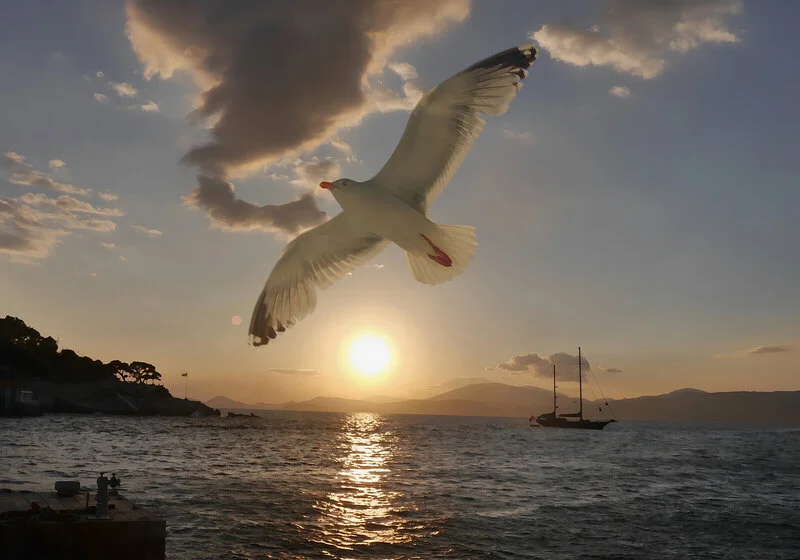
Jörgen Thornberg
Jonathan Seagull and Leonard Cohen, 2020
Digital
70 x 50 cm
Text till – Jonathan Seagull and Leonard Cohen
Hydra Colours – Jonathan Seagull and Leonard
From the cliffs of Hydra, Jonathan sets sail,
A seagull with dreams, wings white as pale.
He soars through the skies, both near and far,
Charting the heavens, a luminous star.
Around the world, in endless flight,
He observes the Earth, both day and night.
Cities and oceans, mountains and plains,
He sees all seasons, sun, and rain.
In his heart, a quest to perfect,
Each wingbeat is precise, every turn direct.
He trains and practices, with steadfast grace,
Mastering the art of aerial space.
Below, the gulls screech, they fight, and they squawk,
On beaches, they bicker and trash as they walk.
Jonathan frowns at their noisy display,
Their careless ways and their reckless fray.
"Why must they bicker? Why must they litter?
When the sky's so vast, and the world's much fitter?"
He ponders this question in silent flight,
Seeking wisdom in the quiet of the night.
Yet Hydra's call is strong and true,
His birthplace under skies so blue.
From time to time, he circles back,
To rest his wings, to stay on track.
On the rugged coast, he lands with ease,
Greeting the island with the gentle breeze.
In the rising sun, he spreads his wings,
Ready to soar as the morning sings.
Jonathan Livingston Seagull's tale,
It is one of freedom beyond the pale.
A seeker of truth in the boundless sky,
He flies with purpose, soaring high.
It was an evening in late June, the sun setting over Ermioni across the strait of Hydra. The tired sun lay its head behind the mountains of the West, spraying gold across the curly water. Leonard, Marianne, and I walked along the coastal road towards Kamini, our footsteps echoing in the quiet of the evening. The little Song Thrush fluttering just behind, its wings a blur of motion.
A two-masted ketch had anchored a stone's throw or two from Hydra harbour. Excited voices and feminine giggles rolled over the lazy waves, reaching the bastion where the old naval hero stood as a statue. It was time for supper, and the chef tossed the remnants of a dozen Sea Bass from a Lavraki Plaki, served on a bed of vegetables, into the sea. The guests on the boat devoured some delicious lobsters, accompanied by a white Greek Thea Mantinia. The words for dinner echoed through the rose-coloured sky while the seagulls of Hydra hovered in the air, searching for something delectable for the evening. Even though the day was growing late, there was always room for more delicacies. But not for Jonathan.
"Plaki" refers to a cooking method, usually involving braising or baking, and can refer to several dishes that are cooked in a sauce, typically made with onions, garlic, tomatoes, and olive oil," explained Marianne to the Song Thrush, which did not have fish dishes at the top of its menu. However, there were exceptions like Thrapsala, a shortfin squid stuffed with black couscous, a dish that brought together the best of two worlds for a little bird.
Jonathan Livingston Seagull, not participating in the fight for scraps of food, flew alone, staying behind between the yacht and the port. He had returned from his travels around the globe. Overjoyed to see Hydra again, his special place on Earth, he soared in loop after loop, radiating happiness. Despite being a true globetrotter, this was the place he called home, where he felt a sense of belonging that he couldn't find anywhere else.
Some dozens of meters over the water's surface, Jonathan lowered his webbed feet in front of my lens and greeted Hydra with his beak - Kalispéra Ýdra - turning hard towards the sun in a sharp curve. Jonathan's move was supposed to slow down his flight until the faint wind became a whisper in his face, and the water stood still beneath him and, with it, time. Slow, but was it too slow? The moment later would prove that he was in control. Jonathan narrowed his eyes in fierce concentration, held his breath not to stall, and had his feathers ruffled without lift. He fell into the water, amusing his hungry fellow seagulls. It would be such a disgrace if it happened. Would it? Could it? Not a chance! This was just a glimpse of the extraordinary life Jonathan leads, a life that transcends the boundaries of Earth.
But seagulls never falter, never stall, at least not Jonathan. To stall in the air signifies dishonour and disgrace for birds, not to mention wet wings. It was something Jonathan would never allow to happen. He suspended himself in the air before us, freezing in place. For an instant of a moment that felt like a minute, he extended his wings even further, executed a half roll, accelerated, and gradually ascended, defying all odds. Jonathan accomplished an impossible manoeuvre that others could only dream of. He was no ordinary bird, just another gull among the flock. He was Jonathan Livingston, the seagull above all seagulls.
In his characteristic humility, Leonard shared a unique insight into his creative process. 'While seagulls are not explicitly mentioned in any of my songs,' he explained, 'they are woven into my imagery and metaphors. When I sing about Suzanne sitting and eating oranges by the river, they are there, metaphorically hovering above us. Birds, like Jonathan, have always found their way into my lines, even if they didn't perch on a telephone wire in Hydra.'
There were swaying seagulls in my 'First We Take Manhattan' video, although I didn't mention them in the lyrics. They were always so present that they didn't need to float into my poetry. There, I solved humanity's obstacles. Free birds like Jonathan don't need someone to solve their problems.
Once, during a concert in Victoria, Australia, I told the audience that a seagull visited my hotel window whenever I came to their city. I knew it was the same seagull because it was white with some grey. It was a hungry fellow, and I shared my breakfast with the bird—first, my toast, some ham, and eggs, and then my iPad so it could take a selfie. I carry that image with me all the time so I can show it to its friends all over the world." Leonard chuckled, but the Song Thrush pouted.
"You must forgive me, dear bird if I have never explicitly mentioned you and your beautiful trills. My songs contain all kinds of sounds—barking dogs, a bird clucking from a telephone wire, a chirp here and there, and even garbage trucks." Marianne laughed the most, never ceasing to be amazed by where Leonard drew his inspiration.
"Together with Adam, my son, I wrote a piece about a hummingbird, the last track of my final studio album, 'Thanks for the Dance.' I didn't even sing it; I recited the short poem into the cheap conference room microphone. Adam used the recording in a genius way. So I did my best," he chuckled in embarrassment. "According to Adam, it has a wry ending, typical of my dark-filled humour—very modest, hilarious, and Buddhist. It's his music, not mine." Leonard gestured with invisible wings in the air and recited:
" Listen to the hummingbird
Whose wings you cannot see
Listen to the hummingbird
Don't listen to me."
"If you want seagulls, try Donovan and 'Catch the Wind.' He's much better than me," said Leonard, trying to sound serious.
Most seagulls on the island fly just well enough to travel between the harbour and their food sources, gliding on the thermals to find some simple joy between meals. Flying itself is not the primary concern when there is an abundance of food available, whether it's at sea, near the city dump, or among the houses of Hydra. But not for Jonathan. He was a natural-born pilot, and when the wind calms down, there's always time for eating. Jonathan Livingston Seagull loved flying more than anything else in life. Eating came second.
The other seagulls try to mock him. When you hear the seagulls laughing, you know that Jonathan is around. It's not amusing to witness a fellow gull soar, dive, roll, and perform daring loops much better than oneself. The laughter gets stuck in their throats as envy and anger rise.
But Jonathan couldn't care less because he was not interested in popularity among his fellow birds. He was a free-spirited gull, spending entire days experimenting with new manoeuvres, challenging the laws of physics and accepted principles. He would engage in low-level glides, skim the waves, execute comical dives, and drive the fish beneath the water's surface crazy. Jonathan found greater joy in accomplishing the seemingly impossible rather than accepting scraps from the table of the affluent. Moreover, he despised Lavraki Plaki and had no taste for a lobster shell, which held no appeal for a discerning seagull.
However, Jonathan took great pleasure in target practice on Hydra's statues of ancient heroes and could easily hit Miaouli in the face from a distance of ten wing lengths. Sometimes, he went too far, like when a lovely lady on a boat excursion at sunset had a shot land right in her classic piña colada.
With grace, he's performing these manoeuvres above and around Hydra, and all of us, knowing Jonathan, derive great joy and envy from watching him do so.
The Song Thrush saluted its winged friend and reminded him with a trill that he was a cut above Jonathan, both in flying and singing.
"These boy birds," said Marianne, having the last word.
To be continued…..
Footnote
This is an extract from a novel I have almost finished. Unfortunately, English is not my mother tongue, so please bear with any shortcomings in the language. By doing so, you will, in any case, have a rough idea of what the novel is about.
The original text has been slightly altered to describe an early morning rendezvous on the road with Leonard and Marianne. The couple is on one of their regular visits to Hydra, a Greek island. They reside together on the star Algebar, continuing their love affair that was momentarily interrupted. What does "for a while" mean in Eternity? It signifies not even a fraction of a second, which means nothing.
Leonard and Marianne are riding two donkeys to their old house, preparing for a weekend on Hydra. We have met before at a party. During the leisurely journey along the old cobbled road to Hydra town, I find answers to questions that I, along with many others, have pondered over the years.
The text is intended to evoke an impression of a novel about Time-travellers having a grand celebration in a hijacked villa. When people from the stars throw a party, they spare no expense because the following day is eternal.
What do Leonard Cohen, Marianne Ihlen, Onassis, Jackie O, Maria Callas, Ernest Hemingway, Allan Ladd, Empress Soraya, Audrey Hepburn, Princess Grace Kelly, Greta Garbo, Princess Margaret, and a few hundred other celebrities have in common? The most obvious answer is that they no longer reside on Earth. De har alla flyttat till sina respektive stjärnor, vilket kan vara en nyhet för en del. They have all moved to their respective stars, which may be news to some. They have also visited the Greek island of Hydra and the nightclub Lagoudera—during its golden age, one of Europe's top watering holes for the jet set.
Together with seven hundred other Time-travellers, they return to Earth on the autumn equinox of 2018 for a grand party. Thus, the novel is titled "The Last Dance." The forever jet-setters once again come to Greece, the birthplace of European civilisation, serving as the foundation. They arrive on the island of Hydra, the backdrop, and the former club Lagoudera acts as the stage in an occupied ochre villa high above Hydra town. The Time-travellers are the protagonists, and club owner Babis More narrates the anecdotes surrounding the festivities. I am the sole earthling observer present at the party. The Hydriots and tourists are extras, unaware of what transpires around them. The reader gains insight into how a small island is affected by these guests from the past. Who would want to avoid reading about a real party? About how guests from the rock and pop music era dance wildly, gossip, and ravage a grand buffet, literally stomping their heels on the ceiling.
The guest list was impressive, and the anecdotes matched accordingly. The reader is introduced to various stories, such as how Empress Soraya stood up to playboy Baby Pignatari, and a fifty-year-old mystery involving a missing brooch was solved the day after the grand party during the royal house cleaning. Leonard Cohen explained his affinity for women with the help of his eternal partner, Marianne Ihlen, who remained his muse. The elegant Audrey Hepburn danced gracefully while Princess Grace of Monaco enthusiastically joined. The quartet of Liz Taylor, Richard Burton, Eddie Fisher, and Debbie Reynolds, who married, divorced, and remarried, were all present without resulting in any bloodshed. However, there was a commotion when John Kennedy arrived uninvited and encountered his successor, shipping magnate Aristoteles Onassis. Anthony Perkins was spotted in a corner, passionately kissing his 1960s lover Tab Hunter. And let's not forget Greta Garbo, who playfully revealed whose panties she was wearing. The Time-travellers had no issue with such matters as they indulged in Marianne's specially prepared cannabis buns. The atmosphere was electric, to say the least.
The renowned writer and avid fisherman Ernest Hemingway had an unexpected encounter in the strait outside Hydra. Instead of the intended catch, he hooked a mini-submarine with three party-ready girls on board one of the luxury yachts anchored at Plakes.
However, "The Last Dance" maintains a certain distance from these tales. Nevertheless, it is easy to smile. One of the stories unveils the surprising intelligence of Hydra's most underestimated and bullied girl, who ultimately becomes wealthy by thinking outside the box. The reader also encounters a poorer Hydra, still recovering from the war in the late 1950s, with eight per cent of its population lost. Alongside club owner and party organiser Babis Mores, the novel offers glimpses of this side of Hydra's history.
PS.
If anyone wonders about Time-travellers and life after leaving Earth, they should consider Albert Einstein and his theses, particularly the one about energy's perpetual and indestructible nature. This is an indisputable fact in physics and a fundamental principle of science. The notion that Leonard's poetry and music embody energy is a concept that has been introduced previously. The creation of such art requires a significant amount of energy. Likewise, thoughts also need energy. Scholars suggest that each thought consumes 0.02 kcal while writing one of Leonard's songs requires much more energy, possibly in the hundreds. Therefore, thoughts cannot be destroyed but must endure in some form or another, eternally imperishable. "It doesn't take a god to figure that out," Leonard remarked during our walk.
So, what happens when we depart from life on Earth? Draw your conclusions. It has nothing to do with religion. Leonard shared that the universe is filled with gods, prophets, priests, seers, and fortune-tellers, but only some pay attention up there. Leonard spent his whole life on Earth seeking the truth among various religions, only to discover the veracity after he left. Living on a star has its advantages—author's comment.

Jörgen Thornberg
Malmö
Lite om bilder och mig. Translation in English at the end.
Jag är en nyfiken person som ser allt i bilder, även det jag fäster i ord, gärna tillsammans för bakom alla mina bilder finns en berättelse. Till vissa bilder hör en kortare eller längre novell som följer med bilden.
Bilder berättar historier. Jag omges av naturlig skönhet, intressanta människor och historia var jag än går. Jag använder min kamera för att dokumentera världen och blanda det jag ser med vad jag känner för att fånga den dolda magin.
Mina bilder berättar mina historier. Genom mina bilder, tryck och berättelser. Jag bjuder in dig att ta del av dessa berättelser, in i ditt liv och hem och dela min mycket personliga syn på vår värld. Mer än vad ögat ser. Jag tänker i bilder, drömmer och skriver och pratar om dem; följaktligen måste jag också skapa bilder. De blir vad jag ser, inte nödvändigtvis begränsade till verkligheten. Det finns en bild runt varje hörn. Jag hoppas att du kommer att se vad jag såg och gilla det.
Jag är också en skrivande person och till många bilder hör en kortare eller längre essay. Den följer med tavlan, tryckt på fint papper och med en personlig hälsning från mig.
Flertalet bilder startar sin resa i min kamera. Enkelt förklarat beskriver jag bilden jag ser i mitt inre, upplevd eller fantiserad. Bilden uppstår inom mig redan innan jag fått okularet till ögat. På bråkdelen av ett ögonblick ser jag vad jag vill ha och vad som kan göras med bilden. Här skall jag stoppa in en giraff, stålmannen, Titanic eller vad det är min fantasi finner ut. Ännu märkligare är att jag kommer ihåg minnesbilden långt efteråt när det blir tid att skapa verket. Om jag lyckas eller inte, är upp till betraktaren, oftast präglat av en stråk av svart humor – meningen är att man skall bli underhållen. Mina bilder blir ofta en snackis där de hänger.
Jag föredrar bilder som förmedlar ett budskap i flera lager. Vid första anblicken fylld av feel-good, en vacker utsikt, fint väder, solen skiner, blommor på ängen eller vattnet som ligger förrädiskt spegelblankt. I en sådan bild kan jag gömma min egentliga berättelse, mitt förakt för förtryckare och våldsverkare, rasister och fördomsfulla människor - ett gärna återkommande motiv mer eller mindre dolt i det vackra motivet. Jag försöker förena dem i ett gemensamt narrativ.
Bild och formgivning har löpt som en röd tråd genom livet. Fotokonst känns som en värdig final som jag gärna delar med mig.
Min genre är vid som framgår av mina bilder, temat en blandning av pop- och gatukonst i kollage som kan bestå av hundratals lager. Vissa bilder kan ta veckor, andra någon dag innan det är dags att överlämna resultatet till printverkstaden. Fine Art Prints är digitala fotocollage. I dessa kollage sker rivandet, klippandet, pusslandet, målandet, ritandet och sprayningen digitalt. Det jag monterar in kan vara hundratals år gamla bilder som jag omsorgsfullt frilägger så att de ser ut att vara en del av tavlan men också bilder skapade av mig själv efter min egen fantasi. Därefter besöks printstudion och för vissa bilder numrera en limiterad upplaga (oftast 7 exemplar) och signera för hand. Vissa bilder kan köpas i olika format. Det är bara att fråga efter vilka. Gillar man en bild som är 70x100 men inte har plats på väggen, går den kanske att få i 50x70 cm istället. Frågan är fri.
Metoden Giclée eller Fine Art Print som det också kallas är det moderna sättet för framställning av grafisk konst. Villkoret för denna typ av utskrifter är att en högkvalitativ storformatskrivare används med åldersbeständigt färgpigment och konstnärspapper eller i förekommande fall på duk. Pappret som används möter de krav på livslängd som ställs av museer och gallerier. Normalt säljer jag mina bilder oinramade så att den nya ägaren själv kan bestämma hur de skall se ut, med eller utan passepartout färg på ram, med eller utan glas etc..
Under många år ställde jag bara ut på nätet, i valda grupper och på min egen Facebooksida - https://www.facebook.com/jorgen.thornberg.9
Jag finns också på en egen hemsida som tyvärr inte alltid är uppdaterad – https://www.jth.life/ Där kan du också läsa en del av de berättelser som följer med bilden.
UTSTÄLLNINGAR
Luftkastellet, oktober 2022
Konst i Lund, november 2022
Luftkastellet, mars 2023
Engleson Galleri Caroli, april 2023
Hydra, Greece June 2023
Engleson Galleri Caroli, oktober 2023
Toppen, Höllviken december 2023
Luftkastellet, mars 2024
Torups Galleri, mars 2024
Venice, May 2024
Luftkastellet, oktober 2024
Konst i Advent, December 2024
Galleri Engleson, Caroli December 2024
Jäger & Jansson Galleri, april 2025
A bit about pictures and me.
I'm a curious person who sees everything in pictures, even what I express in words, often combining them, for behind all my pictures lies a story. These narratives, some as short as a single image and others as long as a novel, are the heart and soul of my work.
Pictures tell stories. Wherever I go, I'm surrounded by natural beauty, exciting people, and history. I use my camera to document the world and blend what I see with what I feel to capture the hidden magic.
My images tell my stories. Through my pictures, prints, and narratives, I invite you to partake in these stories in your life and home and share my deeply personal perspective of our world. More than meets the eye. I think in pictures, dream, write, and talk about them; consequently, I must create images too. They become what I see, not necessarily confined to reality. There's a picture around every corner. I hope you'll see what I saw and enjoy it.
I'm also a writer, and many images come with a shorter or longer essay. It accompanies the painting, printed on fine paper with my personal greeting.
Many pictures start their journey on my camera. Simply put, I describe the image I see in my mind, experienced or imagined. The image arises within me even before I bring the eyepiece to my eye. In a fraction of a moment, I see what I want and what can be done with the picture. Here, I'll insert a giraffe, Superman, the Titanic, or whatever my imagination conjures up. Even stranger is that I remember the mental image long after it's time to create the work. Whether I succeed is up to the observer, often imbued with a streak of black humour – the aim is to entertain. My pictures usually become a talking point wherever they hang.
I prefer pictures that convey a message in multiple layers. At first glance, they're filled with feel-good vibes, a beautiful view, lovely weather, the sun shining, flowers in the meadow, or the water lying deceptively calm. But beneath this surface beauty, I often conceal a deeper story, a narrative that challenges societal norms or explores the human condition. I invite you to delve into these hidden narratives and discover the layers of meaning within my work.
Picture and design have been a thread running through my life. Photographic art feels like a fitting finale, and I'm happy to share it.
My genre is varied, as seen in my pictures; the theme is a blend of pop and street art in collages that can consist of hundreds of layers. Some images can take weeks, others just a day before it's time to hand over the result to the print workshop. Fine Art Prints are digital photo collages. In these collages, tearing, cutting, puzzling, painting, drawing, and spraying happen digitally. What I insert can be images hundreds of years old that I carefully extract so they appear to be part of the painting, but also images created by myself, now also generated from my imagination. Next, visit the print studio and, for certain images, number a limited edition (usually 7 copies) and sign them by hand. Some images may be available in other formats. Just ask which ones. If you like an image that's 70x100 but doesn't have space on the wall, you might be able to get it in 50x70 cm instead. The question is open.
The Giclée method, or Fine Art Print as it's also called, is the modern way of producing graphic art. This method ensures the highest quality and longevity of the artwork, using a high-quality large-format printer with archival pigment inks and artist paper or, in some cases, canvas. The paper used meets the longevity requirements set by museums and galleries. I sell my pictures unframed, allowing the new owner to personalise their artwork, confident in the lasting value and quality of the piece.
For many years, I only exhibited online, in selected groups, and on my Facebook page - https://www.facebook.com/jorgen.thornberg.9. I also have my website, which unfortunately is not constantly updated - https://www.jth.life/. You can also read some of the stories accompanying the pictures there.
EXHIBITIONS
Luftkastellet, October 2022
Art in Lund, November 2022
Luftkastellet, March 2023
Engleson Gallery Caroli, April 2023
Hydra, Greece June 2023
Engleson Gallery Caroli, October 2023
Toppen, Höllviken December 2023
Luftkastellet, March 2024
Torup Gallery, March 2024
Venice, May 2024
UTSTÄLLNINGAR
Luftkastellet, oktober 2022
Konst i Lund, november 2022
Luftkastellet, mars 2023
Engleson Galleri Caroli, april 2023
Hydra, Greece June 2023
Engleson Galleri Caroli, oktober 2023
Toppen, Höllviken december 2023
Luftkastellet, mars 2024
Torups Galleri, mars 2024
Venice, May 2024
Luftkastellet, October 2024
Konst i Advent, December 2024
Galleri Engleson, Caroli December 2024
Jäger & Jansson Galleri, April 2025
Utbildning
Autodidakt
Medlem i konstnärsförening
Öppna Sinnen
Med i konstrunda
Konstrundan i Skåne
Utställningar
Luftkastellet, October 2022
Art in Lund, November 2022
Luftkastellet, March 2023
Engleson Gallery Caroli, April 2023
Hydra, Greece June 2023
Engleson Gallery Caroli, October 2023
Toppen, Höllviken December 2023
Luftkastellet, March 2024
Torup Gallery, March 2024
Venice, May 2024