Vi använder cookies för att ge dig bästa möjliga upplevelse. Välj vilka cookies du tillåter.
Läs mer i vår integritetspolicy
Jörgen Thornberg
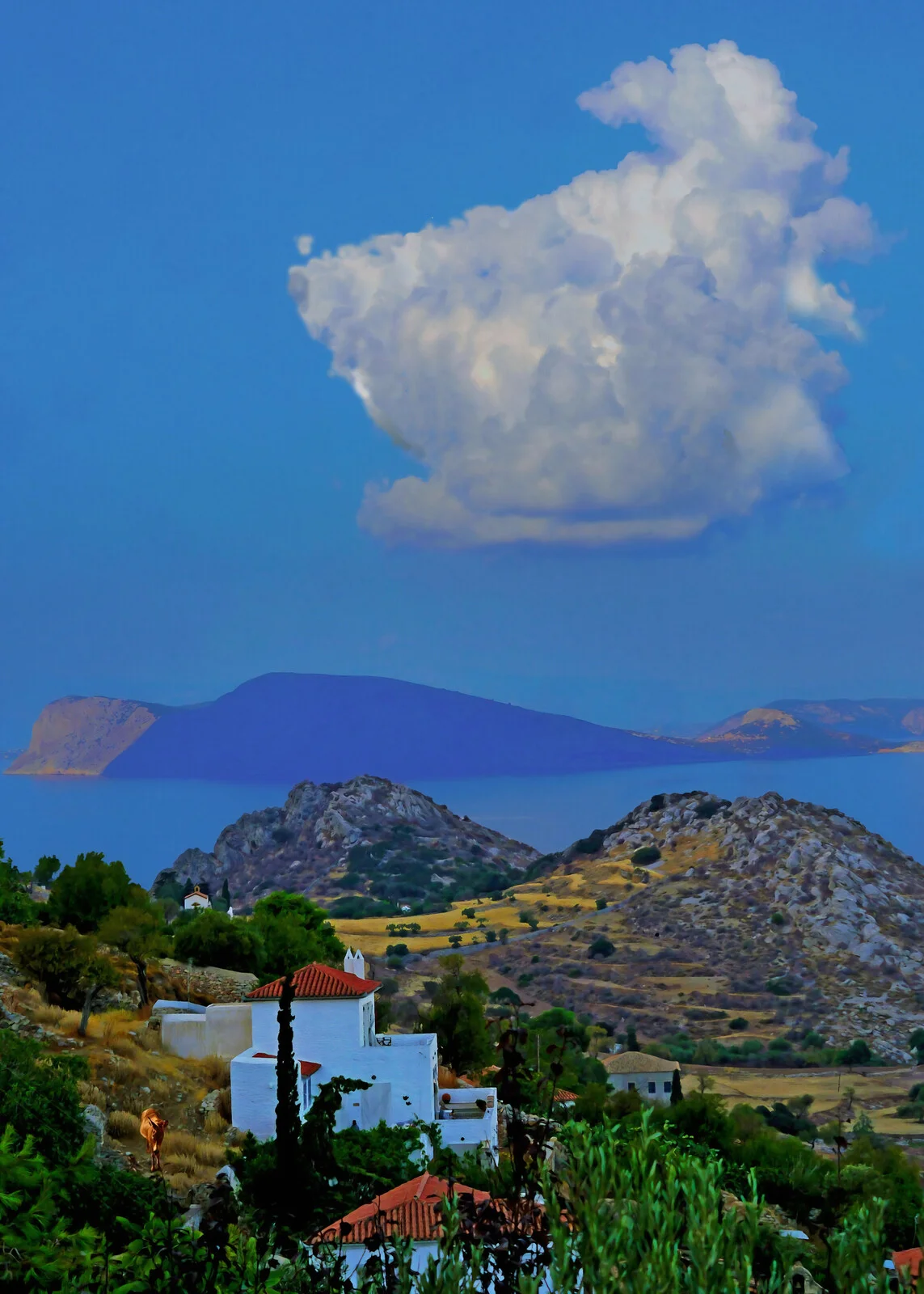
The Little Red Riding Hoof, 2024
Digital
50 x 70 cm
The image with its peculiar cloud might be a coincidence, but not necessarily. It was taken on May 22 this year. Next year marks two hundred years since Laskarina Bouboulina died; today, it is just one hundred ninety-nine—Hydra's own Little Golden-Hood who grew up to become a heroine. The donkey standing in our neighbour's garden is named after her, Laskarina, but always called The Little Red Riding Hoof because of her unusual red fur. There are many stories to tell about her, but not now. For now, we will focus on a tale in many versions, but only this one is truly authentic.
Here follows an educational tale that might have been told to the children of Hydra in the 18th century when the cruel Ottomans still occupied Greece. It was not until 1821 that the Hydriots and other Greeks could overthrow the oppressors, the Turkish wolves who had been feasting on Greeks since Constantinople fell in 1453. This tale, deeply rooted in history and culture, provides a unique perspective on the war of independence and the liberation of Greece.
In general, I want to warn against the Brothers Grimm and other storytellers of the past, as their tales are equally gruesome. They did not hesitate to push a wicked witch into the oven, roast her alive, or trick a troll into splitting open its belly. The culprits were always children, often a girl and boy together. The adults stayed cowardly in the background. This is what the little children used to live with; they were told after evening prayers and something to stimulate their dreams. Nowadays, we censor children's reality; Donald Duck and the chipmunks Chip and Dale can no longer shoot nuts at each other; Tintin and his swearing Captain Haddock must retract what they said in the 1930s; Asterix and his indomitable Gaulish warriors retroactively repent so as not to disturb the present order. But now, let's move on to the tale from Hydra for those who dare to read it.
In my authentic version of Little Red Riding Hood, the protagonist is named 'Laskarina Bouboulina', which holds significant meaning in the story's context. This tale version can be traced back to the 10th century, adding to its historical and cultural significance. According to oral tradition, it really happened at a time when there were still occasional wolves on Hydra. This unique twist on a familiar tale is what makes it so intriguing.
In the old French and Italian versions of the story, Little Red Riding Hood is depicted as independent and clever, adding depth to her character and making the story more intriguing. In my story, which has Arvanite roots, she is more like a twelve-year-old girl. Independent creatures who think they know everything about the world but are still fragile under the bold surface.
Prepare to be surprised. The tale of Little Red Riding Hood, which we thought we knew so well, takes a different turn. The little girl, known as 'Little Golden-Hood', is not the one who meets a tragic end. The wicked wolf is caught and devoured in the end, a twist that keeps us on the edge of our seats. This unexpected twist adds a new layer of intrigue to the story, making it a compelling read for all.
Only listen. The true story begins something like this:
There was once a little peasant girl, pretty and excellent as a star in its season. Her real name was Laskarina, but she was often called 'Little Golden-Hood' because of the beautiful little cloak with a gold-coloured hood she always wore. This hood was given to her by her grandmother, who was so old that she did not know her age; it was supposed to bring her good luck, for it was made from a ray of sunshine, she said. And as the good old woman was considered something of a witch, everyone thought the little hood rather bewitched, too.
And so it was, as you will see.
One day, the mother told the child, "Let us see, my Little Golden-Hood if you know how to find your way yourself. You shall take this good piece of cake to your grandmother for tomorrow's Sunday treat. You will ask her how she is and come back at once without stopping to chat on the way with people you don't know. Do you quite understand?"
"I quite understand," replied Laskarina gaily. And off she went with the cake, quite proud of her errand.
But the grandmother lived in Episkopi, another village, and there was a big pine wood to cross before getting there. At a turn of the road under the trees, suddenly, "Who goes there?"
"Everybody's friend Wolfie the Turk," said Wolfie, licking his lips. He had seen the child start alone, and the villain was waiting to devour her when, at the exact moment, he perceived some woodcutters who might observe him, and he changed his mind. Instead of falling upon Laskarina, he came frisking up to her like a good dog.
"Yassou! My nice Little Golden-Hood," Wolfie said in the softest voice he could manage, his tongue almost licking his lips in anticipation. So the little girl, her innocence shining through her eyes, stopped to talk with the wolf, who, for all that, she did not know in the least.
"You know me, then!" said Laskarina. "What is your name?"
"My name is Wolfie." He thought it unnecessary to mention the Turk part; some Hydriots were a bit sensitive about that. "And where are you going, my pretty one, with your little basket on your arm?"
"I am going to my grandmother's to bring her a good piece of carrot cake and some Retsina for her Sunday treat tomorrow."
"And where does she live, your grandmother?"
"She lives on the other side of the woods in Episkopi, the last house in the village, near the windmill."
"Ah! Yes! I know now," said Wolfie. "Well, that's just where I'm going; I shall get there before you, no doubt, with your little bits of legs, and I'll tell her you're coming to see her; then she'll wait for you."
Wolfie cut across the wood and arrived at the grandmother's house in less than five minutes. He knocked at the door: toc, toc.
No answer.
He knocked louder.
Nobody.
Then Wolfie stood on his hind legs, put his forepaws on the latch, pushed and opened the door. Not a soul in the house. The old woman had risen early to sell herbs in Hydra town, and she had gone off in such haste that she had left her bed unmade, with her embroidered nightcap on the pillow.
"Good!" said Wolfie to himself. I know what I'll do." He shut the door, pulled on the grandmother's nightcap, and put it down to his eyes. Then, after drawing the curtains, Wolfie lay down all his length in the bed.
In the meantime, the good Laskarina went quietly on her way, as little girls do, amusing herself here and there by picking Easter daisies, watching the little birds making their nests, and running after the butterflies which fluttered in the sunshine.
At last, she arrived at the door.
Knock, knock.
"Who is there?" said Wolfie the Turk, softening his rough voice as best he could.
"It's me, Granny, your Little Golden-Hood. I'm bringing you a big piece of cake for your Sunday treat tomorrow."
"Press your finger on the latch, then push, and the door opens."
"Why are you still in bed? Have you got a cold, Granny?" she said, coming in.
"Ahem! A little, a little . . ." replied Wolfie the Turk, pretending to cough. "Shut the door well, my little lamb. Put your basket on the table, and then take off your dress and come and lie down by me. You shall rest a little."
Laskarina undressed, but she kept her little hood upon her head. The poor little thing was stunned when she saw what a figure her Granny looked like.
"Oh!" cried Laskarina, "how like you are to Wolfie, a friend of mine, Grandmother!"
"That's because of my nightcap, child," replied Wolfie the Turk, hesitatingly.
"Oh! What hairy arms you've got, Granny!"
"All the better to hug you, my dear child."
"Oh! What a big tongue you've got, Grandma!"
"All the better for answering, little child."
"Oh! What a mouthful of great white teeth you have, Grandmother!"
"That's for crunching little children with!" Wolfie the Turk opened his jaws wide to swallow Laskarina.
But Laskarina threw her head to the side crying, "Mamma! Mamma!" so Wolfie the Turk only caught her little hood.
"Oh dear! Oh dear!" Wolfie the Turk drew back his head in pain, crying and shaking his jaw as if he had swallowed red-hot coals. It was the fire-coloured hood that had burnt his tongue right down his throat.
The hood, you see, was one of those magic Arvanite caps they used to have in former times, in the stories, for making oneself invisible or invulnerable. Laskarina had gotten it from Granny, who had let Hydra's witch sew it. So there was Wolfie the Turk with his throat badly burnt, jumping off the bed and desperately trying to find the door, howling and howling as if all the dogs on Hydra were at his heels.
At the exact moment, Granny arrived, returning from Hydra town with her long sack empty on her shoulder. She had had a good morning at the market and had sold out her herbs to the last sprig.
"Ah, we have a guest. A bandit!" Granny cried, "Wait a bit!" Quickly, she opened her sack wide across the door, and the maddened Wolfie the Turk sprang headfirst into the sack.
Wolfie the Turk was caught and swallowed like a letter into a mailbox. The brave old dame shut her sack, opened the trapdoor to the house's cistern, emptied the sack, and closed the trapdoor. Wolfie the Turk, still howling, tumbled into the water deep down and subsequently drowned.
"Ah, you scoundrel! You thought you would crunch my little grandchild! Well, tomorrow, we will make her a muff of your skin, and you shall be crunched, for we will give your carcass to the dogs," laughed Granny heartlessly.
Granny hastened to dress poor Laskarina, still trembling with fear in the bed.
"Well," Granny said to the child, "without the witch's golden hood, where would you be now, darling?" To restore the child's mood, Granny made her eat a good piece of cake and drink some wine, after which Granny took her by the hand and led her back to the house.
Laskarina promised over and over again that she would never stop to listen to a wolf so that, at last, Granny forgave her. And Laskarina, the Little Golden-Hood, kept her word. And in fine weather, she may still be seen in the fields with her pretty little hood, the colour of the sun. But to see her, you must rise early, just before sunrise.
Fortunately, it ended as it did, for Laskarina grew up to be a brave revolutionary and was important during the war of independence when Hydriots and other Greeks drove out all the wolves and liberated Greece.
Jörgen Thornberg
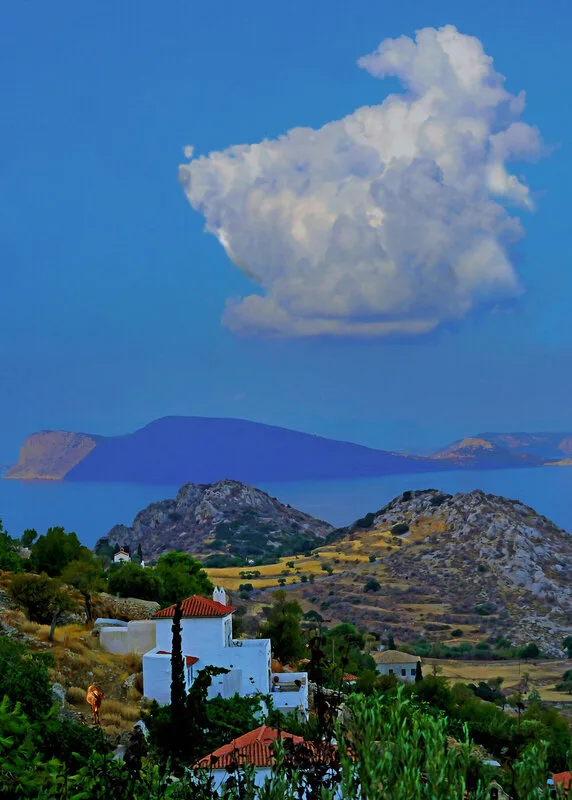
The Little Red Riding Hoof, 2024
Digital
50 x 70 cm
The image with its peculiar cloud might be a coincidence, but not necessarily. It was taken on May 22 this year. Next year marks two hundred years since Laskarina Bouboulina died; today, it is just one hundred ninety-nine—Hydra's own Little Golden-Hood who grew up to become a heroine. The donkey standing in our neighbour's garden is named after her, Laskarina, but always called The Little Red Riding Hoof because of her unusual red fur. There are many stories to tell about her, but not now. For now, we will focus on a tale in many versions, but only this one is truly authentic.
Here follows an educational tale that might have been told to the children of Hydra in the 18th century when the cruel Ottomans still occupied Greece. It was not until 1821 that the Hydriots and other Greeks could overthrow the oppressors, the Turkish wolves who had been feasting on Greeks since Constantinople fell in 1453. This tale, deeply rooted in history and culture, provides a unique perspective on the war of independence and the liberation of Greece.
In general, I want to warn against the Brothers Grimm and other storytellers of the past, as their tales are equally gruesome. They did not hesitate to push a wicked witch into the oven, roast her alive, or trick a troll into splitting open its belly. The culprits were always children, often a girl and boy together. The adults stayed cowardly in the background. This is what the little children used to live with; they were told after evening prayers and something to stimulate their dreams. Nowadays, we censor children's reality; Donald Duck and the chipmunks Chip and Dale can no longer shoot nuts at each other; Tintin and his swearing Captain Haddock must retract what they said in the 1930s; Asterix and his indomitable Gaulish warriors retroactively repent so as not to disturb the present order. But now, let's move on to the tale from Hydra for those who dare to read it.
In my authentic version of Little Red Riding Hood, the protagonist is named 'Laskarina Bouboulina', which holds significant meaning in the story's context. This tale version can be traced back to the 10th century, adding to its historical and cultural significance. According to oral tradition, it really happened at a time when there were still occasional wolves on Hydra. This unique twist on a familiar tale is what makes it so intriguing.
In the old French and Italian versions of the story, Little Red Riding Hood is depicted as independent and clever, adding depth to her character and making the story more intriguing. In my story, which has Arvanite roots, she is more like a twelve-year-old girl. Independent creatures who think they know everything about the world but are still fragile under the bold surface.
Prepare to be surprised. The tale of Little Red Riding Hood, which we thought we knew so well, takes a different turn. The little girl, known as 'Little Golden-Hood', is not the one who meets a tragic end. The wicked wolf is caught and devoured in the end, a twist that keeps us on the edge of our seats. This unexpected twist adds a new layer of intrigue to the story, making it a compelling read for all.
Only listen. The true story begins something like this:
There was once a little peasant girl, pretty and excellent as a star in its season. Her real name was Laskarina, but she was often called 'Little Golden-Hood' because of the beautiful little cloak with a gold-coloured hood she always wore. This hood was given to her by her grandmother, who was so old that she did not know her age; it was supposed to bring her good luck, for it was made from a ray of sunshine, she said. And as the good old woman was considered something of a witch, everyone thought the little hood rather bewitched, too.
And so it was, as you will see.
One day, the mother told the child, "Let us see, my Little Golden-Hood if you know how to find your way yourself. You shall take this good piece of cake to your grandmother for tomorrow's Sunday treat. You will ask her how she is and come back at once without stopping to chat on the way with people you don't know. Do you quite understand?"
"I quite understand," replied Laskarina gaily. And off she went with the cake, quite proud of her errand.
But the grandmother lived in Episkopi, another village, and there was a big pine wood to cross before getting there. At a turn of the road under the trees, suddenly, "Who goes there?"
"Everybody's friend Wolfie the Turk," said Wolfie, licking his lips. He had seen the child start alone, and the villain was waiting to devour her when, at the exact moment, he perceived some woodcutters who might observe him, and he changed his mind. Instead of falling upon Laskarina, he came frisking up to her like a good dog.
"Yassou! My nice Little Golden-Hood," Wolfie said in the softest voice he could manage, his tongue almost licking his lips in anticipation. So the little girl, her innocence shining through her eyes, stopped to talk with the wolf, who, for all that, she did not know in the least.
"You know me, then!" said Laskarina. "What is your name?"
"My name is Wolfie." He thought it unnecessary to mention the Turk part; some Hydriots were a bit sensitive about that. "And where are you going, my pretty one, with your little basket on your arm?"
"I am going to my grandmother's to bring her a good piece of carrot cake and some Retsina for her Sunday treat tomorrow."
"And where does she live, your grandmother?"
"She lives on the other side of the woods in Episkopi, the last house in the village, near the windmill."
"Ah! Yes! I know now," said Wolfie. "Well, that's just where I'm going; I shall get there before you, no doubt, with your little bits of legs, and I'll tell her you're coming to see her; then she'll wait for you."
Wolfie cut across the wood and arrived at the grandmother's house in less than five minutes. He knocked at the door: toc, toc.
No answer.
He knocked louder.
Nobody.
Then Wolfie stood on his hind legs, put his forepaws on the latch, pushed and opened the door. Not a soul in the house. The old woman had risen early to sell herbs in Hydra town, and she had gone off in such haste that she had left her bed unmade, with her embroidered nightcap on the pillow.
"Good!" said Wolfie to himself. I know what I'll do." He shut the door, pulled on the grandmother's nightcap, and put it down to his eyes. Then, after drawing the curtains, Wolfie lay down all his length in the bed.
In the meantime, the good Laskarina went quietly on her way, as little girls do, amusing herself here and there by picking Easter daisies, watching the little birds making their nests, and running after the butterflies which fluttered in the sunshine.
At last, she arrived at the door.
Knock, knock.
"Who is there?" said Wolfie the Turk, softening his rough voice as best he could.
"It's me, Granny, your Little Golden-Hood. I'm bringing you a big piece of cake for your Sunday treat tomorrow."
"Press your finger on the latch, then push, and the door opens."
"Why are you still in bed? Have you got a cold, Granny?" she said, coming in.
"Ahem! A little, a little . . ." replied Wolfie the Turk, pretending to cough. "Shut the door well, my little lamb. Put your basket on the table, and then take off your dress and come and lie down by me. You shall rest a little."
Laskarina undressed, but she kept her little hood upon her head. The poor little thing was stunned when she saw what a figure her Granny looked like.
"Oh!" cried Laskarina, "how like you are to Wolfie, a friend of mine, Grandmother!"
"That's because of my nightcap, child," replied Wolfie the Turk, hesitatingly.
"Oh! What hairy arms you've got, Granny!"
"All the better to hug you, my dear child."
"Oh! What a big tongue you've got, Grandma!"
"All the better for answering, little child."
"Oh! What a mouthful of great white teeth you have, Grandmother!"
"That's for crunching little children with!" Wolfie the Turk opened his jaws wide to swallow Laskarina.
But Laskarina threw her head to the side crying, "Mamma! Mamma!" so Wolfie the Turk only caught her little hood.
"Oh dear! Oh dear!" Wolfie the Turk drew back his head in pain, crying and shaking his jaw as if he had swallowed red-hot coals. It was the fire-coloured hood that had burnt his tongue right down his throat.
The hood, you see, was one of those magic Arvanite caps they used to have in former times, in the stories, for making oneself invisible or invulnerable. Laskarina had gotten it from Granny, who had let Hydra's witch sew it. So there was Wolfie the Turk with his throat badly burnt, jumping off the bed and desperately trying to find the door, howling and howling as if all the dogs on Hydra were at his heels.
At the exact moment, Granny arrived, returning from Hydra town with her long sack empty on her shoulder. She had had a good morning at the market and had sold out her herbs to the last sprig.
"Ah, we have a guest. A bandit!" Granny cried, "Wait a bit!" Quickly, she opened her sack wide across the door, and the maddened Wolfie the Turk sprang headfirst into the sack.
Wolfie the Turk was caught and swallowed like a letter into a mailbox. The brave old dame shut her sack, opened the trapdoor to the house's cistern, emptied the sack, and closed the trapdoor. Wolfie the Turk, still howling, tumbled into the water deep down and subsequently drowned.
"Ah, you scoundrel! You thought you would crunch my little grandchild! Well, tomorrow, we will make her a muff of your skin, and you shall be crunched, for we will give your carcass to the dogs," laughed Granny heartlessly.
Granny hastened to dress poor Laskarina, still trembling with fear in the bed.
"Well," Granny said to the child, "without the witch's golden hood, where would you be now, darling?" To restore the child's mood, Granny made her eat a good piece of cake and drink some wine, after which Granny took her by the hand and led her back to the house.
Laskarina promised over and over again that she would never stop to listen to a wolf so that, at last, Granny forgave her. And Laskarina, the Little Golden-Hood, kept her word. And in fine weather, she may still be seen in the fields with her pretty little hood, the colour of the sun. But to see her, you must rise early, just before sunrise.
Fortunately, it ended as it did, for Laskarina grew up to be a brave revolutionary and was important during the war of independence when Hydriots and other Greeks drove out all the wolves and liberated Greece.

Jörgen Thornberg
Malmö
Lite om bilder och mig. Translation in English at the end.
Jag är en nyfiken person som ser allt i bilder, även det jag fäster i ord, gärna tillsammans för bakom alla mina bilder finns en berättelse. Till vissa bilder hör en kortare eller längre novell som följer med bilden.
Bilder berättar historier. Jag omges av naturlig skönhet, intressanta människor och historia var jag än går. Jag använder min kamera för att dokumentera världen och blanda det jag ser med vad jag känner för att fånga den dolda magin.
Mina bilder berättar mina historier. Genom mina bilder, tryck och berättelser. Jag bjuder in dig att ta del av dessa berättelser, in i ditt liv och hem och dela min mycket personliga syn på vår värld. Mer än vad ögat ser. Jag tänker i bilder, drömmer och skriver och pratar om dem; följaktligen måste jag också skapa bilder. De blir vad jag ser, inte nödvändigtvis begränsade till verkligheten. Det finns en bild runt varje hörn. Jag hoppas att du kommer att se vad jag såg och gilla det.
Jag är också en skrivande person och till många bilder hör en kortare eller längre essay. Den följer med tavlan, tryckt på fint papper och med en personlig hälsning från mig.
Flertalet bilder startar sin resa i min kamera. Enkelt förklarat beskriver jag bilden jag ser i mitt inre, upplevd eller fantiserad. Bilden uppstår inom mig redan innan jag fått okularet till ögat. På bråkdelen av ett ögonblick ser jag vad jag vill ha och vad som kan göras med bilden. Här skall jag stoppa in en giraff, stålmannen, Titanic eller vad det är min fantasi finner ut. Ännu märkligare är att jag kommer ihåg minnesbilden långt efteråt när det blir tid att skapa verket. Om jag lyckas eller inte, är upp till betraktaren, oftast präglat av en stråk av svart humor – meningen är att man skall bli underhållen. Mina bilder blir ofta en snackis där de hänger.
Jag föredrar bilder som förmedlar ett budskap i flera lager. Vid första anblicken fylld av feel-good, en vacker utsikt, fint väder, solen skiner, blommor på ängen eller vattnet som ligger förrädiskt spegelblankt. I en sådan bild kan jag gömma min egentliga berättelse, mitt förakt för förtryckare och våldsverkare, rasister och fördomsfulla människor - ett gärna återkommande motiv mer eller mindre dolt i det vackra motivet. Jag försöker förena dem i ett gemensamt narrativ.
Bild och formgivning har löpt som en röd tråd genom livet. Fotokonst känns som en värdig final som jag gärna delar med mig.
Min genre är vid som framgår av mina bilder, temat en blandning av pop- och gatukonst i kollage som kan bestå av hundratals lager. Vissa bilder kan ta veckor, andra någon dag innan det är dags att överlämna resultatet till printverkstaden. Fine Art Prints är digitala fotocollage. I dessa kollage sker rivandet, klippandet, pusslandet, målandet, ritandet och sprayningen digitalt. Det jag monterar in kan vara hundratals år gamla bilder som jag omsorgsfullt frilägger så att de ser ut att vara en del av tavlan men också bilder skapade av mig själv efter min egen fantasi. Därefter besöks printstudion och för vissa bilder numrera en limiterad upplaga (oftast 7 exemplar) och signera för hand. Vissa bilder kan köpas i olika format. Det är bara att fråga efter vilka. Gillar man en bild som är 70x100 men inte har plats på väggen, går den kanske att få i 50x70 cm istället. Frågan är fri.
Metoden Giclée eller Fine Art Print som det också kallas är det moderna sättet för framställning av grafisk konst. Villkoret för denna typ av utskrifter är att en högkvalitativ storformatskrivare används med åldersbeständigt färgpigment och konstnärspapper eller i förekommande fall på duk. Pappret som används möter de krav på livslängd som ställs av museer och gallerier. Normalt säljer jag mina bilder oinramade så att den nya ägaren själv kan bestämma hur de skall se ut, med eller utan passepartout färg på ram, med eller utan glas etc..
Under många år ställde jag bara ut på nätet, i valda grupper och på min egen Facebooksida - https://www.facebook.com/jorgen.thornberg.9
Jag finns också på en egen hemsida som tyvärr inte alltid är uppdaterad – https://www.jth.life/ Där kan du också läsa en del av de berättelser som följer med bilden.
UTSTÄLLNINGAR
Luftkastellet, oktober 2022
Konst i Lund, november 2022
Luftkastellet, mars 2023
Engleson Galleri Caroli, april 2023
Hydra, Greece June 2023
Engleson Galleri Caroli, oktober 2023
Toppen, Höllviken december 2023
Luftkastellet, mars 2024
Torups Galleri, mars 2024
Venice, May 2024
Luftkastellet, oktober 2024
Konst i Advent, December 2024
Galleri Engleson, Caroli December 2024
Jäger & Jansson Galleri, april 2025
A bit about pictures and me.
I'm a curious person who sees everything in pictures, even what I express in words, often combining them, for behind all my pictures lies a story. These narratives, some as short as a single image and others as long as a novel, are the heart and soul of my work.
Pictures tell stories. Wherever I go, I'm surrounded by natural beauty, exciting people, and history. I use my camera to document the world and blend what I see with what I feel to capture the hidden magic.
My images tell my stories. Through my pictures, prints, and narratives, I invite you to partake in these stories in your life and home and share my deeply personal perspective of our world. More than meets the eye. I think in pictures, dream, write, and talk about them; consequently, I must create images too. They become what I see, not necessarily confined to reality. There's a picture around every corner. I hope you'll see what I saw and enjoy it.
I'm also a writer, and many images come with a shorter or longer essay. It accompanies the painting, printed on fine paper with my personal greeting.
Many pictures start their journey on my camera. Simply put, I describe the image I see in my mind, experienced or imagined. The image arises within me even before I bring the eyepiece to my eye. In a fraction of a moment, I see what I want and what can be done with the picture. Here, I'll insert a giraffe, Superman, the Titanic, or whatever my imagination conjures up. Even stranger is that I remember the mental image long after it's time to create the work. Whether I succeed is up to the observer, often imbued with a streak of black humour – the aim is to entertain. My pictures usually become a talking point wherever they hang.
I prefer pictures that convey a message in multiple layers. At first glance, they're filled with feel-good vibes, a beautiful view, lovely weather, the sun shining, flowers in the meadow, or the water lying deceptively calm. But beneath this surface beauty, I often conceal a deeper story, a narrative that challenges societal norms or explores the human condition. I invite you to delve into these hidden narratives and discover the layers of meaning within my work.
Picture and design have been a thread running through my life. Photographic art feels like a fitting finale, and I'm happy to share it.
My genre is varied, as seen in my pictures; the theme is a blend of pop and street art in collages that can consist of hundreds of layers. Some images can take weeks, others just a day before it's time to hand over the result to the print workshop. Fine Art Prints are digital photo collages. In these collages, tearing, cutting, puzzling, painting, drawing, and spraying happen digitally. What I insert can be images hundreds of years old that I carefully extract so they appear to be part of the painting, but also images created by myself, now also generated from my imagination. Next, visit the print studio and, for certain images, number a limited edition (usually 7 copies) and sign them by hand. Some images may be available in other formats. Just ask which ones. If you like an image that's 70x100 but doesn't have space on the wall, you might be able to get it in 50x70 cm instead. The question is open.
The Giclée method, or Fine Art Print as it's also called, is the modern way of producing graphic art. This method ensures the highest quality and longevity of the artwork, using a high-quality large-format printer with archival pigment inks and artist paper or, in some cases, canvas. The paper used meets the longevity requirements set by museums and galleries. I sell my pictures unframed, allowing the new owner to personalise their artwork, confident in the lasting value and quality of the piece.
For many years, I only exhibited online, in selected groups, and on my Facebook page - https://www.facebook.com/jorgen.thornberg.9. I also have my website, which unfortunately is not constantly updated - https://www.jth.life/. You can also read some of the stories accompanying the pictures there.
EXHIBITIONS
Luftkastellet, October 2022
Art in Lund, November 2022
Luftkastellet, March 2023
Engleson Gallery Caroli, April 2023
Hydra, Greece June 2023
Engleson Gallery Caroli, October 2023
Toppen, Höllviken December 2023
Luftkastellet, March 2024
Torup Gallery, March 2024
Venice, May 2024
UTSTÄLLNINGAR
Luftkastellet, oktober 2022
Konst i Lund, november 2022
Luftkastellet, mars 2023
Engleson Galleri Caroli, april 2023
Hydra, Greece June 2023
Engleson Galleri Caroli, oktober 2023
Toppen, Höllviken december 2023
Luftkastellet, mars 2024
Torups Galleri, mars 2024
Venice, May 2024
Luftkastellet, October 2024
Konst i Advent, December 2024
Galleri Engleson, Caroli December 2024
Jäger & Jansson Galleri, April 2025
Utbildning
Autodidakt
Medlem i konstnärsförening
Öppna Sinnen
Med i konstrunda
Konstrundan i Skåne
Utställningar
Luftkastellet, October 2022
Art in Lund, November 2022
Luftkastellet, March 2023
Engleson Gallery Caroli, April 2023
Hydra, Greece June 2023
Engleson Gallery Caroli, October 2023
Toppen, Höllviken December 2023
Luftkastellet, March 2024
Torup Gallery, March 2024
Venice, May 2024