Vi använder cookies för att ge dig bästa möjliga upplevelse. Välj vilka cookies du tillåter.
Läs mer i vår integritetspolicy
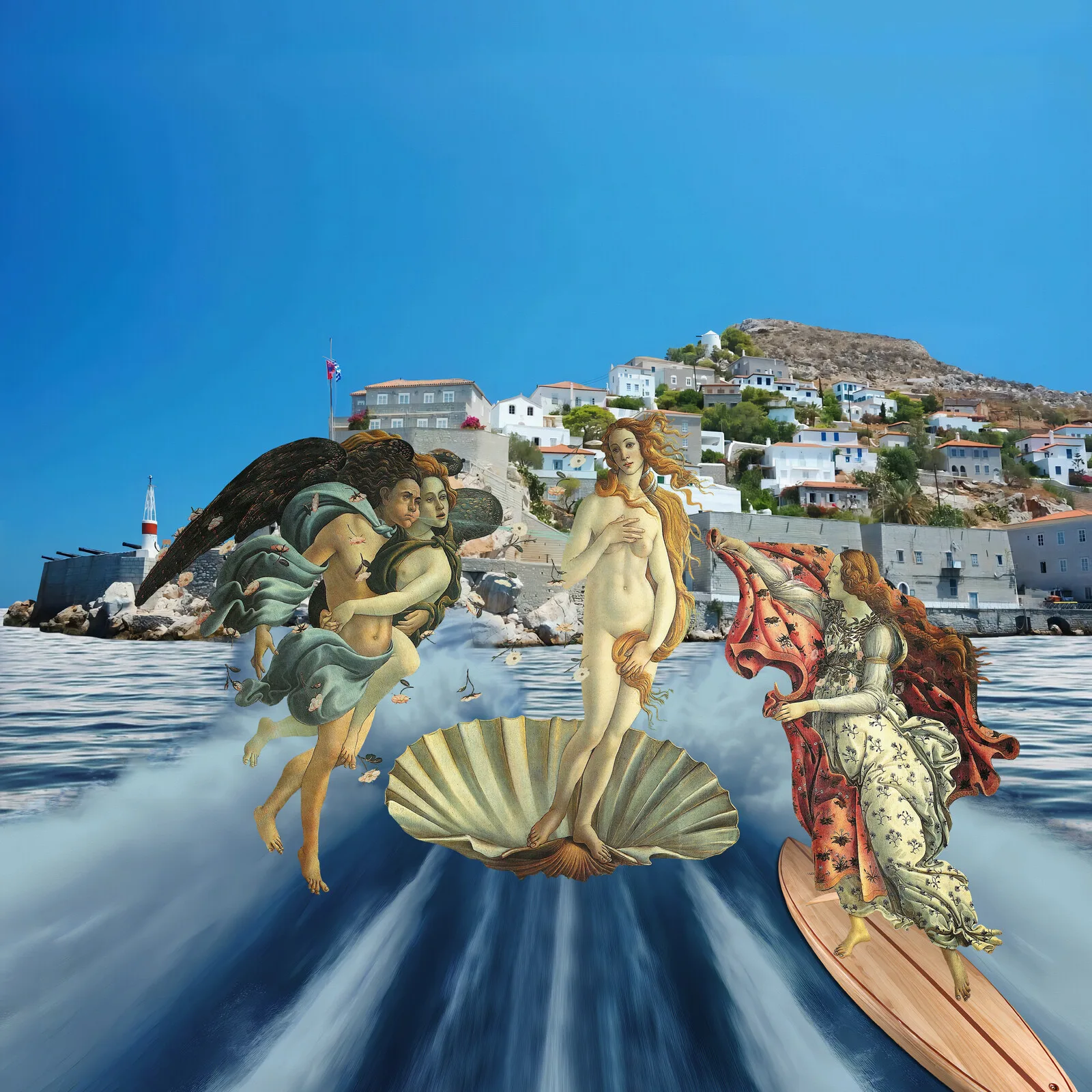
Jörgen Thornberg
Venus Reborn in Style, 2024
Digital
70 x 70 cm
Venus, our Venus,
You came like a fresh wind from the west,
Rushing into our harbour,
Reborn three millennia old,
To a world that will never be what it was.
Time stands still in eternity,
But not on Earth,
Yet your beauty remains in the image,
Forever etched in timeless art.
Giorgios had spotted her at Hydronetta, a beautiful woman sitting alone at one of the small tables by the sea. There was something about her, a mystery that seemed to transcend time, which piqued his curiosity. The drink before her was as red as the setting sun, untouched, with the ice melted, a detail that added to the enigma.
Giorgios, a former art history student who had transitioned into a reporter for Athens News, was known for his ability to uncover hidden stories. This curiosity led him to the solitary woman. The challenge was approaching her without seeming intrusive or flirtatious, a delicate balance he was determined to strike.
"Is this your favourite way to unwind after a long day? Sitting by the seaside at sunset without watching it, letting the ice melt in your glass?" he asked, leaning forward from the neighbouring table. It was a make-or-break question, impossible to answer with a simple yes or no, and combined with a polite but curious smile, it should work. And it did.
Venus: "Oh, sorry, I was lost in thought. Could you repeat the question?" Giorgios repeated it, and she began to share her feelings about a long journey. She spoke of her recent return to Hydra, where she hadn't been for a long time, and how everything felt new, overwhelming, and challenging. Her words carried a hint of vulnerability, drawing Giorgios in even more.
Giorgios introduced himself, explaining that he worked for Athens News and was generally curious about people. Something familiar about her sparked his interest, a connection he couldn't quite place. He had a rare ability to listen to his inner voice, which sometimes felt taken over by others, and right now, he felt that way as if they were both on the same wavelength.
"Venus," she introduced herself, looking through him as she extended a graceful hand adorned with an ancient-looking gold ring. The ring featured a portrait of Alexander the Great—not a modern design.
Giorgios: "You mentioned a long journey but only got as far as revisiting the Archaeological site of Mycenae. You said the stones were still upright, and the Lion Gate was a novelty with its regularly cut stones. That intrigued me because, as far as I know, they haven't stood upright since the days of Troy."
Venus: "Sorry," Venus said, embarrassed. "I misspoke. I meant... I'm unsure what I meant because it was so long ago."
Giorgios: "Your face is familiar, though we haven't met," Giorgios said, looking deeply into her eyes. "You are the Venus, the woman in Botticelli's painting. Simonetta, I believe her name was."
Venus: “Simonetta Cattaneo Vespucci.”
Giorgios: "Yes, that was her name. Have you also studied art history?"
Venus: "No, but I have met her, you could say. But she is not the one in the painting."
Giorgios: "I have learned that the model painted as Venus is Simonetta Cattaneo Vespucci. She was apparently a noblewoman from Genoa or perhaps, as many people like to believe – to underline the name's coincidence – from Porto Venere (Venus Harbour)."
Venus: "Yes, Simonetta arrived in Florence with her young husband, a distant cousin of Amerigo Vespucci, during the period when Lorenzo the Magnificent and his brother Giuliano of the Medici family rose to power."
Giorgios: "The couple joined the court life, and Simonetta's beauty became legendary in Florence, right?"
Venus: "Indeed. It seems that both Giuliano and Botticelli himself fell in love with her. In 1475, 'Giuliano's tournament' occurred in Santa Croce Square. Giuliano participated because the prize was a flag with Simonetta's portrait, which Botticelli painted. 'La Sans Pareille,' meaning 'the unequalled,' was written on the flag."
Giorgios: "Simonetta did not inspire only Botticelli's Venus but even other women painted by the artist?"
Venus: "Correct. She so inspired Botticelli that he arranged to be buried at the foot of his muse in the Florentine church of Ognissanti. However, he was not the only one captivated by the young blonde woman. Piero di Cosimo portrayed her as Cleopatra, and Lorenzo the Magnificent and Luigi Pulci wrote rhymes for her."
Giorgios: "What happened to her? She seems to have vanished into thin air."
Venus: "The young woman was a presence as stunning as she was short-lived in Florence. She died just a year after the tournament, probably due to tuberculosis."
Giorgios: "How tragic for such a beautiful girl."
Venus: "Even after her death, Botticelli continued to create artworks inspired by her. His masterpieces, Venus and Primavera, displayed at the Uffizi Gallery, were painted about ten years after Simonetta's death. Her beauty was fixed in the artist's mind, and he painted her from memory. What has been forgotten is that Botticelli also created a Venus and Summer and planned to create an autumn and winter scene, but those plans fell through. Venus and Summer, however, was completed and hung in his studio until the day he died. After that, it disappeared from history, missing from the inventory and most likely ending up with Botticelli's friend and rival, Piero di Cosimo. Both had been in love with the enigmatic Simonetta, and Piero felt he needed the painting more after his friend's death."
Giorgios: "How do you know all this?" he asked, looking puzzled.
Venus: "Because I know it's not her who is Venus in the painting. She and I look very much alike, but I am much older."
Giorgios: "So you are Venus, even if that's impossible?" He wasn't indiscreet and didn't ask how many years apart they were. A few years or two thousand.
Venus: "I am who I am and didn't need to model. I could be myself, and Botticelli painted a portrait, not an allegory."
Giorgios: "If you are the Venus in 'The Birth of Venus', who is the woman in Primavera and the supposedly lost Summer painting?"
Venus: "No idea. I wasn't even on Earth when Botticelli painted those. It could be me still. I don't have Simonetta's upturned nose but, as you see, a more classical profile." Venus pointed to her straight nose bridge.
Giorgios: "I understand nothing."
Venus: "You don't need to. We can still have a pleasant time. It took Botticelli a while, and we had a great time. He probably fell in love with me, the eternal bachelor. He was also in love with my twin, Simonetta."
Giorgios: "Did he have any success?"
Venus: "Let's not be indiscreet, and besides, I had my half-sister with me and her lover, the West Wind."
Giorgios: "Zephyrus?" he guessed, thinking that they were part of the painting and, in that case, all made sense. In a way, at least.
Venus: "That's him."
Giorgios: "Then I understand." Which he didn't at all because the whole thing was incomprehensible. "It's been a long time since you were last on Earth, Miss Venus. Not since you modelled for the Italian artist Sandro Botticelli, who wanted to depict how you were born two thousand years earlier, arriving at the shore after birth, when you had emerged from the sea fully grown."
Goddess Venus shook her long, oat-blonde hair: "Yes, it has been a while."
Giorgios: "Isn't it time for your rebirth, Miss Venus?"
Venus: "What a great idea! Half a millennium has passed, and I understand there's more to see on Hydra today. Back then, it was an abandoned island with many trees, some wild goats, but not a single human."
Giorgios: "When you were born, Hydra, as it was called then, wasn't crowded either, was it?"
Venus: "That's correct, but that was intentional. My parents, Zeus and Dione, weren't sure if it would work for me to sail in on a seashell. If it sank, Zeus didn't want any witnesses. That would have been embarrassing for the chief god himself."
Giorgios: "I can understand that. You weren't even named when you came ashore, if I'm not mistaken."
Venus: "True. After safely landing on my seashell, I was named Aphrodite. Venus, which I often use now, is what the Romans called me. Since all the paintings and sculptures bear that name, it's more practical and easier to remember. Consider my age." Venus smiled in a way that made it clear she wanted Giorgios to disagree with her.
Giorgios: "Some say that Miss Venus was born off the coast of Cythera from the foam produced by Uranus's genitals."
Venus: "Nonsense. I was born here in the strait between the island called Dokos and Hydra. Uranus was not involved, but my parents' genitalia. They made love, to put it plainly. I was a love child."
Giorgios: "Of course, you know best."
Venus: "Naturally."
Giorgios: "Among many other things, you are also the patron goddess of prostitutes, a somewhat controversial association, isn't it?"
Venus: "Yes, some sensitive souls are offended by the life I led. However, a positive aspect was that early scholars proposed the concept of 'sacred prostitution' in Greco-Roman culture, an idea which is now generally seen as erroneous. Be that as it may, people certainly took liberties in the past. The wealthy, of course. And we gods. Ordinary people neither had the time nor the means to indulge, let alone buy prostitutes."
Giorgios: "How is it that you, as a goddess, wanted to be associated with prostitution? You did not need to sell your services, Miss Venus?"
Venus, somewhat indignantly: "Certainly not. Men lined up to bed me. However, I was often already lying down. Today, I would be called hypersexual, a nymphomaniac, and probably labelled with some abbreviation. I simply enjoyed sex. Besides, I had a lot to live up to as the goddess associated with love, lust, beauty, pleasure, passion, procreation, desire, sex, fertility, and prosperity."
Giorgios, smiling: "Yes, the list is long, but no holds barred, one could say."
Venus: "My main festival was the Aphrodisia, celebrated annually in midsummer. It was quite an event, to say the least."
Giorgios: "I can imagine. So, it would be fitting to be reborn on Hydra just in time for Miaoulia, the festival which is also in midsummer. The Hydriots are in a festive mood, and people come from all over the world. The fireworks are worthy of a goddess."
Venus: "Great idea! I'll take it."
Giorgios: "Now that you're here, Miss Venus. Was there something special that drew you to Earth after such a long time?"
Venus: "One of my many boyfriends, Ares, the god of war, had some business on Earth and convinced me to come along. I initially thought of saying no, but when he pointed out that the event he was attending was related to me, I allowed myself to be persuaded."
Giorgios: "Exciting! May I ask what event that was?"
Giorgios: "Absolutely! A few weeks ago, by earthly time, it was exactly 3,200 years since the Trojan War broke out. And indeed, you had a role in that conflict."
Venus: "Aha! So long ago. Time certainly flies. Ares was your boyfriend even three thousand years ago, wasn't he?"
Venus: "I can't deny it, but he was one of the few where I was caught red-handed. I was caught in the middle of the act of adultery with Ares. It was a major scandal. He is a good lover who has lasted more than three millennia. Not many can claim that." Venus laughed heartily.
Giorgios: "The Trojan War! Please tell our readers about it and your role."
Venus: "Ok. But just briefly. This legendary conflict in Greek mythology took place between 1184 and 1176 BC. The Achaeans (Greeks) waged war against the city of Troy after Paris took Helen from her husband, Menelaus, king of Sparta. The war is one of the most important events in Greek mythology, and it has been narrated through many works of Greek literature, most notably Homer's Iliad. Along with Athena and Hera, I was one of the three goddesses whose feud resulted in the beginning of the Trojan War, and I played a major role throughout the Iliad. Odysseus, one of the war's heroes, was my lover for a while." Venus sighed dreamily.
Giorgios: "Along with Athena and Hera, you were one of the three goddesses whose feud resulted in the beginning of the Trojan War, and you played a major role throughout the Iliad, right?"
Venus: "Yes, it started as a trivial matter that got out of hand. I promised Paris, the prince of Troy, the most beautiful woman in the world, which led to Paris abducting Helen from Sparta. That was unnecessary and had nothing to do with my promise. I actually meant myself because Paris was an attractive man. His abduction, not me, triggered the war between Troy and the Greek states where Odysseus participated. Every cloud has a silver lining," Venus said, looking dreamily towards outer Space, hidden by the blue sky.
Giorgios: "The good thing, was it Odysseus?" asked Giorgios with a big dirty smile. Perhaps the goddess was hiding some historical secret he could reveal to the readers. What a scoop that would be.
Venus: "Yes. We were together for a while but didn't part as friends. When the war was over, the scoundrel left without properly saying goodbye. In the end, Odysseus was more interested in his wife Penelope and his kingdom than in me, a goddess and the most beautiful woman in the known world." Evidently, the scars of being disregarded for a mortal wife remained three millennia later.
Giorgios: "So it was you who tried to prevent him from returning home?" He sensed the scoop was near. What a story it would be to disprove Homer.
Venus: "I don't want to exaggerate my role, but yes, I was involved. All of Olympus knows that. So does Odysseus. The ten long years it took for Odysseus to get home was due to a combination of factors, including his own actions, my and other gods' involvement, and the various dangers he encountered along the way. You've probably heard of them ad nauseam, but just in case, I'll summarise briefly." Venus traced a list in the air.
Venus: "First was my sabotage. I had the ships' keels impregnated with a special substance that nourishes seaweed, moss, algae, and barnacles. The ships were on land while fighting, making them easy to access. Applying this colourless fluid now and then over the years made their boats irresistible to sea creatures. No matter how much they scraped, they could only remove the mess for short periods. As soon as the ships hit the water, it started growing again. Imagine a boat with a lawn underneath. It doesn't go fast, I promise you." Venus laughed so hard she almost cried.
Venus: "One of the main reasons for Odysseus's long journey was that he angered Poseidon by blinding his son, the cyclops Polyphemus. Poseidon did everything he could to prevent Odysseus from reaching home.
During his journey, Odysseus faced many dangers, such as the sirens' song, Scylla and Charybdis, and the sacred cattle of the sun god Helios, which extended his voyage. The tampered sea charts I slipped into Odysseus's supplies added to the trouble," she said maliciously.
Venus: "The wine they brought came from my vineyards and was well-prepared. Odysseus and his crew lost their way several times, either blown off course by storms or making poor decisions under the influence of the wine, leading them to dangerous places." Venus laughed again.
Venus: "The delays with Circe and Calypso added to the time. It was no accident that Odysseus ended up with them. Their islands were marked on my charts as homes of peaceful hermits and lush islands with plenty of fresh water and no threat at all. Quite the opposite." She smiled slyly.
Venus: "The horny Odysseus spent a year with Circe, the sorceress who turned his men into pigs before she tired of his sex and helped him on. He also spent seven years on the island of Ogygia with the nymph Calypso, who kept him as a sex slave until I and other gods ordered her to let him go. I wasn't about to let her have what I couldn't."
Giorgios: "A lot of sex!" It was hard to tell if he was jealous or just looking for a sensation.
Venus: "Those who have read the ancient texts and ogled the frescoes, vases, and mosaics in museums know that's what we were up to. Most of the time. Those were the days. End of story!"
Giorgios: "As Venus, you were highly regarded in Rome as well," he said ingratiatingly, realising that this kind of flattery drove Venus. All narcissists love to be praised, whether genuine or false.
Venus: "Yes. In Roman mythology, I was the ancestor of the Roman people through my son, Aeneas, who survived the fall of Troy and fled to Italy. Julius Caesar claimed me as his ancestor. Besides everything else, I was their goddess of victory in battle and motherhood, two extremes perhaps, but in a strange way connected."
Giorgios: "Motherhood and prostitution," Giorgios tasted the words. "But didn't you have any man you truly loved among all your lovers?"
Venus: "Yes, there was one. Adonis. Adonis and I fell passionately in love and stayed together until death tore us apart. Our myth was a story of beauty born through sinful incest and of love turning into a tragedy, as Ovid described it."
Giorgios: "That sounds intense!" Jotting down more notes. It had already filled many pages.
Venus: "I belonged to Olympus's inner circle and was one of the twelve gods on the mountain. As the goddess of love, beauty, and procreation, I was the most beautiful among the gods and was almost always followed by Cupid (Eros). I maintained a series of romances with Greek gods; the most famous might be my marriage with Vulcan and my affair with Mars. Nevertheless, none of these love stories surpassed the intensity with which I loved Adonis."
Giorgios: "My readers love romances with celebrities; you certainly qualify."
Venus: "Adonis was the son of Myrrha and Cynyras, Cypriot deities. The cult of Adonis in Greece after our affair became firmly linked with mine. But I can reveal that Adonis was not Cypriot at all but Jewish. His true origin was Semitic, and his name was the Semitic title 'Adon,' meaning '(my) lord.'"
Giorgios: "Another scoop," thought the Giorgios, not yet realising that Time-Travellers read minds and his thoughts were sometimes too quick.
Venus: "Be my guest," said Venus with a sly smile. "The Canaanite god Adon was just like Adonis, a god of beauty," continued Venus. "Adon moved to Greece with a Hellenized name. There are also links between Adonis and gods from other civilisations like Osiris in Egypt, Baal in Ugarit, and Tammuz in Babylon. Civilisations from Mesopotamia to Greece all adored gods of beauty with myths similar to Adonis. On top of that, in Mesopotamian mythologies, Adonis appeared as a couple with the goddess Astarte, who was none other than me, 1700 years before I became Venus. My alter egos had much in common, such as being goddesses of fertility and renewal." Venus paused dramatically before continuing. "You'll get another scoop."
Giorgios: "Oh, great! I'm all ears," he said, sounding a bit flustered, feeling seen through.
Venus: "Can you imagine Adonis's father was also his grandfather? His mother, Myrrha, was in love with her father and fantasised about having sex with him. But fear of his reaction held her back. She had flirted with him and dressed provocatively in his presence, but he never noticed. Not even a lustful glance. He only saw her as his daughter, nothing more. Myrrha attempted to commit suicide, but as she was about to take her life, her lady-in-waiting entered the room and stopped her. Myrrha then confessed her unnatural love and proclaimed that the only way she could bear to live was to be with her father. Reluctantly, the lady-in-waiting agreed to help make this unholy union happen as long as Myrrha promised not to commit suicide."
Giorgios: "What a gruesome story, her own flesh and blood," said the Giorgios. "But surely nothing happened?"
Venus: "Oh, it did. During the festival of Ceres, the married women of Cyprus were not allowed to see their husbands for nine days. Myrrha's father, Cinyras's bed, was empty as his wife participated in the celebrations. The lady-in-waiting saw an opportunity. She approached Cinyras and told him of a woman who truly loved him. She made up a fake name, and when the king asked how old the girl was, the lady-in-waiting replied, 'As old as Myrrha.' Like many mature men, Cinyras thought being with a young woman would restore his youth, so he agreed."
Giorgios: "What can one say?"
Venus: "Nothing, because I'm telling the story," said Venus sharply. "The lady-in-waiting arranged for Myrrha to meet her father in absolute darkness, telling him the girl was shy.
The affair lasted only a few days until Cinyras, driven by curiosity about his lover's identity, took a lamp and discovered that the young girl was Myrrha. In a fit of rage, he immediately reached for his sword, intending to kill his daughter. However, Myrrha fled, escaping her father's wrath. She lived in exile for nine months, journeying until she reached Sabaea in the Arabian Peninsula. Myrrha had travelled thousands of miles to evade the consequences of her sin, but she could not escape the overwhelming guilt. Exhausted, pregnant, and terrified, she prayed to the gods for mercy. In response, the gods transformed her into a tree known as the myrrh tree."
Giorgios: "It was good that she could feel shame," said Giorgios sanctimoniously. He had made out with his sister in his teens, and if their parents hadn't come home, it might have gone further.
Venus: "Although Myrrha had been transformed into a tree, her unborn child remained inside her. Assuming the role of Lucina, the protectress of childbirth, Juno found the tree and helped bring forth a boy from the wooden womb. The Naiad nymphs then bathed the boy with the tears (myrrh) that Myrrha had shed during childbirth. Her child was Adonis, destined to be one of the most beautiful mortals ever to walk the Earth. It is quite striking that the result of one of mythology's most haunting incestuous unions was such a beautiful and perfect being." Venus had a tear in her eye, moved by the story she was telling.
Giorgios: "What a tragic story and the spice Christ received when he lay in his manger. What symbolism? Excuse me for a brief question. Is Juno the same as Hera, Zeus's wife? In other words, your mother."
Venus: "In principle, yes, though the Romans complicated things by making Juno both Jupiter's sister and wife. Incest, in other words. Regarding Christ's spice, that might be a bit far-fetched, but my union with Adonis is closer. Many years later, when Adonis had grown into the most beautiful man on Earth, he fell into the hands of Persephone, goddess of the underworld and a real man-eater. But he was mine! That witch!"
Giorgios: "Did you tell her that?" asked Giorgios provocatively.
Venus: "You bet I did!" Venus nearly shouted. "When I saw Adonis for the first time as a young boy, I was amazed by his beauty. He was mine, and I decided to hide him from the rest of the goddesses. I entrusted him to Persephone, whom I never saw as a rival. As Hades' wife, I thought she was preoccupied with the dead and uninterested in living boy candy. But oh, how wrong I was. She looked after the boy for years, but when he grew older and became increasingly attractive, Persephone fell in love with him, and they became lovers. I saw it happen but had promised my father, Zeus, to stay back no matter how painful it was. I consoled myself with Cupid, an eternal sweet sixteen."
Giorgios: "Child-snatching," said Giorgios indignantly, but acceptable in many countries.
Venus: "One evening, I was kissing Cupid when an arrow slipped from his quiver and injured my breast," Venus continued, ignoring Giorgios's double standards. "As is known, Cupid's arrows had the power to make people fall in love, and gods were no exception. When I got hit by the arrow, I saw Adonis passing by. From that moment, I fell madly in love with him. I abandoned my previous promiscuous life and all my lovers to completely devote myself to live in the woods with Adonis as man and wife."
Giorgios: "Didn't the old underworld hag get upset?" asked Giorgios indelicately. Persephone and Venus were the same age.
Venus: "It was inevitable," said Venus, avoiding commenting on his remark about age. She was only slightly younger than Persephone, around 4,000 years old, if you include her time as a goddess in Mesopotamia. "A conflict arose between Persephone and me, who refused to turn over Adonis. Our father Zeus intervened and ruled that Adonis should spend four months a year with Persephone in Hades, the Underworld, then four months with me, and the remaining four months however he wished. Because Adonis was so taken with my charm, he devoted his free four months to me, and Persephone was so angry that she told Adonis to go to hell. Thus, he became mine entirely."
Giorgios: “What luck. Then peace was restored in Zeus's family." For being a reporter, he was unusually naive. He should have realised that gods are like women, unforgiving and vengeful.
Venus: "You think! Persephone and I haven't spoken since that day." Venus snapped her neck before continuing with a more sorrowful tone. "Adonis was not only a great lover but also well-known for his hunting skills. During one of our hunting journeys in the Afqa Forest (near Byblos in today's Lebanon), Adonis was attacked by a wild boar. He started bleeding profusely in my arms; I poured my magical nectar on his wounds in vain. Within minutes, he was gone. Although Adonis died, the blood mixed with my nectar and flowed onto the soil where a flower sprouted from the ground, its scent the same as my nectar and the colour of Adonis' blood – the Anemone flower. The blood reached the river and coloured the water red. The river became known as the 'Adonis River' in the Lebanese village of Afqa - today insensitively renamed River Abraham as a nod to one of the patriarchs shared by all the Abrahamic religions, Judaism, Christianity, and Islam.
Giorgios: "I truly regret your loss, even if it happened so long ago." He didn't know where to place his sympathetic gaze.
Venus: "The Adonis River runs from Mount Lebanon and flows into the sea," Venus continued to distract from what could have been. "It loses its bluish colour once a year and takes on a bloody red hue, pouring into the Mediterranean and dyeing a large part of the riverbanks red – a sign to the people of Byblos to start their time of mourning. It is believed that it was at this time of year that Adonis was wounded in Lebanon, and his blood went to the riverbed. One of the reasons why the river turns red at this time of the year is the strong wind blowing soil into the river. The soil of Lebanon and this region, in particular, is known for its red colour, and the river turns purple when mixed with the soil," finished Venus, significantly calmer.
Venus: "Remnants of Adonis worship are still present today among some nations of the Levant, Mesopotamia, and even Persia/Iran, where it is manifested as part of spring folklore celebrations, like the Feast of Nauroz. So, it could be worth celebrating me, too, to let me be reborn on this island. The question is how I can arrive in style, for a goddess like me cannot simply show up like any female tourist returning from a swim."
Giorgios: "I think I have an idea," said the Giorgios. "If you can bring in the wind god Zephyrus and the goddess of Spring who accompanied you last time."
Venus: "One part is no problem. Zephyrus is on Earth quite often because he has to keep an eye on his western winds. He and the other winds take turns watching. Lucky for you earthlings, otherwise, it would blow any which way. He might already be here to blow away spring and make way for summer. You know that Zephyrus is the herald of spring. He doesn't live far away in the Milky Way and will be here in a few days as soon as I have contacted him and told him I want to be reborn."
Giorgios: "Perfect, but what is the problem then?"
Venus: "They are a couple, you see. He and my sister."
Giorgios: “Persephone!?”
Venus: "Yes, she is Spring and is in Botticelli's painting, my Lady in Waiting," said Venus gloomily.
Giorgios: "I thought you said you hadn't spoken since before Christ." Giorgios rolled his eyes.
Venus: "We haven't."
Giorgios: "But you're in the same painting."
Venus: "When you sit for a painting, you can keep silent, and that's what we did. Plus, you don't have to sit there all the time. The painting took over a year to complete, and when you eat and drink, you keep quiet, so it worked out. If something important came up, we could communicate through Botticelli or his wife. Or read each other's thoughts."
Giorgios: "Then do the same this time. You can talk through me if she agrees."
Venus: "Of course she will. Persephone is a real camera hog. She's not depicted as often as I am and grabs every opportunity. In pictures, it's the only time she's as big as me, size 38. But only on the outside, so don't be mistaken."
Giorgios: "Then it's settled," relieved as the scoops lined up. Having exclusive rights to Venus's rebirth had to be the most significant thing since man landed on the moon, and then no one had exclusive rights.
Venus: "Yes, I guess it is," sighed Venus. "Then we just need to find a large enough seashell."
Giorgios: "So you can float gracefully into Hydra's harbour driven by Zephyrus's breath." Giorgios was a true romantic.
Venus: "Gracefully! You must be joking! There will be a rush and excitement, and I plan to surge into the harbour like a minor tsunami. That's what I call worthy. I must show that it's not a weak old hag coming but a goddess in her prime, still the most beautiful on both Earth and in Space. So, the last word is mine, as it belongs to the woman who has survived all times and is found both in the Louvre and in Florence."
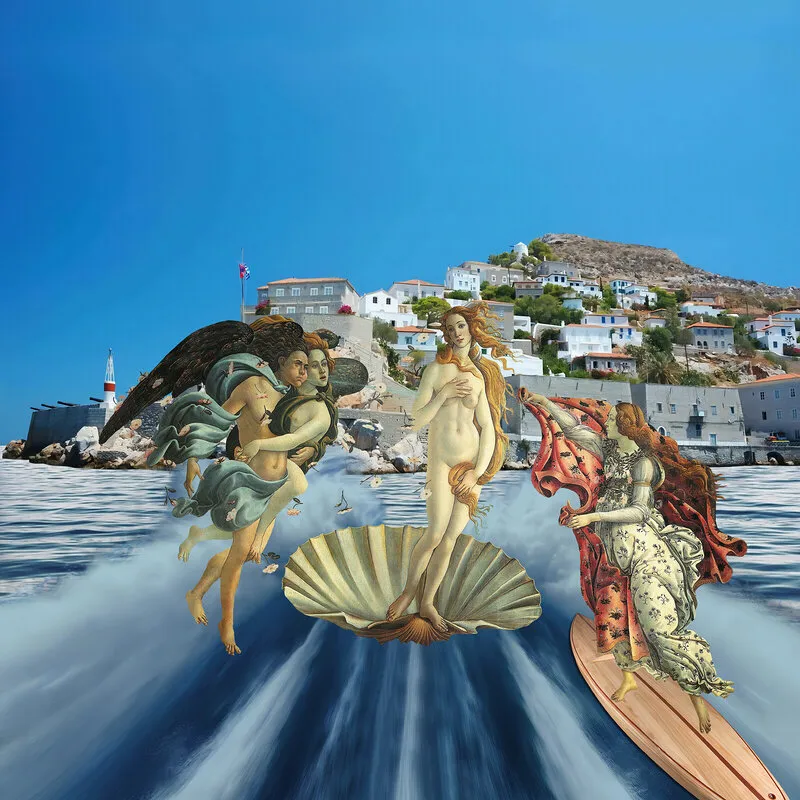
Jörgen Thornberg
Venus Reborn in Style, 2024
Digital
70 x 70 cm
Venus, our Venus,
You came like a fresh wind from the west,
Rushing into our harbour,
Reborn three millennia old,
To a world that will never be what it was.
Time stands still in eternity,
But not on Earth,
Yet your beauty remains in the image,
Forever etched in timeless art.
Giorgios had spotted her at Hydronetta, a beautiful woman sitting alone at one of the small tables by the sea. There was something about her, a mystery that seemed to transcend time, which piqued his curiosity. The drink before her was as red as the setting sun, untouched, with the ice melted, a detail that added to the enigma.
Giorgios, a former art history student who had transitioned into a reporter for Athens News, was known for his ability to uncover hidden stories. This curiosity led him to the solitary woman. The challenge was approaching her without seeming intrusive or flirtatious, a delicate balance he was determined to strike.
"Is this your favourite way to unwind after a long day? Sitting by the seaside at sunset without watching it, letting the ice melt in your glass?" he asked, leaning forward from the neighbouring table. It was a make-or-break question, impossible to answer with a simple yes or no, and combined with a polite but curious smile, it should work. And it did.
Venus: "Oh, sorry, I was lost in thought. Could you repeat the question?" Giorgios repeated it, and she began to share her feelings about a long journey. She spoke of her recent return to Hydra, where she hadn't been for a long time, and how everything felt new, overwhelming, and challenging. Her words carried a hint of vulnerability, drawing Giorgios in even more.
Giorgios introduced himself, explaining that he worked for Athens News and was generally curious about people. Something familiar about her sparked his interest, a connection he couldn't quite place. He had a rare ability to listen to his inner voice, which sometimes felt taken over by others, and right now, he felt that way as if they were both on the same wavelength.
"Venus," she introduced herself, looking through him as she extended a graceful hand adorned with an ancient-looking gold ring. The ring featured a portrait of Alexander the Great—not a modern design.
Giorgios: "You mentioned a long journey but only got as far as revisiting the Archaeological site of Mycenae. You said the stones were still upright, and the Lion Gate was a novelty with its regularly cut stones. That intrigued me because, as far as I know, they haven't stood upright since the days of Troy."
Venus: "Sorry," Venus said, embarrassed. "I misspoke. I meant... I'm unsure what I meant because it was so long ago."
Giorgios: "Your face is familiar, though we haven't met," Giorgios said, looking deeply into her eyes. "You are the Venus, the woman in Botticelli's painting. Simonetta, I believe her name was."
Venus: “Simonetta Cattaneo Vespucci.”
Giorgios: "Yes, that was her name. Have you also studied art history?"
Venus: "No, but I have met her, you could say. But she is not the one in the painting."
Giorgios: "I have learned that the model painted as Venus is Simonetta Cattaneo Vespucci. She was apparently a noblewoman from Genoa or perhaps, as many people like to believe – to underline the name's coincidence – from Porto Venere (Venus Harbour)."
Venus: "Yes, Simonetta arrived in Florence with her young husband, a distant cousin of Amerigo Vespucci, during the period when Lorenzo the Magnificent and his brother Giuliano of the Medici family rose to power."
Giorgios: "The couple joined the court life, and Simonetta's beauty became legendary in Florence, right?"
Venus: "Indeed. It seems that both Giuliano and Botticelli himself fell in love with her. In 1475, 'Giuliano's tournament' occurred in Santa Croce Square. Giuliano participated because the prize was a flag with Simonetta's portrait, which Botticelli painted. 'La Sans Pareille,' meaning 'the unequalled,' was written on the flag."
Giorgios: "Simonetta did not inspire only Botticelli's Venus but even other women painted by the artist?"
Venus: "Correct. She so inspired Botticelli that he arranged to be buried at the foot of his muse in the Florentine church of Ognissanti. However, he was not the only one captivated by the young blonde woman. Piero di Cosimo portrayed her as Cleopatra, and Lorenzo the Magnificent and Luigi Pulci wrote rhymes for her."
Giorgios: "What happened to her? She seems to have vanished into thin air."
Venus: "The young woman was a presence as stunning as she was short-lived in Florence. She died just a year after the tournament, probably due to tuberculosis."
Giorgios: "How tragic for such a beautiful girl."
Venus: "Even after her death, Botticelli continued to create artworks inspired by her. His masterpieces, Venus and Primavera, displayed at the Uffizi Gallery, were painted about ten years after Simonetta's death. Her beauty was fixed in the artist's mind, and he painted her from memory. What has been forgotten is that Botticelli also created a Venus and Summer and planned to create an autumn and winter scene, but those plans fell through. Venus and Summer, however, was completed and hung in his studio until the day he died. After that, it disappeared from history, missing from the inventory and most likely ending up with Botticelli's friend and rival, Piero di Cosimo. Both had been in love with the enigmatic Simonetta, and Piero felt he needed the painting more after his friend's death."
Giorgios: "How do you know all this?" he asked, looking puzzled.
Venus: "Because I know it's not her who is Venus in the painting. She and I look very much alike, but I am much older."
Giorgios: "So you are Venus, even if that's impossible?" He wasn't indiscreet and didn't ask how many years apart they were. A few years or two thousand.
Venus: "I am who I am and didn't need to model. I could be myself, and Botticelli painted a portrait, not an allegory."
Giorgios: "If you are the Venus in 'The Birth of Venus', who is the woman in Primavera and the supposedly lost Summer painting?"
Venus: "No idea. I wasn't even on Earth when Botticelli painted those. It could be me still. I don't have Simonetta's upturned nose but, as you see, a more classical profile." Venus pointed to her straight nose bridge.
Giorgios: "I understand nothing."
Venus: "You don't need to. We can still have a pleasant time. It took Botticelli a while, and we had a great time. He probably fell in love with me, the eternal bachelor. He was also in love with my twin, Simonetta."
Giorgios: "Did he have any success?"
Venus: "Let's not be indiscreet, and besides, I had my half-sister with me and her lover, the West Wind."
Giorgios: "Zephyrus?" he guessed, thinking that they were part of the painting and, in that case, all made sense. In a way, at least.
Venus: "That's him."
Giorgios: "Then I understand." Which he didn't at all because the whole thing was incomprehensible. "It's been a long time since you were last on Earth, Miss Venus. Not since you modelled for the Italian artist Sandro Botticelli, who wanted to depict how you were born two thousand years earlier, arriving at the shore after birth, when you had emerged from the sea fully grown."
Goddess Venus shook her long, oat-blonde hair: "Yes, it has been a while."
Giorgios: "Isn't it time for your rebirth, Miss Venus?"
Venus: "What a great idea! Half a millennium has passed, and I understand there's more to see on Hydra today. Back then, it was an abandoned island with many trees, some wild goats, but not a single human."
Giorgios: "When you were born, Hydra, as it was called then, wasn't crowded either, was it?"
Venus: "That's correct, but that was intentional. My parents, Zeus and Dione, weren't sure if it would work for me to sail in on a seashell. If it sank, Zeus didn't want any witnesses. That would have been embarrassing for the chief god himself."
Giorgios: "I can understand that. You weren't even named when you came ashore, if I'm not mistaken."
Venus: "True. After safely landing on my seashell, I was named Aphrodite. Venus, which I often use now, is what the Romans called me. Since all the paintings and sculptures bear that name, it's more practical and easier to remember. Consider my age." Venus smiled in a way that made it clear she wanted Giorgios to disagree with her.
Giorgios: "Some say that Miss Venus was born off the coast of Cythera from the foam produced by Uranus's genitals."
Venus: "Nonsense. I was born here in the strait between the island called Dokos and Hydra. Uranus was not involved, but my parents' genitalia. They made love, to put it plainly. I was a love child."
Giorgios: "Of course, you know best."
Venus: "Naturally."
Giorgios: "Among many other things, you are also the patron goddess of prostitutes, a somewhat controversial association, isn't it?"
Venus: "Yes, some sensitive souls are offended by the life I led. However, a positive aspect was that early scholars proposed the concept of 'sacred prostitution' in Greco-Roman culture, an idea which is now generally seen as erroneous. Be that as it may, people certainly took liberties in the past. The wealthy, of course. And we gods. Ordinary people neither had the time nor the means to indulge, let alone buy prostitutes."
Giorgios: "How is it that you, as a goddess, wanted to be associated with prostitution? You did not need to sell your services, Miss Venus?"
Venus, somewhat indignantly: "Certainly not. Men lined up to bed me. However, I was often already lying down. Today, I would be called hypersexual, a nymphomaniac, and probably labelled with some abbreviation. I simply enjoyed sex. Besides, I had a lot to live up to as the goddess associated with love, lust, beauty, pleasure, passion, procreation, desire, sex, fertility, and prosperity."
Giorgios, smiling: "Yes, the list is long, but no holds barred, one could say."
Venus: "My main festival was the Aphrodisia, celebrated annually in midsummer. It was quite an event, to say the least."
Giorgios: "I can imagine. So, it would be fitting to be reborn on Hydra just in time for Miaoulia, the festival which is also in midsummer. The Hydriots are in a festive mood, and people come from all over the world. The fireworks are worthy of a goddess."
Venus: "Great idea! I'll take it."
Giorgios: "Now that you're here, Miss Venus. Was there something special that drew you to Earth after such a long time?"
Venus: "One of my many boyfriends, Ares, the god of war, had some business on Earth and convinced me to come along. I initially thought of saying no, but when he pointed out that the event he was attending was related to me, I allowed myself to be persuaded."
Giorgios: "Exciting! May I ask what event that was?"
Giorgios: "Absolutely! A few weeks ago, by earthly time, it was exactly 3,200 years since the Trojan War broke out. And indeed, you had a role in that conflict."
Venus: "Aha! So long ago. Time certainly flies. Ares was your boyfriend even three thousand years ago, wasn't he?"
Venus: "I can't deny it, but he was one of the few where I was caught red-handed. I was caught in the middle of the act of adultery with Ares. It was a major scandal. He is a good lover who has lasted more than three millennia. Not many can claim that." Venus laughed heartily.
Giorgios: "The Trojan War! Please tell our readers about it and your role."
Venus: "Ok. But just briefly. This legendary conflict in Greek mythology took place between 1184 and 1176 BC. The Achaeans (Greeks) waged war against the city of Troy after Paris took Helen from her husband, Menelaus, king of Sparta. The war is one of the most important events in Greek mythology, and it has been narrated through many works of Greek literature, most notably Homer's Iliad. Along with Athena and Hera, I was one of the three goddesses whose feud resulted in the beginning of the Trojan War, and I played a major role throughout the Iliad. Odysseus, one of the war's heroes, was my lover for a while." Venus sighed dreamily.
Giorgios: "Along with Athena and Hera, you were one of the three goddesses whose feud resulted in the beginning of the Trojan War, and you played a major role throughout the Iliad, right?"
Venus: "Yes, it started as a trivial matter that got out of hand. I promised Paris, the prince of Troy, the most beautiful woman in the world, which led to Paris abducting Helen from Sparta. That was unnecessary and had nothing to do with my promise. I actually meant myself because Paris was an attractive man. His abduction, not me, triggered the war between Troy and the Greek states where Odysseus participated. Every cloud has a silver lining," Venus said, looking dreamily towards outer Space, hidden by the blue sky.
Giorgios: "The good thing, was it Odysseus?" asked Giorgios with a big dirty smile. Perhaps the goddess was hiding some historical secret he could reveal to the readers. What a scoop that would be.
Venus: "Yes. We were together for a while but didn't part as friends. When the war was over, the scoundrel left without properly saying goodbye. In the end, Odysseus was more interested in his wife Penelope and his kingdom than in me, a goddess and the most beautiful woman in the known world." Evidently, the scars of being disregarded for a mortal wife remained three millennia later.
Giorgios: "So it was you who tried to prevent him from returning home?" He sensed the scoop was near. What a story it would be to disprove Homer.
Venus: "I don't want to exaggerate my role, but yes, I was involved. All of Olympus knows that. So does Odysseus. The ten long years it took for Odysseus to get home was due to a combination of factors, including his own actions, my and other gods' involvement, and the various dangers he encountered along the way. You've probably heard of them ad nauseam, but just in case, I'll summarise briefly." Venus traced a list in the air.
Venus: "First was my sabotage. I had the ships' keels impregnated with a special substance that nourishes seaweed, moss, algae, and barnacles. The ships were on land while fighting, making them easy to access. Applying this colourless fluid now and then over the years made their boats irresistible to sea creatures. No matter how much they scraped, they could only remove the mess for short periods. As soon as the ships hit the water, it started growing again. Imagine a boat with a lawn underneath. It doesn't go fast, I promise you." Venus laughed so hard she almost cried.
Venus: "One of the main reasons for Odysseus's long journey was that he angered Poseidon by blinding his son, the cyclops Polyphemus. Poseidon did everything he could to prevent Odysseus from reaching home.
During his journey, Odysseus faced many dangers, such as the sirens' song, Scylla and Charybdis, and the sacred cattle of the sun god Helios, which extended his voyage. The tampered sea charts I slipped into Odysseus's supplies added to the trouble," she said maliciously.
Venus: "The wine they brought came from my vineyards and was well-prepared. Odysseus and his crew lost their way several times, either blown off course by storms or making poor decisions under the influence of the wine, leading them to dangerous places." Venus laughed again.
Venus: "The delays with Circe and Calypso added to the time. It was no accident that Odysseus ended up with them. Their islands were marked on my charts as homes of peaceful hermits and lush islands with plenty of fresh water and no threat at all. Quite the opposite." She smiled slyly.
Venus: "The horny Odysseus spent a year with Circe, the sorceress who turned his men into pigs before she tired of his sex and helped him on. He also spent seven years on the island of Ogygia with the nymph Calypso, who kept him as a sex slave until I and other gods ordered her to let him go. I wasn't about to let her have what I couldn't."
Giorgios: "A lot of sex!" It was hard to tell if he was jealous or just looking for a sensation.
Venus: "Those who have read the ancient texts and ogled the frescoes, vases, and mosaics in museums know that's what we were up to. Most of the time. Those were the days. End of story!"
Giorgios: "As Venus, you were highly regarded in Rome as well," he said ingratiatingly, realising that this kind of flattery drove Venus. All narcissists love to be praised, whether genuine or false.
Venus: "Yes. In Roman mythology, I was the ancestor of the Roman people through my son, Aeneas, who survived the fall of Troy and fled to Italy. Julius Caesar claimed me as his ancestor. Besides everything else, I was their goddess of victory in battle and motherhood, two extremes perhaps, but in a strange way connected."
Giorgios: "Motherhood and prostitution," Giorgios tasted the words. "But didn't you have any man you truly loved among all your lovers?"
Venus: "Yes, there was one. Adonis. Adonis and I fell passionately in love and stayed together until death tore us apart. Our myth was a story of beauty born through sinful incest and of love turning into a tragedy, as Ovid described it."
Giorgios: "That sounds intense!" Jotting down more notes. It had already filled many pages.
Venus: "I belonged to Olympus's inner circle and was one of the twelve gods on the mountain. As the goddess of love, beauty, and procreation, I was the most beautiful among the gods and was almost always followed by Cupid (Eros). I maintained a series of romances with Greek gods; the most famous might be my marriage with Vulcan and my affair with Mars. Nevertheless, none of these love stories surpassed the intensity with which I loved Adonis."
Giorgios: "My readers love romances with celebrities; you certainly qualify."
Venus: "Adonis was the son of Myrrha and Cynyras, Cypriot deities. The cult of Adonis in Greece after our affair became firmly linked with mine. But I can reveal that Adonis was not Cypriot at all but Jewish. His true origin was Semitic, and his name was the Semitic title 'Adon,' meaning '(my) lord.'"
Giorgios: "Another scoop," thought the Giorgios, not yet realising that Time-Travellers read minds and his thoughts were sometimes too quick.
Venus: "Be my guest," said Venus with a sly smile. "The Canaanite god Adon was just like Adonis, a god of beauty," continued Venus. "Adon moved to Greece with a Hellenized name. There are also links between Adonis and gods from other civilisations like Osiris in Egypt, Baal in Ugarit, and Tammuz in Babylon. Civilisations from Mesopotamia to Greece all adored gods of beauty with myths similar to Adonis. On top of that, in Mesopotamian mythologies, Adonis appeared as a couple with the goddess Astarte, who was none other than me, 1700 years before I became Venus. My alter egos had much in common, such as being goddesses of fertility and renewal." Venus paused dramatically before continuing. "You'll get another scoop."
Giorgios: "Oh, great! I'm all ears," he said, sounding a bit flustered, feeling seen through.
Venus: "Can you imagine Adonis's father was also his grandfather? His mother, Myrrha, was in love with her father and fantasised about having sex with him. But fear of his reaction held her back. She had flirted with him and dressed provocatively in his presence, but he never noticed. Not even a lustful glance. He only saw her as his daughter, nothing more. Myrrha attempted to commit suicide, but as she was about to take her life, her lady-in-waiting entered the room and stopped her. Myrrha then confessed her unnatural love and proclaimed that the only way she could bear to live was to be with her father. Reluctantly, the lady-in-waiting agreed to help make this unholy union happen as long as Myrrha promised not to commit suicide."
Giorgios: "What a gruesome story, her own flesh and blood," said the Giorgios. "But surely nothing happened?"
Venus: "Oh, it did. During the festival of Ceres, the married women of Cyprus were not allowed to see their husbands for nine days. Myrrha's father, Cinyras's bed, was empty as his wife participated in the celebrations. The lady-in-waiting saw an opportunity. She approached Cinyras and told him of a woman who truly loved him. She made up a fake name, and when the king asked how old the girl was, the lady-in-waiting replied, 'As old as Myrrha.' Like many mature men, Cinyras thought being with a young woman would restore his youth, so he agreed."
Giorgios: "What can one say?"
Venus: "Nothing, because I'm telling the story," said Venus sharply. "The lady-in-waiting arranged for Myrrha to meet her father in absolute darkness, telling him the girl was shy.
The affair lasted only a few days until Cinyras, driven by curiosity about his lover's identity, took a lamp and discovered that the young girl was Myrrha. In a fit of rage, he immediately reached for his sword, intending to kill his daughter. However, Myrrha fled, escaping her father's wrath. She lived in exile for nine months, journeying until she reached Sabaea in the Arabian Peninsula. Myrrha had travelled thousands of miles to evade the consequences of her sin, but she could not escape the overwhelming guilt. Exhausted, pregnant, and terrified, she prayed to the gods for mercy. In response, the gods transformed her into a tree known as the myrrh tree."
Giorgios: "It was good that she could feel shame," said Giorgios sanctimoniously. He had made out with his sister in his teens, and if their parents hadn't come home, it might have gone further.
Venus: "Although Myrrha had been transformed into a tree, her unborn child remained inside her. Assuming the role of Lucina, the protectress of childbirth, Juno found the tree and helped bring forth a boy from the wooden womb. The Naiad nymphs then bathed the boy with the tears (myrrh) that Myrrha had shed during childbirth. Her child was Adonis, destined to be one of the most beautiful mortals ever to walk the Earth. It is quite striking that the result of one of mythology's most haunting incestuous unions was such a beautiful and perfect being." Venus had a tear in her eye, moved by the story she was telling.
Giorgios: "What a tragic story and the spice Christ received when he lay in his manger. What symbolism? Excuse me for a brief question. Is Juno the same as Hera, Zeus's wife? In other words, your mother."
Venus: "In principle, yes, though the Romans complicated things by making Juno both Jupiter's sister and wife. Incest, in other words. Regarding Christ's spice, that might be a bit far-fetched, but my union with Adonis is closer. Many years later, when Adonis had grown into the most beautiful man on Earth, he fell into the hands of Persephone, goddess of the underworld and a real man-eater. But he was mine! That witch!"
Giorgios: "Did you tell her that?" asked Giorgios provocatively.
Venus: "You bet I did!" Venus nearly shouted. "When I saw Adonis for the first time as a young boy, I was amazed by his beauty. He was mine, and I decided to hide him from the rest of the goddesses. I entrusted him to Persephone, whom I never saw as a rival. As Hades' wife, I thought she was preoccupied with the dead and uninterested in living boy candy. But oh, how wrong I was. She looked after the boy for years, but when he grew older and became increasingly attractive, Persephone fell in love with him, and they became lovers. I saw it happen but had promised my father, Zeus, to stay back no matter how painful it was. I consoled myself with Cupid, an eternal sweet sixteen."
Giorgios: "Child-snatching," said Giorgios indignantly, but acceptable in many countries.
Venus: "One evening, I was kissing Cupid when an arrow slipped from his quiver and injured my breast," Venus continued, ignoring Giorgios's double standards. "As is known, Cupid's arrows had the power to make people fall in love, and gods were no exception. When I got hit by the arrow, I saw Adonis passing by. From that moment, I fell madly in love with him. I abandoned my previous promiscuous life and all my lovers to completely devote myself to live in the woods with Adonis as man and wife."
Giorgios: "Didn't the old underworld hag get upset?" asked Giorgios indelicately. Persephone and Venus were the same age.
Venus: "It was inevitable," said Venus, avoiding commenting on his remark about age. She was only slightly younger than Persephone, around 4,000 years old, if you include her time as a goddess in Mesopotamia. "A conflict arose between Persephone and me, who refused to turn over Adonis. Our father Zeus intervened and ruled that Adonis should spend four months a year with Persephone in Hades, the Underworld, then four months with me, and the remaining four months however he wished. Because Adonis was so taken with my charm, he devoted his free four months to me, and Persephone was so angry that she told Adonis to go to hell. Thus, he became mine entirely."
Giorgios: “What luck. Then peace was restored in Zeus's family." For being a reporter, he was unusually naive. He should have realised that gods are like women, unforgiving and vengeful.
Venus: "You think! Persephone and I haven't spoken since that day." Venus snapped her neck before continuing with a more sorrowful tone. "Adonis was not only a great lover but also well-known for his hunting skills. During one of our hunting journeys in the Afqa Forest (near Byblos in today's Lebanon), Adonis was attacked by a wild boar. He started bleeding profusely in my arms; I poured my magical nectar on his wounds in vain. Within minutes, he was gone. Although Adonis died, the blood mixed with my nectar and flowed onto the soil where a flower sprouted from the ground, its scent the same as my nectar and the colour of Adonis' blood – the Anemone flower. The blood reached the river and coloured the water red. The river became known as the 'Adonis River' in the Lebanese village of Afqa - today insensitively renamed River Abraham as a nod to one of the patriarchs shared by all the Abrahamic religions, Judaism, Christianity, and Islam.
Giorgios: "I truly regret your loss, even if it happened so long ago." He didn't know where to place his sympathetic gaze.
Venus: "The Adonis River runs from Mount Lebanon and flows into the sea," Venus continued to distract from what could have been. "It loses its bluish colour once a year and takes on a bloody red hue, pouring into the Mediterranean and dyeing a large part of the riverbanks red – a sign to the people of Byblos to start their time of mourning. It is believed that it was at this time of year that Adonis was wounded in Lebanon, and his blood went to the riverbed. One of the reasons why the river turns red at this time of the year is the strong wind blowing soil into the river. The soil of Lebanon and this region, in particular, is known for its red colour, and the river turns purple when mixed with the soil," finished Venus, significantly calmer.
Venus: "Remnants of Adonis worship are still present today among some nations of the Levant, Mesopotamia, and even Persia/Iran, where it is manifested as part of spring folklore celebrations, like the Feast of Nauroz. So, it could be worth celebrating me, too, to let me be reborn on this island. The question is how I can arrive in style, for a goddess like me cannot simply show up like any female tourist returning from a swim."
Giorgios: "I think I have an idea," said the Giorgios. "If you can bring in the wind god Zephyrus and the goddess of Spring who accompanied you last time."
Venus: "One part is no problem. Zephyrus is on Earth quite often because he has to keep an eye on his western winds. He and the other winds take turns watching. Lucky for you earthlings, otherwise, it would blow any which way. He might already be here to blow away spring and make way for summer. You know that Zephyrus is the herald of spring. He doesn't live far away in the Milky Way and will be here in a few days as soon as I have contacted him and told him I want to be reborn."
Giorgios: "Perfect, but what is the problem then?"
Venus: "They are a couple, you see. He and my sister."
Giorgios: “Persephone!?”
Venus: "Yes, she is Spring and is in Botticelli's painting, my Lady in Waiting," said Venus gloomily.
Giorgios: "I thought you said you hadn't spoken since before Christ." Giorgios rolled his eyes.
Venus: "We haven't."
Giorgios: "But you're in the same painting."
Venus: "When you sit for a painting, you can keep silent, and that's what we did. Plus, you don't have to sit there all the time. The painting took over a year to complete, and when you eat and drink, you keep quiet, so it worked out. If something important came up, we could communicate through Botticelli or his wife. Or read each other's thoughts."
Giorgios: "Then do the same this time. You can talk through me if she agrees."
Venus: "Of course she will. Persephone is a real camera hog. She's not depicted as often as I am and grabs every opportunity. In pictures, it's the only time she's as big as me, size 38. But only on the outside, so don't be mistaken."
Giorgios: "Then it's settled," relieved as the scoops lined up. Having exclusive rights to Venus's rebirth had to be the most significant thing since man landed on the moon, and then no one had exclusive rights.
Venus: "Yes, I guess it is," sighed Venus. "Then we just need to find a large enough seashell."
Giorgios: "So you can float gracefully into Hydra's harbour driven by Zephyrus's breath." Giorgios was a true romantic.
Venus: "Gracefully! You must be joking! There will be a rush and excitement, and I plan to surge into the harbour like a minor tsunami. That's what I call worthy. I must show that it's not a weak old hag coming but a goddess in her prime, still the most beautiful on both Earth and in Space. So, the last word is mine, as it belongs to the woman who has survived all times and is found both in the Louvre and in Florence."

Jörgen Thornberg
Malmö
Lite om bilder och mig. Translation in English at the end.
Jag är en nyfiken person som ser allt i bilder, även det jag fäster i ord, gärna tillsammans för bakom alla mina bilder finns en berättelse. Till vissa bilder hör en kortare eller längre novell som följer med bilden.
Bilder berättar historier. Jag omges av naturlig skönhet, intressanta människor och historia var jag än går. Jag använder min kamera för att dokumentera världen och blanda det jag ser med vad jag känner för att fånga den dolda magin.
Mina bilder berättar mina historier. Genom mina bilder, tryck och berättelser. Jag bjuder in dig att ta del av dessa berättelser, in i ditt liv och hem och dela min mycket personliga syn på vår värld. Mer än vad ögat ser. Jag tänker i bilder, drömmer och skriver och pratar om dem; följaktligen måste jag också skapa bilder. De blir vad jag ser, inte nödvändigtvis begränsade till verkligheten. Det finns en bild runt varje hörn. Jag hoppas att du kommer att se vad jag såg och gilla det.
Jag är också en skrivande person och till många bilder hör en kortare eller längre essay. Den följer med tavlan, tryckt på fint papper och med en personlig hälsning från mig.
Flertalet bilder startar sin resa i min kamera. Enkelt förklarat beskriver jag bilden jag ser i mitt inre, upplevd eller fantiserad. Bilden uppstår inom mig redan innan jag fått okularet till ögat. På bråkdelen av ett ögonblick ser jag vad jag vill ha och vad som kan göras med bilden. Här skall jag stoppa in en giraff, stålmannen, Titanic eller vad det är min fantasi finner ut. Ännu märkligare är att jag kommer ihåg minnesbilden långt efteråt när det blir tid att skapa verket. Om jag lyckas eller inte, är upp till betraktaren, oftast präglat av en stråk av svart humor – meningen är att man skall bli underhållen. Mina bilder blir ofta en snackis där de hänger.
Jag föredrar bilder som förmedlar ett budskap i flera lager. Vid första anblicken fylld av feel-good, en vacker utsikt, fint väder, solen skiner, blommor på ängen eller vattnet som ligger förrädiskt spegelblankt. I en sådan bild kan jag gömma min egentliga berättelse, mitt förakt för förtryckare och våldsverkare, rasister och fördomsfulla människor - ett gärna återkommande motiv mer eller mindre dolt i det vackra motivet. Jag försöker förena dem i ett gemensamt narrativ.
Bild och formgivning har löpt som en röd tråd genom livet. Fotokonst känns som en värdig final som jag gärna delar med mig.
Min genre är vid som framgår av mina bilder, temat en blandning av pop- och gatukonst i kollage som kan bestå av hundratals lager. Vissa bilder kan ta veckor, andra någon dag innan det är dags att överlämna resultatet till printverkstaden. Fine Art Prints är digitala fotocollage. I dessa kollage sker rivandet, klippandet, pusslandet, målandet, ritandet och sprayningen digitalt. Det jag monterar in kan vara hundratals år gamla bilder som jag omsorgsfullt frilägger så att de ser ut att vara en del av tavlan men också bilder skapade av mig själv efter min egen fantasi. Därefter besöks printstudion och för vissa bilder numrera en limiterad upplaga (oftast 7 exemplar) och signera för hand. Vissa bilder kan köpas i olika format. Det är bara att fråga efter vilka. Gillar man en bild som är 70x100 men inte har plats på väggen, går den kanske att få i 50x70 cm istället. Frågan är fri.
Metoden Giclée eller Fine Art Print som det också kallas är det moderna sättet för framställning av grafisk konst. Villkoret för denna typ av utskrifter är att en högkvalitativ storformatskrivare används med åldersbeständigt färgpigment och konstnärspapper eller i förekommande fall på duk. Pappret som används möter de krav på livslängd som ställs av museer och gallerier. Normalt säljer jag mina bilder oinramade så att den nya ägaren själv kan bestämma hur de skall se ut, med eller utan passepartout färg på ram, med eller utan glas etc..
Under många år ställde jag bara ut på nätet, i valda grupper och på min egen Facebooksida - https://www.facebook.com/jorgen.thornberg.9
Jag finns också på en egen hemsida som tyvärr inte alltid är uppdaterad – https://www.jth.life/ Där kan du också läsa en del av de berättelser som följer med bilden.
UTSTÄLLNINGAR
Luftkastellet, oktober 2022
Konst i Lund, november 2022
Luftkastellet, mars 2023
Engleson Galleri Caroli, april 2023
Hydra, Greece June 2023
Engleson Galleri Caroli, oktober 2023
Toppen, Höllviken december 2023
Luftkastellet, mars 2024
Torups Galleri, mars 2024
Venice, May 2024
Luftkastellet, oktober 2024
Konst i Advent, December 2024
Galleri Engleson, Caroli December 2024
Jäger & Jansson Galleri, april 2025
A bit about pictures and me.
I'm a curious person who sees everything in pictures, even what I express in words, often combining them, for behind all my pictures lies a story. These narratives, some as short as a single image and others as long as a novel, are the heart and soul of my work.
Pictures tell stories. Wherever I go, I'm surrounded by natural beauty, exciting people, and history. I use my camera to document the world and blend what I see with what I feel to capture the hidden magic.
My images tell my stories. Through my pictures, prints, and narratives, I invite you to partake in these stories in your life and home and share my deeply personal perspective of our world. More than meets the eye. I think in pictures, dream, write, and talk about them; consequently, I must create images too. They become what I see, not necessarily confined to reality. There's a picture around every corner. I hope you'll see what I saw and enjoy it.
I'm also a writer, and many images come with a shorter or longer essay. It accompanies the painting, printed on fine paper with my personal greeting.
Many pictures start their journey on my camera. Simply put, I describe the image I see in my mind, experienced or imagined. The image arises within me even before I bring the eyepiece to my eye. In a fraction of a moment, I see what I want and what can be done with the picture. Here, I'll insert a giraffe, Superman, the Titanic, or whatever my imagination conjures up. Even stranger is that I remember the mental image long after it's time to create the work. Whether I succeed is up to the observer, often imbued with a streak of black humour – the aim is to entertain. My pictures usually become a talking point wherever they hang.
I prefer pictures that convey a message in multiple layers. At first glance, they're filled with feel-good vibes, a beautiful view, lovely weather, the sun shining, flowers in the meadow, or the water lying deceptively calm. But beneath this surface beauty, I often conceal a deeper story, a narrative that challenges societal norms or explores the human condition. I invite you to delve into these hidden narratives and discover the layers of meaning within my work.
Picture and design have been a thread running through my life. Photographic art feels like a fitting finale, and I'm happy to share it.
My genre is varied, as seen in my pictures; the theme is a blend of pop and street art in collages that can consist of hundreds of layers. Some images can take weeks, others just a day before it's time to hand over the result to the print workshop. Fine Art Prints are digital photo collages. In these collages, tearing, cutting, puzzling, painting, drawing, and spraying happen digitally. What I insert can be images hundreds of years old that I carefully extract so they appear to be part of the painting, but also images created by myself, now also generated from my imagination. Next, visit the print studio and, for certain images, number a limited edition (usually 7 copies) and sign them by hand. Some images may be available in other formats. Just ask which ones. If you like an image that's 70x100 but doesn't have space on the wall, you might be able to get it in 50x70 cm instead. The question is open.
The Giclée method, or Fine Art Print as it's also called, is the modern way of producing graphic art. This method ensures the highest quality and longevity of the artwork, using a high-quality large-format printer with archival pigment inks and artist paper or, in some cases, canvas. The paper used meets the longevity requirements set by museums and galleries. I sell my pictures unframed, allowing the new owner to personalise their artwork, confident in the lasting value and quality of the piece.
For many years, I only exhibited online, in selected groups, and on my Facebook page - https://www.facebook.com/jorgen.thornberg.9. I also have my website, which unfortunately is not constantly updated - https://www.jth.life/. You can also read some of the stories accompanying the pictures there.
EXHIBITIONS
Luftkastellet, October 2022
Art in Lund, November 2022
Luftkastellet, March 2023
Engleson Gallery Caroli, April 2023
Hydra, Greece June 2023
Engleson Gallery Caroli, October 2023
Toppen, Höllviken December 2023
Luftkastellet, March 2024
Torup Gallery, March 2024
Venice, May 2024
UTSTÄLLNINGAR
Luftkastellet, oktober 2022
Konst i Lund, november 2022
Luftkastellet, mars 2023
Engleson Galleri Caroli, april 2023
Hydra, Greece June 2023
Engleson Galleri Caroli, oktober 2023
Toppen, Höllviken december 2023
Luftkastellet, mars 2024
Torups Galleri, mars 2024
Venice, May 2024
Luftkastellet, October 2024
Konst i Advent, December 2024
Galleri Engleson, Caroli December 2024
Jäger & Jansson Galleri, April 2025
Utbildning
Autodidakt
Medlem i konstnärsförening
Öppna Sinnen
Med i konstrunda
Konstrundan i Skåne
Utställningar
Luftkastellet, October 2022
Art in Lund, November 2022
Luftkastellet, March 2023
Engleson Gallery Caroli, April 2023
Hydra, Greece June 2023
Engleson Gallery Caroli, October 2023
Toppen, Höllviken December 2023
Luftkastellet, March 2024
Torup Gallery, March 2024
Venice, May 2024