Vi använder cookies för att ge dig bästa möjliga upplevelse. Välj vilka cookies du tillåter.
Läs mer i vår integritetspolicy
Jörgen Thornberg
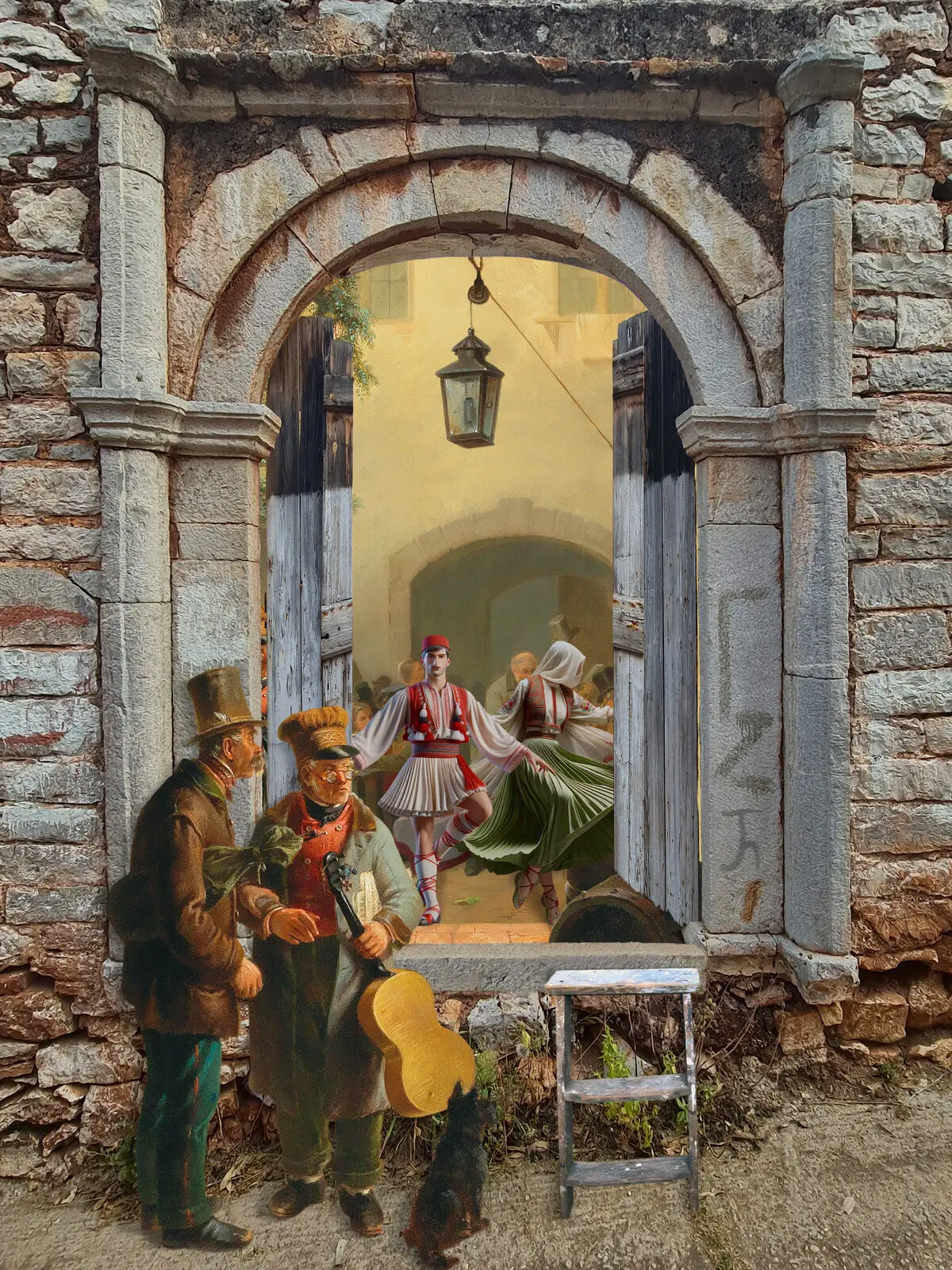
A hundred years too late. Party at the Admiral's Mansion, 2023
Digital
50 x 70 cm
In the grand mansion above Hydra's shore,
Young Antonios Kriezis and his bride, they adore,
Dancing a lively Sousta, their spirits soar,
In each step, their youth and passion restore.
Kyriakoula, his love, with grace and delight,
Joins him in dance under the moon's gentle light,
Their home echoes joy; their hearts take flight,
While his ships rest in the harbour, gleaming bright.
A merchant of renown, Antonios commands,
Trading with the world, wealth flows from his hands,
But soon the call to freedom, on Greece he stands,
To liberate from the Turk with his valiant bands.
Hero of the seas, admiral bold and true,
Antonios fights fiercely, his courage in view,
With Kyriakoula beside him, their love renews,
As they danced through the years, their family grew.
Their mansion, a beacon of joy and grace,
Hosts laughter and guests filling the space,
Antonios wild dances, setting the pace,
From sunrise to sunset, their love they embrace.
Time makes him Prime Minister, leading with pride,
Yet, in their home on Hydra, they both reside,
With sunsets over Kamini, where beauty abides,
Their dances continue in the ebbing tide.
As Time-Travellers now, through memories, they roam,
In the ruins of their mansion, their eternal home,
Music still plays, where their spirits are known,
And outside the gate, eager feet find their own.
In the picture, Hydra's hero Antonios Kriezis is dancing a lively Sousta with his wife to celebrate their wedding one hundred and ninety years earlier. It was a grand celebration. He was a war hero and admiral, and Kyriakoula, the daughter of the Bey of Hydra, Georgios Voulgaris, so all Hydra and half of Greece were indeed there. As the poem describes, once a symbol of their grandeur, the mansion is now a ruin with empty, gaping windows. The decay of the mansion, a process I have witnessed over the past twenty-five years, is a stark reminder of the passage of time and the transience of human achievements. Since the roof collapsed about ten years ago, the process has accelerated, leaving behind only memories of the grand parties and the vibrant life that once filled its halls. On my early morning walks, I have occasionally encountered the admiral sitting on a stone bench across from Vlychos Road, sadly observing the ruin. He constantly hums 'Miserlou,' an ancient, sorrowful tune. He explained that the name in Greek means 'Egyptian girl' or 'Egyptian woman.' He believed the song originated in the Greek and Levantine communities in the Mediterranean. The melody is melancholy, and the slow, enchanting rhythm conveys longing and nostalgia. In Greek culture, 'Miserlou' is often associated with loss and separation, and the old admiral missed his house and all the beautiful parties he and his wife had over the years.
The admiral's wife, Kyriakoula Kriezi, was a woman of elegance and grace, known for her exquisite taste in fashion and her role as a lady-in-waiting to Queen Amalia. Her love for dance was not just a hobby but a reflection of her vibrant spirit, a spirit that continued to live on even after she departed from this world. In a touching tribute to her, their descendants learned the new dance, Sirtaki, which she never had the chance to experience. This dance, now a cherished part of their family's traditions, is a testament to the enduring power of love and the role of dance in preserving memories and traditions. This dance keeps her spirit alive in their hearts like the memories of their vibrant parties and shared moments.
Outside the mansion, a couple of wandering musicians, a common sight in those days, arrived a little too late. Inside the gate, a dozen musicians were already in full swing, their music, the crisp, ringing sound of steel strings, flowing out over the area. The bouzouki's sound was unmistakable, whether a slow, mournful solo or a lively dance tune. The sweet dog, a loyal companion of the indeterminate breed they had brought with them, probably suffered even more. The enticing aromas of all the food served inside were a veritable torment to his nose. When the Kriezis hosted a party, nothing was lacking, not even for dogs and cats. The atmosphere was filled with laughter, music, and the clinking of glasses, a testament to the couple's love for life and generosity. These parties were a true reflection of their vibrant spirits and desire to share their joy with others.
Like the admiral and his wife, we have all danced the Sirtaki throughout our lives. Sirtaki, a dance that transcends borders and evokes the essence of Greece, has a rhythm that can stir even the most stony-hearted. It speaks to the soul and manifests joy, sorrow, triumph, despair, resilience, and defiance. Sirtaki is not just a dance but a symbol of Greek identity. It is a cultural touchstone that has helped the Greek people preserve their heritage through centuries of adversity, resonating with our own experiences of joy, sorrow, and resilience. Its universal appeal invites us all, regardless of our cultural background, to celebrate Greek culture.
Origins and Evolution
Sirtaki is often mistaken for an ancient Greek dance, but its origins are relatively modern. The dance was created for the 1964 film 'Zorba the Greek', choreographed by Giorgos Provias. Its name derives from the word "syrtos," a common name for a group of traditional Greek dances. Sirtaki combines slow and fast versions of the hasapiko dance, creating a compelling crescendo that captures the audience's spirit.
Greek folk music, however, has deep roots that stretch back to ancient times. The Greeks have always used music to express their deepest emotions and experiences. Instruments like the lyre and the aulos were integral to Greek culture and used in ceremonies and everyday entertainment.
Turkish Occupation and Cultural Preservation
Greece was under Ottoman rule from the mid-15th Century until the early 19th Century. This period was marked by significant hardship and oppression, yet the Greeks found ways to keep their culture alive. Music and dance, as the most vibrant and expressive forms of cultural heritage, played crucial roles in this cultural resilience. Despite the restrictions and the risk of punishment, the Greeks clandestinely celebrated their traditions through songs and dances, passing down their history and identity through generations. This underscores the vital role of music and dance in preserving our cultural heritage, a testament to the resilience and spirit of the Greek people.
Folk songs, known as "dimotika tragoudia," became a means of covert resistance. They told stories of heroism and lamented the loss of freedom. These songs kept the spirit of Hellenism alive, reminding the Greeks of their glorious past and fuelling their desire for liberation.
The Greek War of Independence
The Greek War of Independence began in 1821 and was pivotal in Greek history. Music was a significant source of inspiration and morale for the revolutionaries. Songs like 'Thourios' by Rigas Feraios became anthems of freedom, rallying the people to fight against the Ottoman Empire. Dance, too, played its part. Traditional dances, such as the rebetiko and kalamatas, were performed to boost the fighters' morale and celebrate victories. Sirtaki, with its lively rhythm and expressive movements, became a symbol of the Greeks' determination to regain their freedom and a testament to the resilience and spirit of the Greek people.
Dance, too, played its part in the Greek War of Independence. Traditional dances, such as the rebetiko and kalamatas, were not just physical expressions; they were acts of defiance, showcasing a culture that refused to be suppressed. These dances were performed to boost the fighters' morale and celebrate victories, a powerful reminder of the Greeks' determination to regain their freedom.
The 20th Century brought new challenges for Greece, including the Asia Minor Catastrophe, World War II, and the Greek Civil War. These events led to significant Greek emigration, creating a vast diaspora. Greek communities around the world used music and dance to maintain their connection to their homeland. Music and dance, with their ability to evoke strong emotions and convey cultural messages, became powerful tools in preserving Greek identity and fostering a sense of unity among the diaspora.
Sirtaki, with its dramatic flair and deep emotional resonance, became more than a dance; it became a bridge between Greece and its diaspora. The dance was simple enough for anyone to learn but powerful enough to convey profound cultural messages. It became a staple at Greek festivals and celebrations worldwide, allowing Greeks to express their identity and unity no matter where they lived. For the Greek diaspora, Sirtaki is a nostalgic reminder of their homeland, a symbol of their enduring connection to Greece, and a crucial tool in preserving the Greek identity. This celebration of our cultural heritage through music and dance inspires us all with its enduring power and longevity.
Mikis Theodorakis and 'Zorba the Greek'
Mikis Theodorakis, one of Greece's most iconic composers, played a pivotal role in popularising Greek music internationally. His score for Zorba the Greek brought the sounds of Greece to a global audience, showcasing the emotional depth and cultural significance of Greek folk music. The film, based on the novel by Nikos Kazantzakis, tells the story of an English writer who finds a new zest for life in Crete under the influence of the irrepressible Alexis Zorba.
The climax of the film, featuring the now-famous Sirtaki dance on the beach, is a cinematic tour de force. The scene, set against the backdrop of the azure sea and the golden sand, captures the essence of Greek culture and the spirit of the dance. Anthony Quinn's portrayal of Zorba, dancing with unrestrained joy and abandon, captivated audiences worldwide. The scene encapsulates the Greek spirit—resilient, passionate, and eternally optimistic- and the dance, with its lively rhythm and expressive movements, symbolises Greek cultural heritage.
Theodorakis's music resonated deeply with audiences, blending traditional Greek melodies with modern orchestration. It introduced the world to the beauty of Greek folk music, highlighting its emotional depth and cultural significance. His compositions, filled with passion and nostalgia, became a testament to Greece's rich cultural heritage, evoking a sense of pride and appreciation in listeners.
Resistance Against the Junta
Theodorakis's influence extended beyond the silver screen. His music symbolised resistance during the military junta that ruled Greece from 1967 to 1974. The junta banned his work, but Greeks continued to play and sing his songs in defiance. Music, once again, became a weapon against oppression, uniting people in their struggle for democracy. Songs like 'To Yelasto Paidi' and 'Antigonides' became anthems of resistance, their powerful lyrics and melodies inspiring hope and resilience and reminding the Greek people of their shared heritage and aspirations.
Songs like "To Yelasto Paidi" and "Antigonides" became anthems of resistance, their powerful lyrics and melodies inspiring hope and resilience. Theodorakis himself was imprisoned and exiled, but his music continued to resonate, rallying the Greek people and reminding them of their shared heritage and aspirations.
Greek Music and Identity
Greek music, with its rich tapestry of influences and styles, is a testament to the resilience and creativity of the Greek people. From the ancient lyre to the bouzouki, from dimotika tragoudia to rebetiko, Greek music has always been a vital part of the country's cultural identity. This enduring creativity and resilience in the face of adversity is truly inspiring.
Sirtaki, as a modern expression of this tradition, embodies the spirit of Greece. It is a dance that everyone can participate in, symbolising unity and communal joy. The gradual build-up from slow, measured steps to a wild, exuberant finale mirrors the Greek experience—marked by struggles but ultimately triumphant.
The Global Impact
Today, Greek music and dance continue to captivate audiences worldwide. With their lively music, vibrant dances, and delicious food, Greek festivals attract people from all walks of life. Sirtaki is often the highlight, with everyone, Greek or not, joining the dance.
The legacy of Theodorakis and Zorba the Greek endures ensures that Greek music remains a vibrant and dynamic part of global culture. Whether in the homeland or the diaspora, Greeks celebrate their heritage through music and dance, keeping their traditions alive and vibrant. This global recognition and appreciation of Greek music is a testament to its enduring power and the unbreakable spirit of a people who have always found strength in their music, dance, and shared heritage.
Sirtaki and Greek folk music are not just artistic expressions; they are the heartbeat of a nation. They have carried the spirit of Greece through centuries of hardship, rebellion, and renewal, standing as a testament to the resilience of the Greek people. They have united Greeks across the globe, fostering a sense of identity and belonging and inspiring us with their enduring power and the unbreakable spirit of a people who have always found strength in their music, dance, and shared heritage.
As long as there are Greeks who dance the Sirtaki and sing the songs of their ancestors, Greece's spirit will continue to thrive. This is a testament to the enduring power of culture and the unbreakable spirit of a people who have always found strength in their music, dance, and shared heritage.
Sirtaki: The Dance Born from Cinema Magic
Sirtaki, a dance synonymous with Greek culture, surprisingly did not originate from the annals of ancient traditions but was instead crafted for the 1964 film "Zorba the Greek." This dance, immortalised by Anthony Quinn's spirited performance, has become emblematic of Greek joy and resilience. Yet, the story of Sirtaki is as much a tale of cinematic creativity as it is of cultural expression.
A Dance for the Silver Screen
The name "Sirtaki" might suggest a connection to the traditional Cretan dance "Syrtos," where dancers characteristically drag their feet in a smooth, flowing manner. However, Sirtaki is a unique fusion of multiple dance styles. It combines the slower, deliberate movements of the hasapiko dance with the faster, more vigorous steps of the Hasaposerviko. Additionally, it incorporates elements from the Zeybek dance, renowned for its expressive and free-form style.
The choreography for "Zorba the Greek" was crafted by Giorgos Provias. However, the film's lead actor, Anthony Quinn, played a pivotal role in the creation of Sirtaki. He received dance lessons from Stelios Katsivelakis, although some claim several dancers contributed to teaching Quinn. These lessons included various traditional Greek dances such as Kalamatianos, Chaniotikos syrtos, Pentozali with Psalidia (scissor-like) movements, and Hasapiko. Initially, the Zeibekiko dance was excluded as it was deemed unsuitable for a non-Greek and less visually appealing on screen.
Quinn's iconic dragging-sliding steps, a hallmark of Sirtaki, were not a planned part of the dance. They were a product of necessity. Due to a broken foot, he struggled with the hopping motions of traditional dances. He adapted by inventing smoother, dragging steps, which he claimed were taught to him by a villager. This practical adaptation, combined with the film's immediate need, led to the unexpected birth of Sirtaki. This dance would later transcend its cinematic origins to become a symbol of Greek culture.
A Dance of Transformation
Sirtaki is typically performed in a line or circle formation, with dancers holding their neighbours' shoulders. When dancing solo, the dancer's arms are raised horizontally on either side. The dance is characterised by its progressive tempo: it starts slowly and gracefully, gradually building in speed and intensity.
The music for Sirtaki is set in a 4/4 meter, which increases in tempo as the dance progresses, often shifting to a 2/4 meter in the fastest sections. This change reflects the dance's transition from smooth, leisurely movements to energetic, vigorous actions, incorporating hops and leaps.
A Closer Look at the Influences
Originally a medieval military dance, Hasapiko features precise, controlled movements that mimic the actions of butchers (hence its name, which means "the butcher's dance"). It starts slowly, emphasising coordination and synchronisation among dancers.
Hasaposerviko is a faster variation of the Hasapiko, incorporating quicker steps and more dynamic movements. It's known for its lively and spirited nature.
Unlike Hasapiko and Hasaposerviko, which have structured formats, Zeibekiko is a solo dance characterised by its improvisational style. It is deeply expressive, often reflecting the dancer's emotions and personal story.
Kalamatianos is a popular Greek folk dance performed in a circle. It is known for its upbeat tempo and joyful movements. It is a symbol of celebration and community.
Chaniotikos Syrtos is a regional variant of the Syrtos dance from Chania, Crete. It involves smooth, dragging steps and is performed with grace and fluidity.
A traditional Cretan war dance, Pentozali is vigorous and involves leaping and high energy. The Psalidia movements are named for their scissor-like nature, reflecting sharp, quick actions.
Sirtaki as a Unifying Force
Despite its cinematic origins, Sirtaki has become a powerful symbol of Greek culture. Traditional dances were not just a form of entertainment but crucial in preserving Greek identity and heritage during the long Ottoman occupation. Dance was a form of resistance, a way to keep the spirit of freedom alive. Sirtaki, though modern, embodies this spirit of resilience and joy, making it a living testament to the strength of Greek culture.
Greek folk music and dance became rallying points for unity and cultural pride in the fight for independence and later during the struggle against the military junta. Mikis Theodorakis, who composed the iconic music for "Zorba the Greek," used his art to inspire and mobilise. His music and the image of Quinn dancing Sirtaki changed the world's perception of Greek culture, highlighting its vibrancy and indomitable spirit.
The Dance That Dances Beyond the Screen
Sirtaki is more than just a dance from a movie; it is a celebration of life, a testament to Greek resilience, and a bridge between past and present. It has united Greeks worldwide, uniting them in a shared expression of joy and cultural pride. Through its rhythm and movements, Sirtaki tells a story of endurance, community, and the unyielding human spirit, fostering a sense of unity among its participants.
Jörgen Thornberg
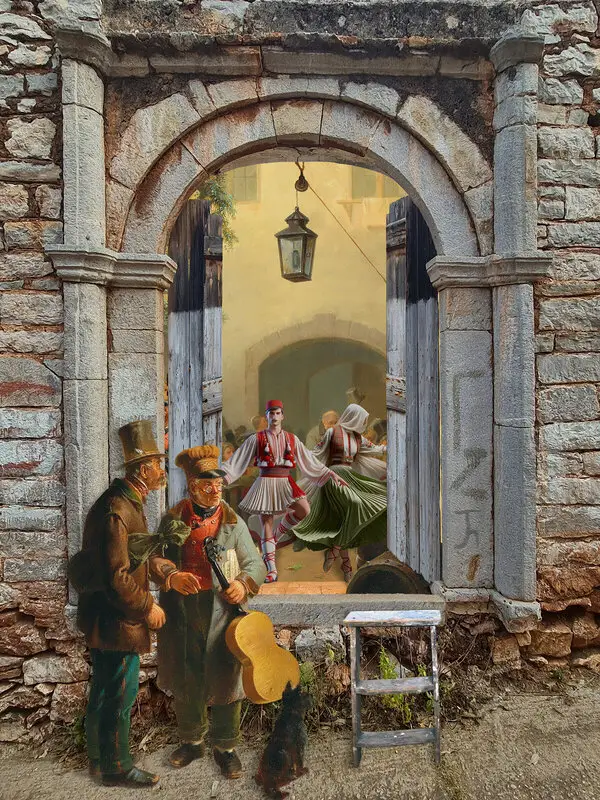
A hundred years too late. Party at the Admiral's Mansion, 2023
Digital
50 x 70 cm
In the grand mansion above Hydra's shore,
Young Antonios Kriezis and his bride, they adore,
Dancing a lively Sousta, their spirits soar,
In each step, their youth and passion restore.
Kyriakoula, his love, with grace and delight,
Joins him in dance under the moon's gentle light,
Their home echoes joy; their hearts take flight,
While his ships rest in the harbour, gleaming bright.
A merchant of renown, Antonios commands,
Trading with the world, wealth flows from his hands,
But soon the call to freedom, on Greece he stands,
To liberate from the Turk with his valiant bands.
Hero of the seas, admiral bold and true,
Antonios fights fiercely, his courage in view,
With Kyriakoula beside him, their love renews,
As they danced through the years, their family grew.
Their mansion, a beacon of joy and grace,
Hosts laughter and guests filling the space,
Antonios wild dances, setting the pace,
From sunrise to sunset, their love they embrace.
Time makes him Prime Minister, leading with pride,
Yet, in their home on Hydra, they both reside,
With sunsets over Kamini, where beauty abides,
Their dances continue in the ebbing tide.
As Time-Travellers now, through memories, they roam,
In the ruins of their mansion, their eternal home,
Music still plays, where their spirits are known,
And outside the gate, eager feet find their own.
In the picture, Hydra's hero Antonios Kriezis is dancing a lively Sousta with his wife to celebrate their wedding one hundred and ninety years earlier. It was a grand celebration. He was a war hero and admiral, and Kyriakoula, the daughter of the Bey of Hydra, Georgios Voulgaris, so all Hydra and half of Greece were indeed there. As the poem describes, once a symbol of their grandeur, the mansion is now a ruin with empty, gaping windows. The decay of the mansion, a process I have witnessed over the past twenty-five years, is a stark reminder of the passage of time and the transience of human achievements. Since the roof collapsed about ten years ago, the process has accelerated, leaving behind only memories of the grand parties and the vibrant life that once filled its halls. On my early morning walks, I have occasionally encountered the admiral sitting on a stone bench across from Vlychos Road, sadly observing the ruin. He constantly hums 'Miserlou,' an ancient, sorrowful tune. He explained that the name in Greek means 'Egyptian girl' or 'Egyptian woman.' He believed the song originated in the Greek and Levantine communities in the Mediterranean. The melody is melancholy, and the slow, enchanting rhythm conveys longing and nostalgia. In Greek culture, 'Miserlou' is often associated with loss and separation, and the old admiral missed his house and all the beautiful parties he and his wife had over the years.
The admiral's wife, Kyriakoula Kriezi, was a woman of elegance and grace, known for her exquisite taste in fashion and her role as a lady-in-waiting to Queen Amalia. Her love for dance was not just a hobby but a reflection of her vibrant spirit, a spirit that continued to live on even after she departed from this world. In a touching tribute to her, their descendants learned the new dance, Sirtaki, which she never had the chance to experience. This dance, now a cherished part of their family's traditions, is a testament to the enduring power of love and the role of dance in preserving memories and traditions. This dance keeps her spirit alive in their hearts like the memories of their vibrant parties and shared moments.
Outside the mansion, a couple of wandering musicians, a common sight in those days, arrived a little too late. Inside the gate, a dozen musicians were already in full swing, their music, the crisp, ringing sound of steel strings, flowing out over the area. The bouzouki's sound was unmistakable, whether a slow, mournful solo or a lively dance tune. The sweet dog, a loyal companion of the indeterminate breed they had brought with them, probably suffered even more. The enticing aromas of all the food served inside were a veritable torment to his nose. When the Kriezis hosted a party, nothing was lacking, not even for dogs and cats. The atmosphere was filled with laughter, music, and the clinking of glasses, a testament to the couple's love for life and generosity. These parties were a true reflection of their vibrant spirits and desire to share their joy with others.
Like the admiral and his wife, we have all danced the Sirtaki throughout our lives. Sirtaki, a dance that transcends borders and evokes the essence of Greece, has a rhythm that can stir even the most stony-hearted. It speaks to the soul and manifests joy, sorrow, triumph, despair, resilience, and defiance. Sirtaki is not just a dance but a symbol of Greek identity. It is a cultural touchstone that has helped the Greek people preserve their heritage through centuries of adversity, resonating with our own experiences of joy, sorrow, and resilience. Its universal appeal invites us all, regardless of our cultural background, to celebrate Greek culture.
Origins and Evolution
Sirtaki is often mistaken for an ancient Greek dance, but its origins are relatively modern. The dance was created for the 1964 film 'Zorba the Greek', choreographed by Giorgos Provias. Its name derives from the word "syrtos," a common name for a group of traditional Greek dances. Sirtaki combines slow and fast versions of the hasapiko dance, creating a compelling crescendo that captures the audience's spirit.
Greek folk music, however, has deep roots that stretch back to ancient times. The Greeks have always used music to express their deepest emotions and experiences. Instruments like the lyre and the aulos were integral to Greek culture and used in ceremonies and everyday entertainment.
Turkish Occupation and Cultural Preservation
Greece was under Ottoman rule from the mid-15th Century until the early 19th Century. This period was marked by significant hardship and oppression, yet the Greeks found ways to keep their culture alive. Music and dance, as the most vibrant and expressive forms of cultural heritage, played crucial roles in this cultural resilience. Despite the restrictions and the risk of punishment, the Greeks clandestinely celebrated their traditions through songs and dances, passing down their history and identity through generations. This underscores the vital role of music and dance in preserving our cultural heritage, a testament to the resilience and spirit of the Greek people.
Folk songs, known as "dimotika tragoudia," became a means of covert resistance. They told stories of heroism and lamented the loss of freedom. These songs kept the spirit of Hellenism alive, reminding the Greeks of their glorious past and fuelling their desire for liberation.
The Greek War of Independence
The Greek War of Independence began in 1821 and was pivotal in Greek history. Music was a significant source of inspiration and morale for the revolutionaries. Songs like 'Thourios' by Rigas Feraios became anthems of freedom, rallying the people to fight against the Ottoman Empire. Dance, too, played its part. Traditional dances, such as the rebetiko and kalamatas, were performed to boost the fighters' morale and celebrate victories. Sirtaki, with its lively rhythm and expressive movements, became a symbol of the Greeks' determination to regain their freedom and a testament to the resilience and spirit of the Greek people.
Dance, too, played its part in the Greek War of Independence. Traditional dances, such as the rebetiko and kalamatas, were not just physical expressions; they were acts of defiance, showcasing a culture that refused to be suppressed. These dances were performed to boost the fighters' morale and celebrate victories, a powerful reminder of the Greeks' determination to regain their freedom.
The 20th Century brought new challenges for Greece, including the Asia Minor Catastrophe, World War II, and the Greek Civil War. These events led to significant Greek emigration, creating a vast diaspora. Greek communities around the world used music and dance to maintain their connection to their homeland. Music and dance, with their ability to evoke strong emotions and convey cultural messages, became powerful tools in preserving Greek identity and fostering a sense of unity among the diaspora.
Sirtaki, with its dramatic flair and deep emotional resonance, became more than a dance; it became a bridge between Greece and its diaspora. The dance was simple enough for anyone to learn but powerful enough to convey profound cultural messages. It became a staple at Greek festivals and celebrations worldwide, allowing Greeks to express their identity and unity no matter where they lived. For the Greek diaspora, Sirtaki is a nostalgic reminder of their homeland, a symbol of their enduring connection to Greece, and a crucial tool in preserving the Greek identity. This celebration of our cultural heritage through music and dance inspires us all with its enduring power and longevity.
Mikis Theodorakis and 'Zorba the Greek'
Mikis Theodorakis, one of Greece's most iconic composers, played a pivotal role in popularising Greek music internationally. His score for Zorba the Greek brought the sounds of Greece to a global audience, showcasing the emotional depth and cultural significance of Greek folk music. The film, based on the novel by Nikos Kazantzakis, tells the story of an English writer who finds a new zest for life in Crete under the influence of the irrepressible Alexis Zorba.
The climax of the film, featuring the now-famous Sirtaki dance on the beach, is a cinematic tour de force. The scene, set against the backdrop of the azure sea and the golden sand, captures the essence of Greek culture and the spirit of the dance. Anthony Quinn's portrayal of Zorba, dancing with unrestrained joy and abandon, captivated audiences worldwide. The scene encapsulates the Greek spirit—resilient, passionate, and eternally optimistic- and the dance, with its lively rhythm and expressive movements, symbolises Greek cultural heritage.
Theodorakis's music resonated deeply with audiences, blending traditional Greek melodies with modern orchestration. It introduced the world to the beauty of Greek folk music, highlighting its emotional depth and cultural significance. His compositions, filled with passion and nostalgia, became a testament to Greece's rich cultural heritage, evoking a sense of pride and appreciation in listeners.
Resistance Against the Junta
Theodorakis's influence extended beyond the silver screen. His music symbolised resistance during the military junta that ruled Greece from 1967 to 1974. The junta banned his work, but Greeks continued to play and sing his songs in defiance. Music, once again, became a weapon against oppression, uniting people in their struggle for democracy. Songs like 'To Yelasto Paidi' and 'Antigonides' became anthems of resistance, their powerful lyrics and melodies inspiring hope and resilience and reminding the Greek people of their shared heritage and aspirations.
Songs like "To Yelasto Paidi" and "Antigonides" became anthems of resistance, their powerful lyrics and melodies inspiring hope and resilience. Theodorakis himself was imprisoned and exiled, but his music continued to resonate, rallying the Greek people and reminding them of their shared heritage and aspirations.
Greek Music and Identity
Greek music, with its rich tapestry of influences and styles, is a testament to the resilience and creativity of the Greek people. From the ancient lyre to the bouzouki, from dimotika tragoudia to rebetiko, Greek music has always been a vital part of the country's cultural identity. This enduring creativity and resilience in the face of adversity is truly inspiring.
Sirtaki, as a modern expression of this tradition, embodies the spirit of Greece. It is a dance that everyone can participate in, symbolising unity and communal joy. The gradual build-up from slow, measured steps to a wild, exuberant finale mirrors the Greek experience—marked by struggles but ultimately triumphant.
The Global Impact
Today, Greek music and dance continue to captivate audiences worldwide. With their lively music, vibrant dances, and delicious food, Greek festivals attract people from all walks of life. Sirtaki is often the highlight, with everyone, Greek or not, joining the dance.
The legacy of Theodorakis and Zorba the Greek endures ensures that Greek music remains a vibrant and dynamic part of global culture. Whether in the homeland or the diaspora, Greeks celebrate their heritage through music and dance, keeping their traditions alive and vibrant. This global recognition and appreciation of Greek music is a testament to its enduring power and the unbreakable spirit of a people who have always found strength in their music, dance, and shared heritage.
Sirtaki and Greek folk music are not just artistic expressions; they are the heartbeat of a nation. They have carried the spirit of Greece through centuries of hardship, rebellion, and renewal, standing as a testament to the resilience of the Greek people. They have united Greeks across the globe, fostering a sense of identity and belonging and inspiring us with their enduring power and the unbreakable spirit of a people who have always found strength in their music, dance, and shared heritage.
As long as there are Greeks who dance the Sirtaki and sing the songs of their ancestors, Greece's spirit will continue to thrive. This is a testament to the enduring power of culture and the unbreakable spirit of a people who have always found strength in their music, dance, and shared heritage.
Sirtaki: The Dance Born from Cinema Magic
Sirtaki, a dance synonymous with Greek culture, surprisingly did not originate from the annals of ancient traditions but was instead crafted for the 1964 film "Zorba the Greek." This dance, immortalised by Anthony Quinn's spirited performance, has become emblematic of Greek joy and resilience. Yet, the story of Sirtaki is as much a tale of cinematic creativity as it is of cultural expression.
A Dance for the Silver Screen
The name "Sirtaki" might suggest a connection to the traditional Cretan dance "Syrtos," where dancers characteristically drag their feet in a smooth, flowing manner. However, Sirtaki is a unique fusion of multiple dance styles. It combines the slower, deliberate movements of the hasapiko dance with the faster, more vigorous steps of the Hasaposerviko. Additionally, it incorporates elements from the Zeybek dance, renowned for its expressive and free-form style.
The choreography for "Zorba the Greek" was crafted by Giorgos Provias. However, the film's lead actor, Anthony Quinn, played a pivotal role in the creation of Sirtaki. He received dance lessons from Stelios Katsivelakis, although some claim several dancers contributed to teaching Quinn. These lessons included various traditional Greek dances such as Kalamatianos, Chaniotikos syrtos, Pentozali with Psalidia (scissor-like) movements, and Hasapiko. Initially, the Zeibekiko dance was excluded as it was deemed unsuitable for a non-Greek and less visually appealing on screen.
Quinn's iconic dragging-sliding steps, a hallmark of Sirtaki, were not a planned part of the dance. They were a product of necessity. Due to a broken foot, he struggled with the hopping motions of traditional dances. He adapted by inventing smoother, dragging steps, which he claimed were taught to him by a villager. This practical adaptation, combined with the film's immediate need, led to the unexpected birth of Sirtaki. This dance would later transcend its cinematic origins to become a symbol of Greek culture.
A Dance of Transformation
Sirtaki is typically performed in a line or circle formation, with dancers holding their neighbours' shoulders. When dancing solo, the dancer's arms are raised horizontally on either side. The dance is characterised by its progressive tempo: it starts slowly and gracefully, gradually building in speed and intensity.
The music for Sirtaki is set in a 4/4 meter, which increases in tempo as the dance progresses, often shifting to a 2/4 meter in the fastest sections. This change reflects the dance's transition from smooth, leisurely movements to energetic, vigorous actions, incorporating hops and leaps.
A Closer Look at the Influences
Originally a medieval military dance, Hasapiko features precise, controlled movements that mimic the actions of butchers (hence its name, which means "the butcher's dance"). It starts slowly, emphasising coordination and synchronisation among dancers.
Hasaposerviko is a faster variation of the Hasapiko, incorporating quicker steps and more dynamic movements. It's known for its lively and spirited nature.
Unlike Hasapiko and Hasaposerviko, which have structured formats, Zeibekiko is a solo dance characterised by its improvisational style. It is deeply expressive, often reflecting the dancer's emotions and personal story.
Kalamatianos is a popular Greek folk dance performed in a circle. It is known for its upbeat tempo and joyful movements. It is a symbol of celebration and community.
Chaniotikos Syrtos is a regional variant of the Syrtos dance from Chania, Crete. It involves smooth, dragging steps and is performed with grace and fluidity.
A traditional Cretan war dance, Pentozali is vigorous and involves leaping and high energy. The Psalidia movements are named for their scissor-like nature, reflecting sharp, quick actions.
Sirtaki as a Unifying Force
Despite its cinematic origins, Sirtaki has become a powerful symbol of Greek culture. Traditional dances were not just a form of entertainment but crucial in preserving Greek identity and heritage during the long Ottoman occupation. Dance was a form of resistance, a way to keep the spirit of freedom alive. Sirtaki, though modern, embodies this spirit of resilience and joy, making it a living testament to the strength of Greek culture.
Greek folk music and dance became rallying points for unity and cultural pride in the fight for independence and later during the struggle against the military junta. Mikis Theodorakis, who composed the iconic music for "Zorba the Greek," used his art to inspire and mobilise. His music and the image of Quinn dancing Sirtaki changed the world's perception of Greek culture, highlighting its vibrancy and indomitable spirit.
The Dance That Dances Beyond the Screen
Sirtaki is more than just a dance from a movie; it is a celebration of life, a testament to Greek resilience, and a bridge between past and present. It has united Greeks worldwide, uniting them in a shared expression of joy and cultural pride. Through its rhythm and movements, Sirtaki tells a story of endurance, community, and the unyielding human spirit, fostering a sense of unity among its participants.

Jörgen Thornberg
Malmö
Lite om bilder och mig. Translation in English at the end.
Jag är en nyfiken person som ser allt i bilder, även det jag fäster i ord, gärna tillsammans för bakom alla mina bilder finns en berättelse. Till vissa bilder hör en kortare eller längre novell som följer med bilden.
Bilder berättar historier. Jag omges av naturlig skönhet, intressanta människor och historia var jag än går. Jag använder min kamera för att dokumentera världen och blanda det jag ser med vad jag känner för att fånga den dolda magin.
Mina bilder berättar mina historier. Genom mina bilder, tryck och berättelser. Jag bjuder in dig att ta del av dessa berättelser, in i ditt liv och hem och dela min mycket personliga syn på vår värld. Mer än vad ögat ser. Jag tänker i bilder, drömmer och skriver och pratar om dem; följaktligen måste jag också skapa bilder. De blir vad jag ser, inte nödvändigtvis begränsade till verkligheten. Det finns en bild runt varje hörn. Jag hoppas att du kommer att se vad jag såg och gilla det.
Jag är också en skrivande person och till många bilder hör en kortare eller längre essay. Den följer med tavlan, tryckt på fint papper och med en personlig hälsning från mig.
Flertalet bilder startar sin resa i min kamera. Enkelt förklarat beskriver jag bilden jag ser i mitt inre, upplevd eller fantiserad. Bilden uppstår inom mig redan innan jag fått okularet till ögat. På bråkdelen av ett ögonblick ser jag vad jag vill ha och vad som kan göras med bilden. Här skall jag stoppa in en giraff, stålmannen, Titanic eller vad det är min fantasi finner ut. Ännu märkligare är att jag kommer ihåg minnesbilden långt efteråt när det blir tid att skapa verket. Om jag lyckas eller inte, är upp till betraktaren, oftast präglat av en stråk av svart humor – meningen är att man skall bli underhållen. Mina bilder blir ofta en snackis där de hänger.
Jag föredrar bilder som förmedlar ett budskap i flera lager. Vid första anblicken fylld av feel-good, en vacker utsikt, fint väder, solen skiner, blommor på ängen eller vattnet som ligger förrädiskt spegelblankt. I en sådan bild kan jag gömma min egentliga berättelse, mitt förakt för förtryckare och våldsverkare, rasister och fördomsfulla människor - ett gärna återkommande motiv mer eller mindre dolt i det vackra motivet. Jag försöker förena dem i ett gemensamt narrativ.
Bild och formgivning har löpt som en röd tråd genom livet. Fotokonst känns som en värdig final som jag gärna delar med mig.
Min genre är vid som framgår av mina bilder, temat en blandning av pop- och gatukonst i kollage som kan bestå av hundratals lager. Vissa bilder kan ta veckor, andra någon dag innan det är dags att överlämna resultatet till printverkstaden. Fine Art Prints är digitala fotocollage. I dessa kollage sker rivandet, klippandet, pusslandet, målandet, ritandet och sprayningen digitalt. Det jag monterar in kan vara hundratals år gamla bilder som jag omsorgsfullt frilägger så att de ser ut att vara en del av tavlan men också bilder skapade av mig själv efter min egen fantasi. Därefter besöks printstudion och för vissa bilder numrera en limiterad upplaga (oftast 7 exemplar) och signera för hand. Vissa bilder kan köpas i olika format. Det är bara att fråga efter vilka. Gillar man en bild som är 70x100 men inte har plats på väggen, går den kanske att få i 50x70 cm istället. Frågan är fri.
Metoden Giclée eller Fine Art Print som det också kallas är det moderna sättet för framställning av grafisk konst. Villkoret för denna typ av utskrifter är att en högkvalitativ storformatskrivare används med åldersbeständigt färgpigment och konstnärspapper eller i förekommande fall på duk. Pappret som används möter de krav på livslängd som ställs av museer och gallerier. Normalt säljer jag mina bilder oinramade så att den nya ägaren själv kan bestämma hur de skall se ut, med eller utan passepartout färg på ram, med eller utan glas etc..
Under många år ställde jag bara ut på nätet, i valda grupper och på min egen Facebooksida - https://www.facebook.com/jorgen.thornberg.9
Jag finns också på en egen hemsida som tyvärr inte alltid är uppdaterad – https://www.jth.life/ Där kan du också läsa en del av de berättelser som följer med bilden.
UTSTÄLLNINGAR
Luftkastellet, oktober 2022
Konst i Lund, november 2022
Luftkastellet, mars 2023
Engleson Galleri Caroli, april 2023
Hydra, Greece June 2023
Engleson Galleri Caroli, oktober 2023
Toppen, Höllviken december 2023
Luftkastellet, mars 2024
Torups Galleri, mars 2024
Venice, May 2024
Luftkastellet, oktober 2024
Konst i Advent, December 2024
Galleri Engleson, Caroli December 2024
Jäger & Jansson Galleri, april 2025
A bit about pictures and me.
I'm a curious person who sees everything in pictures, even what I express in words, often combining them, for behind all my pictures lies a story. These narratives, some as short as a single image and others as long as a novel, are the heart and soul of my work.
Pictures tell stories. Wherever I go, I'm surrounded by natural beauty, exciting people, and history. I use my camera to document the world and blend what I see with what I feel to capture the hidden magic.
My images tell my stories. Through my pictures, prints, and narratives, I invite you to partake in these stories in your life and home and share my deeply personal perspective of our world. More than meets the eye. I think in pictures, dream, write, and talk about them; consequently, I must create images too. They become what I see, not necessarily confined to reality. There's a picture around every corner. I hope you'll see what I saw and enjoy it.
I'm also a writer, and many images come with a shorter or longer essay. It accompanies the painting, printed on fine paper with my personal greeting.
Many pictures start their journey on my camera. Simply put, I describe the image I see in my mind, experienced or imagined. The image arises within me even before I bring the eyepiece to my eye. In a fraction of a moment, I see what I want and what can be done with the picture. Here, I'll insert a giraffe, Superman, the Titanic, or whatever my imagination conjures up. Even stranger is that I remember the mental image long after it's time to create the work. Whether I succeed is up to the observer, often imbued with a streak of black humour – the aim is to entertain. My pictures usually become a talking point wherever they hang.
I prefer pictures that convey a message in multiple layers. At first glance, they're filled with feel-good vibes, a beautiful view, lovely weather, the sun shining, flowers in the meadow, or the water lying deceptively calm. But beneath this surface beauty, I often conceal a deeper story, a narrative that challenges societal norms or explores the human condition. I invite you to delve into these hidden narratives and discover the layers of meaning within my work.
Picture and design have been a thread running through my life. Photographic art feels like a fitting finale, and I'm happy to share it.
My genre is varied, as seen in my pictures; the theme is a blend of pop and street art in collages that can consist of hundreds of layers. Some images can take weeks, others just a day before it's time to hand over the result to the print workshop. Fine Art Prints are digital photo collages. In these collages, tearing, cutting, puzzling, painting, drawing, and spraying happen digitally. What I insert can be images hundreds of years old that I carefully extract so they appear to be part of the painting, but also images created by myself, now also generated from my imagination. Next, visit the print studio and, for certain images, number a limited edition (usually 7 copies) and sign them by hand. Some images may be available in other formats. Just ask which ones. If you like an image that's 70x100 but doesn't have space on the wall, you might be able to get it in 50x70 cm instead. The question is open.
The Giclée method, or Fine Art Print as it's also called, is the modern way of producing graphic art. This method ensures the highest quality and longevity of the artwork, using a high-quality large-format printer with archival pigment inks and artist paper or, in some cases, canvas. The paper used meets the longevity requirements set by museums and galleries. I sell my pictures unframed, allowing the new owner to personalise their artwork, confident in the lasting value and quality of the piece.
For many years, I only exhibited online, in selected groups, and on my Facebook page - https://www.facebook.com/jorgen.thornberg.9. I also have my website, which unfortunately is not constantly updated - https://www.jth.life/. You can also read some of the stories accompanying the pictures there.
EXHIBITIONS
Luftkastellet, October 2022
Art in Lund, November 2022
Luftkastellet, March 2023
Engleson Gallery Caroli, April 2023
Hydra, Greece June 2023
Engleson Gallery Caroli, October 2023
Toppen, Höllviken December 2023
Luftkastellet, March 2024
Torup Gallery, March 2024
Venice, May 2024
UTSTÄLLNINGAR
Luftkastellet, oktober 2022
Konst i Lund, november 2022
Luftkastellet, mars 2023
Engleson Galleri Caroli, april 2023
Hydra, Greece June 2023
Engleson Galleri Caroli, oktober 2023
Toppen, Höllviken december 2023
Luftkastellet, mars 2024
Torups Galleri, mars 2024
Venice, May 2024
Luftkastellet, October 2024
Konst i Advent, December 2024
Galleri Engleson, Caroli December 2024
Jäger & Jansson Galleri, April 2025
Utbildning
Autodidakt
Medlem i konstnärsförening
Öppna Sinnen
Med i konstrunda
Konstrundan i Skåne
Utställningar
Luftkastellet, October 2022
Art in Lund, November 2022
Luftkastellet, March 2023
Engleson Gallery Caroli, April 2023
Hydra, Greece June 2023
Engleson Gallery Caroli, October 2023
Toppen, Höllviken December 2023
Luftkastellet, March 2024
Torup Gallery, March 2024
Venice, May 2024