Vi använder cookies för att ge dig bästa möjliga upplevelse. Välj vilka cookies du tillåter.
Läs mer i vår integritetspolicy
Jörgen Thornberg
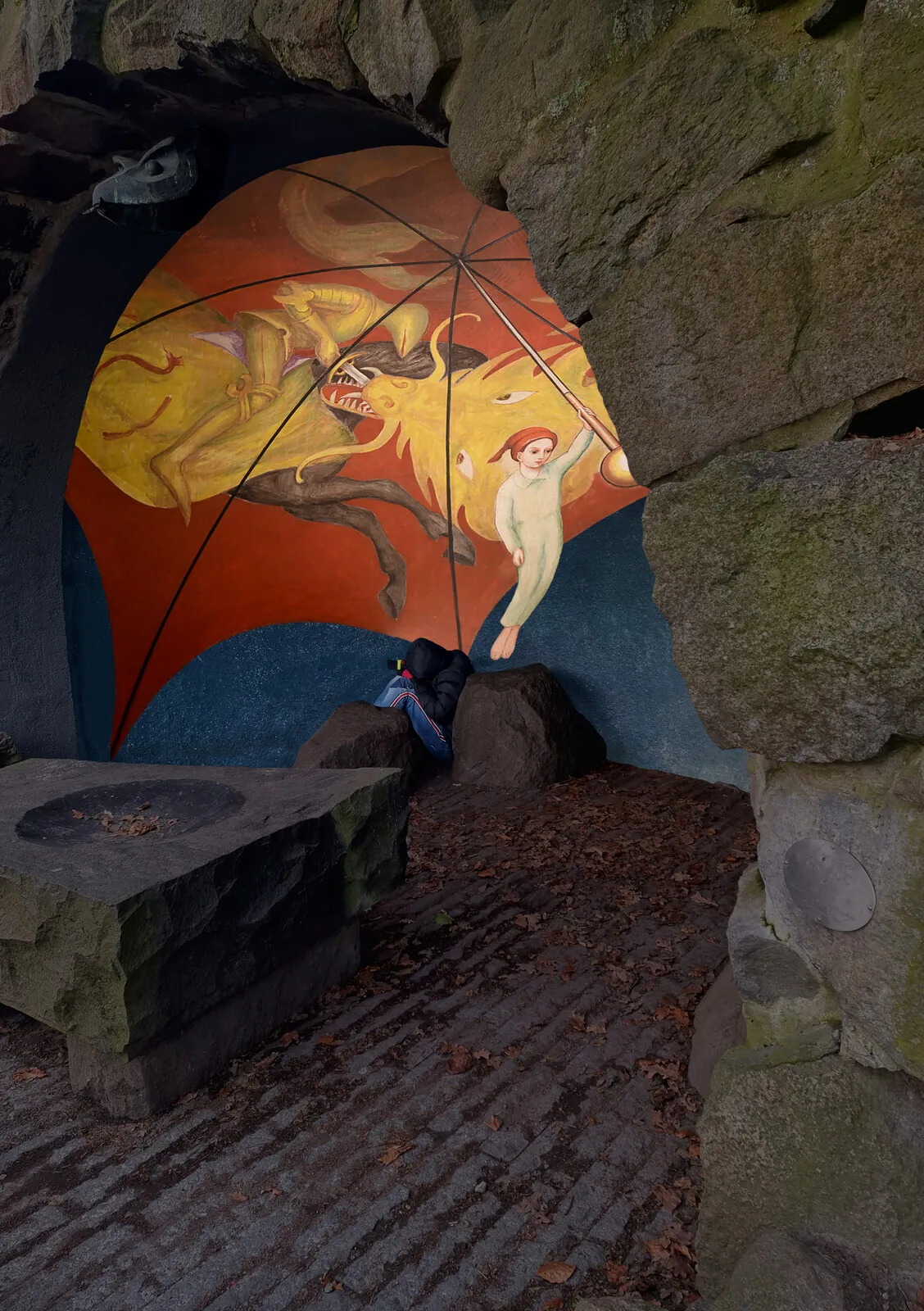
John Blund attending the cave, 2023
Digital
50 x 70 cm
3 200 kr
Early one Sunday morning, around six o'clock, I passed by the Cave in Kungsparken and saw a peculiar scene. Sitting curled up was a boy, and above him, on the roof and wall, watched John Blund, in English, 'the Sandman'. I don't think the lad belonged to the homeless who often use the Cave for overnight stays, whether short or long-term. Instead, the boy hadn't dared to go home after a drunken party and found the Cave a better alternative to heading home and breathing out alcohol fumes on his mother.
The cave walls suddenly became a fresco of John Blund from the story room in Stockholm City Library by the artist Nils Dardel (1888-1943), where the sleeping boy resembled Dardel's earlier work 'The Dying Dandy'. The vivid projection of the boy's dream onto the wall was remarkable. The boy slept peacefully, so John Blund was doing a good job. Dreams travel swiftly as thoughts, faster than the trains between Stockholm and Malmö, and I don't think anyone at the library noticed the nocturnal borrowing. As soon as the boy woke up, the fresco would be back in its place.
John Blund, or "The Sandman" in English, is a mythical figure in European folklore who gently lulls people to sleep and inspires beautiful dreams by sprinkling magical sand into their eyes.
The Sandman is known as John Blund or Jon Blund in Scandinavian folklore. He sprinkles sand or dust into children's eyes at night to bring sleep and dreams. The "grit" or "sleep" (rheum) in one's eyes upon waking is believed to be the Sandman's work from the previous night. The first written record of Jon Blund in the Nordic region is found in Olof Verelius's 'Index lingvæ veteris scythoscandicæ sive gothicæ' from 1691, where he is called Joen Blund and compared to the Edda's Blundur and the Latin Somnus (Greek Hypnos). By the 18th century, he was described as a bringer of sleep, which came primarily to children. The name Jon Blund appears in a 1710 text by Swedish poet Johan Runius.
The Sandman character has been interpreted in various ways, from gentle to sinister. In 1816, E. T. A. Hoffmann (1776–1822) wrote a short story titled 'Der Sandmann', which explored the darker side of the Sandman. According to the protagonist's nurse, the Sandman throws sand in the eyes of children who don't sleep, causing their eyes to fall out. He then collects these eyes and feeds them to his children in his iron nest on the Moon. This nightmarish interpretation contrasts with the more benign versions of the Sandman in other folklore.
Danish author Hans Christian Andersen gave the Sandman a more charming persona in his 1841 fairy tale Ole Lukøje. In this story, Ole relates dreams to a young boy over a week by sprinkling dust into children's eyes. "Ole" is a Danish first name, and "Lukøje" means "close eye."
Nobody knows as many stories as Ole Lukøje or can relate to them nicely. In the evening, while the children are seated at the table or in their little chairs, he comes up the stairs very softly and walks in his socks. He opens the doors without the slightest noise and throws a small quantity of excellent dust in their eyes, just enough to prevent them from keeping them open so they do not see him. Then he creeps behind them and blows softly upon their necks until their heads droop. But Ole Lukøje does not wish to hurt them, for he is very fond of children and only wants them to be quiet so that he may relate to them pretty stories, and they never are silent until they are in bed and asleep. As soon as they sleep, Ole Lukøje sits on the bed. He is nicely dressed; his coat is made of silken fabric; it is impossible to say what colour, for it changes from green to red and red to blue as he turns from side to side. Under each arm, he carries an umbrella; one of them, with pictures on the inside, spreads over the good children, and then they dream the most beautiful stories the whole night. But the other umbrella has no pictures, which he holds over the naughty children so they sleep heavily and wake in the morning without having dreams."
In H.C. Andersen's illustrated version, John Blund is equipped with two umbrellas: a colourful one for good children and a black, pictureless one for naughty children. He also carries a syringe filled with sweet milk to spray into children's eyes, making their eyelids heavy so they fall asleep.
In Romanian folklore, a similar character known as Moș Ene (Ene the Elder) also puts children to sleep. Hoffmann's sinister version of the Sandman is identical to the French Canadian character Bonhomme Sept Heures, who throws sand in children's eyes to blind and capture them.
In the Netherlands, Belgium, and parts of southern Africa, he is known as Klaas Vaak. The character features prominently in the Dutch musical 'De sprookjesmusical Klaas Vaak', a TV series called 'Fairytales of Klaas Vaak', and as an entertainer at the amusement park Efteling.
The Sandman is a recurring character in popular culture, appearing in various forms in film, television, comics, and music. The East German stop-motion children's show' Unser Sandmännchen' (Our Little Sandman), based on Ole Lukøje and Hoffmann's story, has been broadcast since 1959, along with a West German version discontinued after reunification. In the 1990s, the Canadian TV show' Nilus the Sandman' portrayed the character for a new audience. In contrast, the French show 'Bonne nuit les petits' featured a bear, Nounours, caring for two toddlers, Nicolas and Pimprenelle, alongside the Sandman ("Le marchand de sable").
In the animated series 'The Smurfs', the Sandman makes appearances in the episodes "Darkness Monster" and "Lazy's Nightmare," while in 1991, Paul Berry directed a stop-motion short film titled 'The Sandman', based on Hoffmann's story. The Sandman also appears as a Council of Legendary Figures member in 'The Powerpuff Girls' episode "Dream Scheme" and in the movies' The Santa Clause 2' and 'The Santa Clause 3'. The demon Der Kindestod in 'Buffy the Vampire Slayer' is a version of the Sandman, and the ninth season episode "Sleep No More" (2015) of 'Doctor Who' explores the character in a science fiction context. In 'Rise of the Guardians', the Sandman is one of the Guardians, while Netflix's 2022 series 'The Sandman' adapts Neil Gaiman's comics.
Marvel Mystery Comics' Sandman lives in the Land of Dreams, while Neil Gaiman's 75-part comic book series 'The Sandman' for Vertigo Comics (DC Comics) tells the story of Dream of the Endless, also known as Morpheus, the Shaper of Form.
Songs based on the figure of the Sandman include the 1950s classic "Mr Sandman" by The Chordettes, Roy Orbison's "In Dreams," Metallica's "Enter Sandman," Lordi's "Blood Red Sandman," Ed Sheeran's "Sandman" on the album = (Equals), and "Mein Herz brennt" by Rammstein. The Sandman also appears in songs like "Sandmann" by Oomph!, "Morningtown Ride" by The Seekers, and "Headfirst Slide into Cooperstown on a Bad Bet" by Fall Out Boy.
Morpheus ('Fashioner,' derived from Ancient Greek meaning' form, shape') is a god associated with sleep and dreams. In Ovid's 'Metamorphoses', he is the son of Somnus and appears in dreams in human form. From the Middle Ages, the name began to stand more generally for the god of dreams or sleep.
The Sandman, whether called John Blund, Ole Lukøje, or Klaas Vaak, continues to be a fascinating mythical character that transcends cultures and time. From Hoffmann's nightmarish interpretation to Andersen's charming storyteller, the Sandman remains an enduring figure in folklore and popular culture, gently sprinkling magic into our dreams.
Marvel Mystery Comics, the Sandman lives in the Land of Dreams, located in the Realm of Fairies within the potentially imaginary world of Nowhere. The Sandman ruled over the realm and would place a blanket over it daily. Those who grabbed a dream from the dream tree would have a dream based on whatever they grabbed and awaken again when the Sandman removed the blanket over his land. Anyone who did not grab a dream would end up in an eternal, dreamless sleep. Several fictional characters named Sandman have appeared in comic books published by DC Comics. 'The Sandman', the original series, tells the story of Dream of the Endless, who rules the world of dreams. He is an anthropomorphic personification of dreams. He possesses three symbols of office: a helm, an amulet known as the Dreamstone, and a sand pouch.
Morpheus ('Fashioner', derived from the Ancient Greek meaning' form, shape') is a god associated with sleep and dreams. In Ovid's Metamorphoses, he is the son of Somnus and appears in dreams in human form. From the Middle Ages, the name began to stand more generally for the god of dreams or sleep.
Nestled in Malmö's most central park lies the Cave, a charming and intriguing landmark that captures the spirit of Kungsparken. Initially, the land where Kungsparken stands today was built until the 1660s, when the structures were demolished to create a clear line of fire for the nearby fortress. In 1869-1870, the park was established on what had once been part of the fortifications surrounding Malmöhus Castle. Danish landscape architect Ove Høegh Hansen was commissioned to create a romantic park inspired by the English garden style, which developed in the 18th century as a reaction against the rigid formalism of the French Baroque garden.
Kungsparken opened in 1872, initially called Slottsparken. Its current name, "King's Park," derives from King Oscar II, who inaugurated a restaurant there in 1881 during a significant agricultural meeting in Malmö. The park was subsequently named Kung Oscars Park, later shortened to Kungsparken.
Located in central Malmö, not far from Gustav Adolfs Torg and Stortorget, Kungsparken features the classic Kungsparken building, which has housed a casino for several years. Surrounded by a canal near Slottsgatan, the road leading to the casino, Slottsparken embraces Kungsparken, and the two now appear as a single park. Nearby lies Malmöhus, which served as Malmö's castle in the 17th century. As Malmö's oldest public park, Kungsparken embodies the romantic ornamental style of the 1870s. In a romantic park, nature is imitated, with trees planted to appear as if growing naturally. The paths are winding and natural, while lakes and ponds enhance the atmosphere. Visitors are meant to experience different moods as they wander through the park.
Kungsparken covers an area of 8.4 hectares. At its heart lies a cast-iron fountain erected in 1882, while a bust of Gustaf Rydberg (1835-1933), a royal painter, adds a touch of artistic heritage. The Cave, a popular attraction near the fountain, is built of stones primarily covered with vegetation. At its entrance stands a pedestal with a drinking fountain. Over time, the decorations have varied, including wall paintings and a drinking fountain. In 1987, the Cave underwent a restoration, crowned by the copper snakehead' Ormet,' which sprays a thin stream of water from its mouth into a granite bowl. The artistic theme draws from Snorri's Edda, telling the story of Loki's punishment for Balder's murder.
The park boasts 120 types of trees from three continents. During the Bo 86 housing exhibition in Malmö, trees were comprehensively replanted. The exhibition also presented several theme gardens in Kungsparken.
Jörgen Thornberg
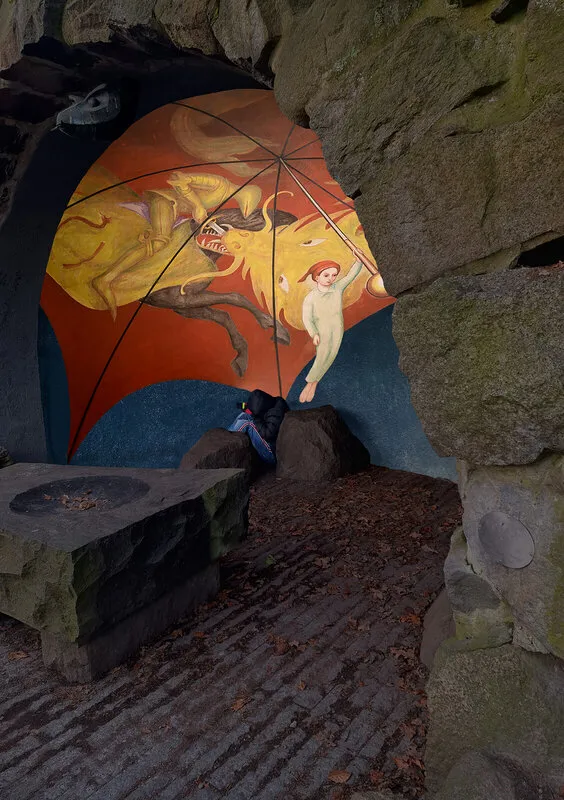
John Blund attending the cave, 2023
Digital
50 x 70 cm
3 200 kr
Early one Sunday morning, around six o'clock, I passed by the Cave in Kungsparken and saw a peculiar scene. Sitting curled up was a boy, and above him, on the roof and wall, watched John Blund, in English, 'the Sandman'. I don't think the lad belonged to the homeless who often use the Cave for overnight stays, whether short or long-term. Instead, the boy hadn't dared to go home after a drunken party and found the Cave a better alternative to heading home and breathing out alcohol fumes on his mother.
The cave walls suddenly became a fresco of John Blund from the story room in Stockholm City Library by the artist Nils Dardel (1888-1943), where the sleeping boy resembled Dardel's earlier work 'The Dying Dandy'. The vivid projection of the boy's dream onto the wall was remarkable. The boy slept peacefully, so John Blund was doing a good job. Dreams travel swiftly as thoughts, faster than the trains between Stockholm and Malmö, and I don't think anyone at the library noticed the nocturnal borrowing. As soon as the boy woke up, the fresco would be back in its place.
John Blund, or "The Sandman" in English, is a mythical figure in European folklore who gently lulls people to sleep and inspires beautiful dreams by sprinkling magical sand into their eyes.
The Sandman is known as John Blund or Jon Blund in Scandinavian folklore. He sprinkles sand or dust into children's eyes at night to bring sleep and dreams. The "grit" or "sleep" (rheum) in one's eyes upon waking is believed to be the Sandman's work from the previous night. The first written record of Jon Blund in the Nordic region is found in Olof Verelius's 'Index lingvæ veteris scythoscandicæ sive gothicæ' from 1691, where he is called Joen Blund and compared to the Edda's Blundur and the Latin Somnus (Greek Hypnos). By the 18th century, he was described as a bringer of sleep, which came primarily to children. The name Jon Blund appears in a 1710 text by Swedish poet Johan Runius.
The Sandman character has been interpreted in various ways, from gentle to sinister. In 1816, E. T. A. Hoffmann (1776–1822) wrote a short story titled 'Der Sandmann', which explored the darker side of the Sandman. According to the protagonist's nurse, the Sandman throws sand in the eyes of children who don't sleep, causing their eyes to fall out. He then collects these eyes and feeds them to his children in his iron nest on the Moon. This nightmarish interpretation contrasts with the more benign versions of the Sandman in other folklore.
Danish author Hans Christian Andersen gave the Sandman a more charming persona in his 1841 fairy tale Ole Lukøje. In this story, Ole relates dreams to a young boy over a week by sprinkling dust into children's eyes. "Ole" is a Danish first name, and "Lukøje" means "close eye."
Nobody knows as many stories as Ole Lukøje or can relate to them nicely. In the evening, while the children are seated at the table or in their little chairs, he comes up the stairs very softly and walks in his socks. He opens the doors without the slightest noise and throws a small quantity of excellent dust in their eyes, just enough to prevent them from keeping them open so they do not see him. Then he creeps behind them and blows softly upon their necks until their heads droop. But Ole Lukøje does not wish to hurt them, for he is very fond of children and only wants them to be quiet so that he may relate to them pretty stories, and they never are silent until they are in bed and asleep. As soon as they sleep, Ole Lukøje sits on the bed. He is nicely dressed; his coat is made of silken fabric; it is impossible to say what colour, for it changes from green to red and red to blue as he turns from side to side. Under each arm, he carries an umbrella; one of them, with pictures on the inside, spreads over the good children, and then they dream the most beautiful stories the whole night. But the other umbrella has no pictures, which he holds over the naughty children so they sleep heavily and wake in the morning without having dreams."
In H.C. Andersen's illustrated version, John Blund is equipped with two umbrellas: a colourful one for good children and a black, pictureless one for naughty children. He also carries a syringe filled with sweet milk to spray into children's eyes, making their eyelids heavy so they fall asleep.
In Romanian folklore, a similar character known as Moș Ene (Ene the Elder) also puts children to sleep. Hoffmann's sinister version of the Sandman is identical to the French Canadian character Bonhomme Sept Heures, who throws sand in children's eyes to blind and capture them.
In the Netherlands, Belgium, and parts of southern Africa, he is known as Klaas Vaak. The character features prominently in the Dutch musical 'De sprookjesmusical Klaas Vaak', a TV series called 'Fairytales of Klaas Vaak', and as an entertainer at the amusement park Efteling.
The Sandman is a recurring character in popular culture, appearing in various forms in film, television, comics, and music. The East German stop-motion children's show' Unser Sandmännchen' (Our Little Sandman), based on Ole Lukøje and Hoffmann's story, has been broadcast since 1959, along with a West German version discontinued after reunification. In the 1990s, the Canadian TV show' Nilus the Sandman' portrayed the character for a new audience. In contrast, the French show 'Bonne nuit les petits' featured a bear, Nounours, caring for two toddlers, Nicolas and Pimprenelle, alongside the Sandman ("Le marchand de sable").
In the animated series 'The Smurfs', the Sandman makes appearances in the episodes "Darkness Monster" and "Lazy's Nightmare," while in 1991, Paul Berry directed a stop-motion short film titled 'The Sandman', based on Hoffmann's story. The Sandman also appears as a Council of Legendary Figures member in 'The Powerpuff Girls' episode "Dream Scheme" and in the movies' The Santa Clause 2' and 'The Santa Clause 3'. The demon Der Kindestod in 'Buffy the Vampire Slayer' is a version of the Sandman, and the ninth season episode "Sleep No More" (2015) of 'Doctor Who' explores the character in a science fiction context. In 'Rise of the Guardians', the Sandman is one of the Guardians, while Netflix's 2022 series 'The Sandman' adapts Neil Gaiman's comics.
Marvel Mystery Comics' Sandman lives in the Land of Dreams, while Neil Gaiman's 75-part comic book series 'The Sandman' for Vertigo Comics (DC Comics) tells the story of Dream of the Endless, also known as Morpheus, the Shaper of Form.
Songs based on the figure of the Sandman include the 1950s classic "Mr Sandman" by The Chordettes, Roy Orbison's "In Dreams," Metallica's "Enter Sandman," Lordi's "Blood Red Sandman," Ed Sheeran's "Sandman" on the album = (Equals), and "Mein Herz brennt" by Rammstein. The Sandman also appears in songs like "Sandmann" by Oomph!, "Morningtown Ride" by The Seekers, and "Headfirst Slide into Cooperstown on a Bad Bet" by Fall Out Boy.
Morpheus ('Fashioner,' derived from Ancient Greek meaning' form, shape') is a god associated with sleep and dreams. In Ovid's 'Metamorphoses', he is the son of Somnus and appears in dreams in human form. From the Middle Ages, the name began to stand more generally for the god of dreams or sleep.
The Sandman, whether called John Blund, Ole Lukøje, or Klaas Vaak, continues to be a fascinating mythical character that transcends cultures and time. From Hoffmann's nightmarish interpretation to Andersen's charming storyteller, the Sandman remains an enduring figure in folklore and popular culture, gently sprinkling magic into our dreams.
Marvel Mystery Comics, the Sandman lives in the Land of Dreams, located in the Realm of Fairies within the potentially imaginary world of Nowhere. The Sandman ruled over the realm and would place a blanket over it daily. Those who grabbed a dream from the dream tree would have a dream based on whatever they grabbed and awaken again when the Sandman removed the blanket over his land. Anyone who did not grab a dream would end up in an eternal, dreamless sleep. Several fictional characters named Sandman have appeared in comic books published by DC Comics. 'The Sandman', the original series, tells the story of Dream of the Endless, who rules the world of dreams. He is an anthropomorphic personification of dreams. He possesses three symbols of office: a helm, an amulet known as the Dreamstone, and a sand pouch.
Morpheus ('Fashioner', derived from the Ancient Greek meaning' form, shape') is a god associated with sleep and dreams. In Ovid's Metamorphoses, he is the son of Somnus and appears in dreams in human form. From the Middle Ages, the name began to stand more generally for the god of dreams or sleep.
Nestled in Malmö's most central park lies the Cave, a charming and intriguing landmark that captures the spirit of Kungsparken. Initially, the land where Kungsparken stands today was built until the 1660s, when the structures were demolished to create a clear line of fire for the nearby fortress. In 1869-1870, the park was established on what had once been part of the fortifications surrounding Malmöhus Castle. Danish landscape architect Ove Høegh Hansen was commissioned to create a romantic park inspired by the English garden style, which developed in the 18th century as a reaction against the rigid formalism of the French Baroque garden.
Kungsparken opened in 1872, initially called Slottsparken. Its current name, "King's Park," derives from King Oscar II, who inaugurated a restaurant there in 1881 during a significant agricultural meeting in Malmö. The park was subsequently named Kung Oscars Park, later shortened to Kungsparken.
Located in central Malmö, not far from Gustav Adolfs Torg and Stortorget, Kungsparken features the classic Kungsparken building, which has housed a casino for several years. Surrounded by a canal near Slottsgatan, the road leading to the casino, Slottsparken embraces Kungsparken, and the two now appear as a single park. Nearby lies Malmöhus, which served as Malmö's castle in the 17th century. As Malmö's oldest public park, Kungsparken embodies the romantic ornamental style of the 1870s. In a romantic park, nature is imitated, with trees planted to appear as if growing naturally. The paths are winding and natural, while lakes and ponds enhance the atmosphere. Visitors are meant to experience different moods as they wander through the park.
Kungsparken covers an area of 8.4 hectares. At its heart lies a cast-iron fountain erected in 1882, while a bust of Gustaf Rydberg (1835-1933), a royal painter, adds a touch of artistic heritage. The Cave, a popular attraction near the fountain, is built of stones primarily covered with vegetation. At its entrance stands a pedestal with a drinking fountain. Over time, the decorations have varied, including wall paintings and a drinking fountain. In 1987, the Cave underwent a restoration, crowned by the copper snakehead' Ormet,' which sprays a thin stream of water from its mouth into a granite bowl. The artistic theme draws from Snorri's Edda, telling the story of Loki's punishment for Balder's murder.
The park boasts 120 types of trees from three continents. During the Bo 86 housing exhibition in Malmö, trees were comprehensively replanted. The exhibition also presented several theme gardens in Kungsparken.
3 200 kr

Jörgen Thornberg
Malmö
Lite om bilder och mig. Translation in English at the end.
Jag är en nyfiken person som ser allt i bilder, även det jag fäster i ord, gärna tillsammans för bakom alla mina bilder finns en berättelse. Till vissa bilder hör en kortare eller längre novell som följer med bilden.
Bilder berättar historier. Jag omges av naturlig skönhet, intressanta människor och historia var jag än går. Jag använder min kamera för att dokumentera världen och blanda det jag ser med vad jag känner för att fånga den dolda magin.
Mina bilder berättar mina historier. Genom mina bilder, tryck och berättelser. Jag bjuder in dig att ta del av dessa berättelser, in i ditt liv och hem och dela min mycket personliga syn på vår värld. Mer än vad ögat ser. Jag tänker i bilder, drömmer och skriver och pratar om dem; följaktligen måste jag också skapa bilder. De blir vad jag ser, inte nödvändigtvis begränsade till verkligheten. Det finns en bild runt varje hörn. Jag hoppas att du kommer att se vad jag såg och gilla det.
Jag är också en skrivande person och till många bilder hör en kortare eller längre essay. Den följer med tavlan, tryckt på fint papper och med en personlig hälsning från mig.
Flertalet bilder startar sin resa i min kamera. Enkelt förklarat beskriver jag bilden jag ser i mitt inre, upplevd eller fantiserad. Bilden uppstår inom mig redan innan jag fått okularet till ögat. På bråkdelen av ett ögonblick ser jag vad jag vill ha och vad som kan göras med bilden. Här skall jag stoppa in en giraff, stålmannen, Titanic eller vad det är min fantasi finner ut. Ännu märkligare är att jag kommer ihåg minnesbilden långt efteråt när det blir tid att skapa verket. Om jag lyckas eller inte, är upp till betraktaren, oftast präglat av en stråk av svart humor – meningen är att man skall bli underhållen. Mina bilder blir ofta en snackis där de hänger.
Jag föredrar bilder som förmedlar ett budskap i flera lager. Vid första anblicken fylld av feel-good, en vacker utsikt, fint väder, solen skiner, blommor på ängen eller vattnet som ligger förrädiskt spegelblankt. I en sådan bild kan jag gömma min egentliga berättelse, mitt förakt för förtryckare och våldsverkare, rasister och fördomsfulla människor - ett gärna återkommande motiv mer eller mindre dolt i det vackra motivet. Jag försöker förena dem i ett gemensamt narrativ.
Bild och formgivning har löpt som en röd tråd genom livet. Fotokonst känns som en värdig final som jag gärna delar med mig.
Min genre är vid som framgår av mina bilder, temat en blandning av pop- och gatukonst i kollage som kan bestå av hundratals lager. Vissa bilder kan ta veckor, andra någon dag innan det är dags att överlämna resultatet till printverkstaden. Fine Art Prints är digitala fotocollage. I dessa kollage sker rivandet, klippandet, pusslandet, målandet, ritandet och sprayningen digitalt. Det jag monterar in kan vara hundratals år gamla bilder som jag omsorgsfullt frilägger så att de ser ut att vara en del av tavlan men också bilder skapade av mig själv efter min egen fantasi. Därefter besöks printstudion och för vissa bilder numrera en limiterad upplaga (oftast 7 exemplar) och signera för hand. Vissa bilder kan köpas i olika format. Det är bara att fråga efter vilka. Gillar man en bild som är 70x100 men inte har plats på väggen, går den kanske att få i 50x70 cm istället. Frågan är fri.
Metoden Giclée eller Fine Art Print som det också kallas är det moderna sättet för framställning av grafisk konst. Villkoret för denna typ av utskrifter är att en högkvalitativ storformatskrivare används med åldersbeständigt färgpigment och konstnärspapper eller i förekommande fall på duk. Pappret som används möter de krav på livslängd som ställs av museer och gallerier. Normalt säljer jag mina bilder oinramade så att den nya ägaren själv kan bestämma hur de skall se ut, med eller utan passepartout färg på ram, med eller utan glas etc..
Under många år ställde jag bara ut på nätet, i valda grupper och på min egen Facebooksida - https://www.facebook.com/jorgen.thornberg.9
Jag finns också på en egen hemsida som tyvärr inte alltid är uppdaterad – https://www.jth.life/ Där kan du också läsa en del av de berättelser som följer med bilden.
UTSTÄLLNINGAR
Luftkastellet, oktober 2022
Konst i Lund, november 2022
Luftkastellet, mars 2023
Engleson Galleri Caroli, april 2023
Hydra, Greece June 2023
Engleson Galleri Caroli, oktober 2023
Toppen, Höllviken december 2023
Luftkastellet, mars 2024
Torups Galleri, mars 2024
Venice, May 2024
Luftkastellet, oktober 2024
Konst i Advent, December 2024
Galleri Engleson, Caroli December 2024
Jäger & Jansson Galleri, april 2025
A bit about pictures and me.
I'm a curious person who sees everything in pictures, even what I express in words, often combining them, for behind all my pictures lies a story. These narratives, some as short as a single image and others as long as a novel, are the heart and soul of my work.
Pictures tell stories. Wherever I go, I'm surrounded by natural beauty, exciting people, and history. I use my camera to document the world and blend what I see with what I feel to capture the hidden magic.
My images tell my stories. Through my pictures, prints, and narratives, I invite you to partake in these stories in your life and home and share my deeply personal perspective of our world. More than meets the eye. I think in pictures, dream, write, and talk about them; consequently, I must create images too. They become what I see, not necessarily confined to reality. There's a picture around every corner. I hope you'll see what I saw and enjoy it.
I'm also a writer, and many images come with a shorter or longer essay. It accompanies the painting, printed on fine paper with my personal greeting.
Many pictures start their journey on my camera. Simply put, I describe the image I see in my mind, experienced or imagined. The image arises within me even before I bring the eyepiece to my eye. In a fraction of a moment, I see what I want and what can be done with the picture. Here, I'll insert a giraffe, Superman, the Titanic, or whatever my imagination conjures up. Even stranger is that I remember the mental image long after it's time to create the work. Whether I succeed is up to the observer, often imbued with a streak of black humour – the aim is to entertain. My pictures usually become a talking point wherever they hang.
I prefer pictures that convey a message in multiple layers. At first glance, they're filled with feel-good vibes, a beautiful view, lovely weather, the sun shining, flowers in the meadow, or the water lying deceptively calm. But beneath this surface beauty, I often conceal a deeper story, a narrative that challenges societal norms or explores the human condition. I invite you to delve into these hidden narratives and discover the layers of meaning within my work.
Picture and design have been a thread running through my life. Photographic art feels like a fitting finale, and I'm happy to share it.
My genre is varied, as seen in my pictures; the theme is a blend of pop and street art in collages that can consist of hundreds of layers. Some images can take weeks, others just a day before it's time to hand over the result to the print workshop. Fine Art Prints are digital photo collages. In these collages, tearing, cutting, puzzling, painting, drawing, and spraying happen digitally. What I insert can be images hundreds of years old that I carefully extract so they appear to be part of the painting, but also images created by myself, now also generated from my imagination. Next, visit the print studio and, for certain images, number a limited edition (usually 7 copies) and sign them by hand. Some images may be available in other formats. Just ask which ones. If you like an image that's 70x100 but doesn't have space on the wall, you might be able to get it in 50x70 cm instead. The question is open.
The Giclée method, or Fine Art Print as it's also called, is the modern way of producing graphic art. This method ensures the highest quality and longevity of the artwork, using a high-quality large-format printer with archival pigment inks and artist paper or, in some cases, canvas. The paper used meets the longevity requirements set by museums and galleries. I sell my pictures unframed, allowing the new owner to personalise their artwork, confident in the lasting value and quality of the piece.
For many years, I only exhibited online, in selected groups, and on my Facebook page - https://www.facebook.com/jorgen.thornberg.9. I also have my website, which unfortunately is not constantly updated - https://www.jth.life/. You can also read some of the stories accompanying the pictures there.
EXHIBITIONS
Luftkastellet, October 2022
Art in Lund, November 2022
Luftkastellet, March 2023
Engleson Gallery Caroli, April 2023
Hydra, Greece June 2023
Engleson Gallery Caroli, October 2023
Toppen, Höllviken December 2023
Luftkastellet, March 2024
Torup Gallery, March 2024
Venice, May 2024
UTSTÄLLNINGAR
Luftkastellet, oktober 2022
Konst i Lund, november 2022
Luftkastellet, mars 2023
Engleson Galleri Caroli, april 2023
Hydra, Greece June 2023
Engleson Galleri Caroli, oktober 2023
Toppen, Höllviken december 2023
Luftkastellet, mars 2024
Torups Galleri, mars 2024
Venice, May 2024
Luftkastellet, October 2024
Konst i Advent, December 2024
Galleri Engleson, Caroli December 2024
Jäger & Jansson Galleri, April 2025
Utbildning
Autodidakt
Medlem i konstnärsförening
Öppna Sinnen
Med i konstrunda
Konstrundan i Skåne
Utställningar
Luftkastellet, October 2022
Art in Lund, November 2022
Luftkastellet, March 2023
Engleson Gallery Caroli, April 2023
Hydra, Greece June 2023
Engleson Gallery Caroli, October 2023
Toppen, Höllviken December 2023
Luftkastellet, March 2024
Torup Gallery, March 2024
Venice, May 2024