Vi använder cookies för att ge dig bästa möjliga upplevelse. Välj vilka cookies du tillåter.
Läs mer i vår integritetspolicy
Jörgen Thornberg
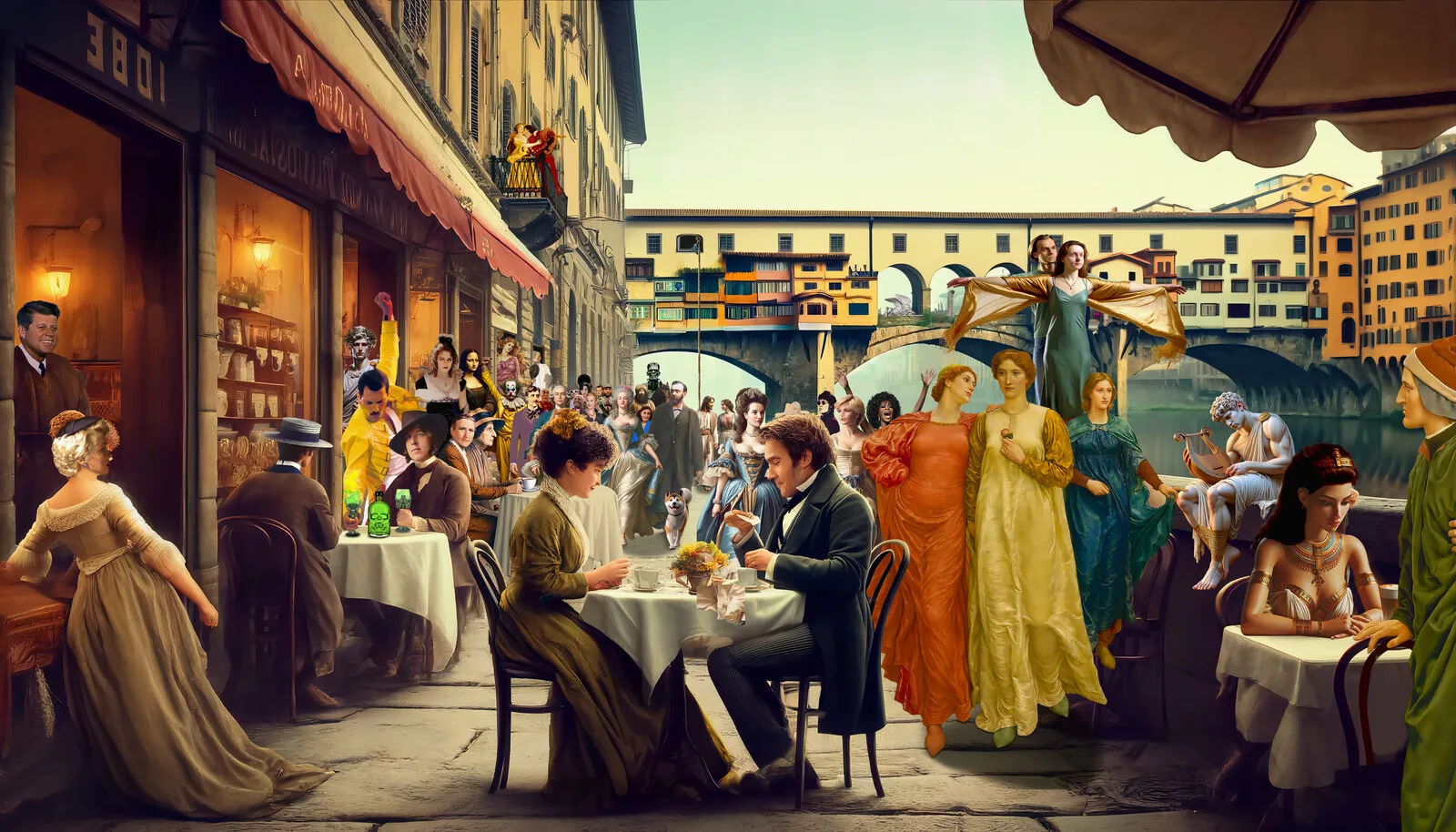
Eternal love, Ponte Vecchio in Florence, 2023
Digital
140 x 80 cm
7 200 kr
My picture gathers Time-Travellers from all eras, witnessing various aspects of love. The image depicts the spurned love, the abused; the unhappy or happy, the self-sacrificing; those who received too much or too little love; stolen love, taken by force, the violent; romantic love; platonic love; maternal and paternal love; and familial and physical love, as Catullus (ca 84–54 BC) described passion, bursting and burning with desire. All varieties are included in the picture in a place known to attract lovers. All these Time-Travelers have their own story to tell. That is the picture. Here is a summary. After that, a longer novella delves deeper into these individuals' lives. The story accompanies the image printed on special paper.
John Keats and Fanny Brawne's love story, a testament to the resilience of love, was marked by deep affection and tragedy. Despite the formidable obstacles of Keats's poor health and financial struggles, their love remained steadfast, inspiring us all with its unwavering strength.
Oscar Wilde and Lord Alfred Douglas. Their forbidden relationship ended in scandal and heartbreak. Despite the costly price of their love, they found solace and strength in each other's company. However, after losing his life's love, Wilde's vibrant spirit was dimmed, and he became a shadow of his former self, a poignant reflection of the devastating impact of love and loss.
Freddie Mercury experienced the passion and pain of love as an openly gay man during a time of prejudice and discrimination. Despite losing his life to AIDS, his love for music and his courage to be true to himself continue to serve as an inspiring example.
Dante Alighieri and Beatrice Portinari. Dante found inspiration and guided his soul through his love for Beatrice, a symbol of purity and beauty. Their love transcended the earthly and became a source of enlightenment and spiritual deepening for Dante.
President John F. Kennedy and Marilyn Monroe represent a forbidden love story that ended in tragedy. Despite their public positions and Marilyn Monroe's naive hopes of becoming his only one, their relationship led to her premature death.
Cleopatra sacrificed everything for her love for Marcus Antonius and lost him and her kingdom. Her passion for Antonius became her downfall, and she returned alone to the earth after losing everything.
Orpheus, the unfortunate demigod from Greek mythology, lost his beloved Eurydice to the underworld and carried the pain of loss through his music and eternal suffering.
Madame de Pompadour and Lady Diana represent two women from different eras who struggled with unhappy love. Despite their influence and success, they struggled with loneliness and expectations from their respective societies.
Whitney Houston's life was marked by success and adversity, including an unhappy love story with Bobby Brown. Despite their tumultuous relationship, Houston continued to shine with her talent and strength despite falling victim to personal demons and heartache.
Mick Jagger’s and Marianne Faithfull’s relationship was marked by turmoil and personal crises, but their unexpected reunion in Florence opens the possibility of new encounters and reconciliation. Despite their difficulties, Faithfull continued to struggle and grow as an artist.
Apollo, the Greek god of the sun, poetry, music, healing, and prophecy, has had his tragedies in love. His loss of the wood nymph Daphne, who turned into a laurel tree to escape his intense courtship, shows that even gods can experience unhappy love and loss.
Greta Garbo, the iconic Hollywood star with a mysterious gaze and magnetic presence, lived a life of romantic adventures and secrecy. Her magnetism and sensual aura made her an object of admiration and desire from all quarters, and her love life continues to fascinate and inspire.
Gertrude Stein and Alice B. Toklas shared a profoundly loving and groundbreaking relationship transcending time and conventions. Their partnership was a love story and a collaboration in intellectual and creative pursuits, and their shared love continues to inspire and shape future generations.
Mona Lisa, man or woman? Leonardo da Vinci's enigmatic masterpiece has inspired many theories about its identity. An Italian researcher now suggests that the portrait may be based on a young man who served as Leonardo's apprentice and possibly his lover, adding a new dimension of interest and controversy to the art world.
The Homosexual Clown. Artists have sparked controversy by creating images of clowns with homosexual undertones, challenging stereotypes and commenting on society's prejudices. They have raised questions about sexuality, identity, and prejudices, highlighting the potential resistance and threat to homosexual individuals in particular cultures and professions.
Marcel Proust, known for his literary masterpiece "In Search of Lost Time," lived a life where his homosexuality was known to close friends and family but never openly acknowledged by himself. Despite public denials, his romantic relationships with men like Reynaldo Hahn and Alfred Agostinelli are documented. His sexual orientation and love life are also reflected in his literary works.
Marie Antoinette and Count Axel von Fersen shared a passionate and complicated love story against a backdrop of political intrigue and revolution. Despite their relationship being shrouded in secrecy and societal expectations, evidence suggests they were lovers. Their love continues to fascinate and inspire, shedding new light on the royal intrigues and passions of the time.
The dog Hachiko's story epitomises loyalty and devotion. This legendary Akita faithfully awaited his deceased master at Shibuya Train Station for years, showcasing a selfless love that touched hearts worldwide. Hachiko's unwavering commitment is a timeless reminder of the enduring power of love and loyalty, inspiring countless tributes and enduring in the annals of history as a symbol of pure devotion.
Anne Frank wrote a diary which depicts her life in hiding during World War II. In it, she also explores her romantic development and attraction to Peter van Pels. Her innermost thoughts and feelings illuminate the universal theme of teenage infatuation and longing for love, even amidst the horrors of war.
His genius characterised Alfred Nobel's life as an inventor and his pursuit of peace and reconciliation. Despite his scientific and business successes, his life was marked by loneliness and an unrealised longing for love. His relationship with Bertha von Suttner, an advocate for peace and disarmament, inspired the creation of the Nobel Peace Prize and reflects the complexity that characterised his life and legacy.
Helen of Troy was known as the most beautiful woman in the world. Helen was a central figure in Greek mythology and the legend of the Trojan War. She was the object of intense admiration and the cause of a long-standing war, but her character is the subject of many interpretations and controversies. She often played against her admirers; her beauty was her gift and curse.
Niccolò Acciaioli was an Italian nobleman and member of an influential banking family. Despite wealth and influence, he suffered from unrequited love for the exiled Empress Catherine II of Constantinople. After her death, he married another woman but remained a patron of art and literature.
Dalai Lama, the spiritual leader of Tibetans, is known for his message of peace and compassion. Despite living in celibacy, he has managed to spread love and guidance to people around the world. His loving nature and deep wisdom have made him a symbol of peace and reconciliation.
Desmond Tutu, a South African Anglican archbishop and human rights activist, represented love and compassion through his life's work. Despite having a happy marriage and family, he was beloved by many for his commitment to justice and peace.
Evita Perón, a prominent figure in Argentine politics and society, was loved by her people for her work for the less fortunate. Despite her tragic death, her legacy lives on and continues to inspire women and leaders around the world.
Kurt Cobain, the guitarist of Nirvana, and Amy Winehouse, the English singer-songwriter, both symbolise tragic fates due to heartbreak and personal struggles. Their lives and deaths are reminders of the high price of emotional pain and the deadly consequence of unfulfilled love.
Romeo and Juliet are reunited in eternity. In this poignant retelling, the tale of Romeo and Juliet takes on a new dimension as we learn about the real-life couple Mariotto and Ganozza, whose love story inspired Shakespeare's masterpiece. Their clandestine romance, born from rival families in Florence, mirrors the tragic fate of literature's most famous star-crossed lovers. Despite the passage of centuries, their story remains a timeless symbol of passion, forbidden love, and the cruel hand of destiny. Through the lens of history, we gain a deeper appreciation for the enduring power and beauty of true love, even in the face of impossible odds.
Fidel Castro and Genghis Khan, the molesters. In this chilling juxtaposition, the narratives of Fidel Castro and Genghis Khan shed light on the dark underbelly of history's most notorious figures. Castro's insatiable sexual appetite and Khan's ruthless exploitation of women paint a stark picture of abuse and power. Their actions serve as a sobering reminder of the pervasive nature of sexual violence throughout history and the enduring impact it has had on countless lives. As their stories unfold, we are confronted with the uncomfortable truth that even the most celebrated figures are not immune to the stain of human cruelty.
Napoleon was defeated in many ways, including in love. The complex legacy of Napoleon Bonaparte comes into focus as we explore his tumultuous romantic relationships and their impact on his larger-than-life persona. Despite his military prowess and political acumen, Napoleon's personal life was marked by betrayal, infidelity, and unrequited love. His obsession with Josephine de Beauharnais reveals a vulnerable side to the French emperor, challenging our perceptions of his ironclad facade. Through the lens of history, we gain a deeper understanding of Napoleon's humanity and the tragic irony of his romantic conquests.
Jesus and Mary Magdalene, a devoted couple, together at last. In a poignant reimagining, Jesus and Mary Magdalene emerge as a dedicated couple whose love transcends the boundaries of time and space. Amidst the grandeur of Florence's architectural marvels, their union is a beacon of hope and redemption, challenging centuries of misconceptions and misinterpretations. As they walk hand in hand, their presence reminds us of the transformative power of love and the enduring legacy of their shared journey. Through their story, we find inspiration to embrace love in all its forms and to seek forgiveness and understanding in a world often consumed by division and discord.
The tragic tale of Frankenstein's monster unfolds with poignant introspection, challenging our preconceived notions of being human. Through the lens of Mary Shelley's timeless classic, we confront themes of isolation, alienation, and the consequences of societal rejection. The monster's quest for acceptance and understanding mirrors our universal longing for connection and belonging. As we grapple with the complexities of creator-creation relationships and existential questions of identity and purpose, we are reminded of the enduring relevance of Shelley's masterpiece in today's age of artificial intelligence and ethical dilemmas.
"Rose and Jack from Titanic" transports readers to the iconic love story of Rose and Jack, immortalised in the film Titanic. Against the setting sun and the river Arno, the Time-Travellers rekindle their forbidden love, defying social norms and familial expectations. Their hearts intertwine as they gaze westward, finding solace in each other's arms amidst the unforgiving world. Despite the passage of time, their love endures, transcending the boundaries of time and space, symbolised by their eternal embrace along the shores of eternity.
"The Sad Winged Lion" introduces readers to the melancholy figure of the Winged Lion, a marble sculpture mourning the fate of Venice and humanity. Carved by the great sculptor Antonio Canova, the lion symbolises the fleeting nature of love and the impending doom of climate change. Canova's journey from humble beginnings to artistic prominence is intertwined with the tragic fate of the lion, culminating in the creation of a butter sculpture that captures the essence of his talent and resilience.
"Mother Canada weeping" shifts the focus to the sculpture of Mother Canada, standing amidst the Ponte Vecchio, shedding tears for the countless lives lost in wars throughout history. From the devastation wrought by Genghis Khan to the horrors of World War II, the sculpture serves as a sad reminder of the staggering human cost of conflict. As war continues to ravage nations and claim lives, Mother Canada stands as a symbol of collective grief, her tears merging with those of mothers and sisters around the world, threatening to overflow the river below.
"Laocoon’s and his sons’ grisly end" recounts Laocoon's warning against the Trojan horse, which his fellow Trojans ignored. Divine retribution ensues as Poseidon and Athena send serpents to kill Laocoon and his sons, serving as a cautionary tale against defying the gods.
"Rapunzel Has Let Down Her Hair" tells the tale of Rapunzel, who recounts her captivity in a tower and forbidden romance with a prince. Themes of love, resilience, and self-discovery emerge as Rapunzel confronts the sorceress and embraces her destiny.
"What is love?" Haddaway sang. Ancient Greek wisdom identifies eight types of love, extending beyond romance. These insights enrich our understanding of human relationships. Love is intertwined with life and happiness, but often, we seek it in the wrong places. While fairy tales end with "happily ever after," real love evolves and manifests in various forms.
Eros, or romantic love, is thrilling but needs nurturing. Philia, or friendship love, is deep and spiritual. Storge, or familial love, is comforting. Ludus, or playful love, keeps the spark alive. Pragma, or enduring love, requires commitment. Mania, or obsessive love, is unhealthy. Agape, or unconditional love, is selfless. Philautia, or self-love, is foundational.
Understanding these nuances helps foster joy and contentment in relationships. Chapman's concept of love languages further elucidates how individuals express and perceive love differently. Recognising and embracing each other's love languages is crucial for nurturing healthy and fulfilling relationships.
Ultimately, love, in its various forms, is the ultimate source of joy in life.
Please read on if you have the time and lust.
A picture vibrating with desire and longing. The image of Lungarno degli Acciaiuoli, the stretch of street between Ponte Santa Trinita and the world's most beautiful bridge, Ponte Vecchio, shows how, on this particular day, a small café has attracted a gathering of individuals who, despite being from different times and places, share a common thread-they all belong to eternity. These 'Time-Travelers ', apart from Mick Jagger and Marianne Faithful, have in common longing, unhappy or unfulfilled love, or the choice to forsake it; their earthly love relationships were painful and sometimes fatally so. That's why they've come to one of the most romantic cities to remember, often with the one who betrayed them or whom they betrayed. After they left Earth, many could reunite, and their love in eternity was fulfilled. Not all, unfortunately; some have had to continue their loneliness beyond the vault of heaven.
Fanny Brawne and John Keats
In the foreground, Fanny Brawne and John Keats are having breakfast. The renowned English Romantic poet shared a poignant love story with Miss Brawne. Their relationship was marked by intense passion but also tinged with tragedy.
Keats met Fanny Brawne in 1818 when he moved into a house neighbouring hers in Hampstead, London. Despite initial misunderstandings and differences in social backgrounds, they soon fell deeply and passionately in love. Their romance, a testament to the power of love and longing, blossomed amidst Keats's creative enthusiasm and Brawne's lively spirit. They exchanged numerous letters, many of which are considered literary treasures today, showcasing their profound affection and longing for each other.
However, their love faced significant challenges, including Keats's precarious financial situation and declining health. Keats was struggling with tuberculosis, a disease that would ultimately claim his life at a tragically young age.
Despite the obstacles, Keats and Brawne's love remained steadfast. Their love story was not just a tale of passion but also of inspiration. With her vibrant spirit, Brawne served as both muse and confidante to Keats, nurturing his poetic endeavours and enriching their love with creativity.
Tragically, their time together was cut short. Keats's health deteriorated rapidly, and in 1821, he left for Italy for a better climate. He bid farewell to Brawne, knowing they might never meet again. Keats died in Rome the following year, at 25, far from his beloved Fanny.
The love story of John Keats and Fanny Brawne is immortalised in Keats's poetry and letters, reflecting both the joy and sorrow of their relationship. Their love story remains a poignant symbol of romance and enduring passion despite its brevity.
Their contented appearance stems from their forever living together on a star they named 'Bright Star,' like Keats' poem to her.
Oscar Wilde and Lord Alfred Douglas
Oscar Wilde licks his wounds at the neighbouring table with his boyfriend, Lord Alfred Douglas, after the scandal erupted back home in England about their forbidden relationship. What better way than a long-forbidden drink, Absinthe, the murky green devil's brew? Freddie Mercury serves them the drink with an exaggerated gesture, Freddie whose love cost the singer his life. In a way, they share fates, he and Wilde, even though Oscar Wilde faded away after his life's love was taken from him.
Freddie Mercury
Freddie Mercury, the legendary frontman of Queen, captivated the world with his unparalleled voice, electrifying stage presence, and unapologetic flamboyance. Behind the glitz and glamour, however, lay a complex story of love and loss.
Mercury's journey was one of unbridled passion and exploration in his music and personal life. As an openly gay man in an era marked by prejudice and discrimination, he fearlessly challenged societal norms and embraced his identity with unwavering pride.
Yet, it was this same love that ultimately cost him his life. Amid the AIDS epidemic, Mercury became one of its most high-profile victims, succumbing to the disease in 1991 at the age of 45. His untimely death sent shockwaves through the music world and beyond, shining a spotlight on the devastating impact of HIV/AIDS and the urgent need for awareness and acceptance.
Despite the tragic circumstances of his passing, Mercury's legacy endures as a beacon of hope and resilience. His music continues to inspire and uplift millions around the globe, reminding us that love knows no bounds and that even in the face of adversity, our spirits can soar.
In the end, Freddie Mercury's life may have been cut short, but his spirit is a testament to the power of love, creativity, and the indomitable human spirit.
Dante Alighieri and Beatrice Portinari
A few steps away from Oscar and his boyfriend by the river Arno, just after the bridge, as you see in the picture, where the shadows whisper tales of love and tragedy, Dante Alighieri, the revered poet, found his muse in Beatrice Portinari, a vision of purity and grace. Their encounter was not one of earthly passion but of divine inspiration.
For Dante, Beatrice embodied the ideal of beauty and virtue, a beacon guiding his soul through the tumultuous journey of life. Their meeting, immortalised in Dante's "La Vita Nuova," sparked a flame that ignited his most excellent work, "The Divine Comedy."
With her radiant presence and ethereal essence, Beatrice became Dante's guide through the circles of Hell and Purgatory and finally to the gates of Paradise. She revealed to him the mysteries of love, redemption, and the universe's divine order in each realm.
Their reunion in the afterlife, depicted in the "Paradiso," transcended mortal limitations as Dante beheld Beatrice in her celestial glory, surrounded by the splendour of heaven. Their purified and sanctified love symbolised the eternal quest for truth and salvation.
Dante and Beatrice never had each other in their lifetime. Their meetings were few and brief. Beatrice was also married to another man, Simone dei Bardi, which further limited the possibility. Despite this, Dante developed a deep love and devotion to Beatrice, and she became a central figure in his life and poetry. Their relationship flourished and became legendary primarily through his writing and spiritual bond with her.
The union of Dante and Beatrice is a tale of earthly romance and a testament to the transformative power of love and the enduring legacy of the human spirit.
President John F. Kennedy next to Marilyn Monroe
In the doorway just to the left in the picture stands, half-obscured, President John F. Kennedy next to Marilyn Monroe dressed in a Renaissance gown and a whimsical hat atop her blonde hair. He wasn't eager to be seen, a president married with two children, and Marilyn naively believed he would leave Mrs. Kennedy for her sake. Marilyn was exploited by many, not least by the film mogul Louis B. Mayer, making #Metoo's pig Harvey Weinstein seem innocent as a choirboy. But it was the unfortunate love for Kennedy that ultimately cost Marilyn her life, whether she received help or succumbed to an overdose.
Cleopatra, Egypt's last pharaoh
Cleopatra, Egypt's last pharaoh, sits alone at her café table, contemplating how her love for Marcus Antonius took her life, how she brought the poisonous serpent to her bosom and let it inject its venom. She had lost everything, her love and her land. From her star, Cleopatra has returned to Earth alone; Mark was preoccupied with an interstellar meeting with the ancient triumvirate.
Orpheus playing his lyre.
Had she wished, she could have made the acquaintance of Orpheus. On top of the wall behind Cleopatra, facing the river, sits the unhappy demigod, playing his lyre.
Orpheus, a figure from Greek mythology, is often unhappy due to the tragic events surrounding his life—the tragic tale of his wife, Eurydice. When Eurydice died, Orpheus, profoundly grieving, journeyed to the Underworld to plead with Hades, the god of the dead, to allow her to return to the world of the living. Hades agreed, under the condition that Orpheus not look back at Eurydice until they reached the surface. However, overcome with doubt and longing, Orpheus couldn't resist the urge to glance back, losing Eurydice forever as she faded back into the shadows of the Underworld.
This loss and the subsequent sorrow define much of Orpheus's story. Additionally, Orpheus's exceptional musical talents and his ability to charm all living creatures with his music often serve as a bittersweet reminder of the beauty and love he lost. His melancholy is thus a result of profound love and the pain of irrevocable loss.
Madame de Pompadour and Lady Diana
Behind Beatrice and her friend walk two strong women with more in common than one might initially realise. These two, Madame de Pompadour and Lady Diana, each represent an iconic and influential historical figure. Despite living in different eras and under different social conditions, they shared many similar traits that made them noteworthy in their societies and the memory of posterity.
Madame de Pompadour, born Jeanne Antoinette Poisson, occupied a central place at the French court as the mistress of King Louis XV during the 1740s and 1750s. Her beauty, elegance, and intelligence made her a significant figure as the king's mistress and a political and cultural power at the court. Madame de Pompadour actively promoted art, literature, and science, and she was a prominent patroness for many artists and writers of her time. Despite her position as a mistress, she could influence politics and foreign policy through her sway over the king.
Similarly, Lady Diana Spencer was a central figure in the British royal family during the late 20th century. As the Princess of Wales and through her marriage to Prince Charles, she became one of the British royal family's most beloved and admired members. Lady Diana's charm, kindness, and commitment to charity made her a beloved figure worldwide. She was known for her work in raising awareness of and combating the stigma surrounding HIV/AIDS and for her work supporting charities that worked with children, single parents, and people affected by war and conflict.
Madame de Pompadour and Lady Diana were known for influencing fashion and style. Madame de Pompadour set trends and became a style icon in her time. At the same time, Lady Diana was known for her distinctive style, which combined elegance with modernity and inspired many people worldwide.
Although Madame de Pompadour and Lady Diana lived in different historical and social contexts, they shared many similar traits that made them significant historical figures. Their influence extended beyond their periods and has continued to inspire and fascinate people long after their deaths.
Both Madame de Pompadour and Lady Diana experienced elements of unhappy love in their lives.
Fluctuations and challenges characterised Madame de Pompadour's relationship with King Louis XV despite her influential position as his mistress. While she held considerable sway over the king and played a pivotal role in the French court, her romantic entanglement with Louis XV was complex. Their liaison was subject to the complexities and intrigues of court politics, and Madame de Pompadour often had to contend with rivals and detractors. Additionally, her longing for genuine love and emotional fulfilment beyond the confines of her role as the king's mistress is a recurring theme in historical accounts of her life.
Similarly, Lady Diana's marriage to Prince Charles was marked by strains and eventual estrangement, culminating in their highly publicised divorce in 1996. Despite the fairy-tale image projected by their union, their relationship faced challenges, including differences in temperament, incompatible interests, and extramarital affairs on both sides. Lady Diana's struggles with loneliness, depression, and the feeling of being unfulfilled in her marriage became increasingly evident over time, contributing to the narrative of her unhappy love life.
Thus, while Madame de Pompadour and Lady Diana occupied vastly different roles and lived in different eras, they grappled with the complexities and disappointments of romantic relationships, adding a layer of tragedy to their otherwise illustrious lives.
Houston rejoices in being free.
Right behind, Whitney Houston rejoices in being free from the burdens of earthly life and from partners like Brown. Whitney, one of the most iconic singers in music history, lived a life filled with brilliant successes and deep trials, including an unhappy love story that affected her in many ways.
Houston was a star from a young age, and her powerful voice and charisma made her one of the most prominent artists of the 1980s and 1990s. Despite her professional successes, Houston struggled with personal demons, including drug abuse and tumultuous romantic relationships.
One of Houston's most well-known and unhappy love stories was her marriage to Bobby Brown, another prominent artist. Despite initially being seen as a glamorous and powerful duo within the entertainment industry, their marriage was characterised by conflicts, drug abuse, and public scandals. For Houston, her marriage to Brown meant a budding career that gradually became overshadowed by personal and professional problems.
The unhappy love story between Houston and Brown became part of their public image and was closely followed by fans and the media. Despite their talents and successes, their relationship seemed unable to overcome the challenges they faced, and their marriage ended in a painful divorce in 2007.
Whitney Houston showed strength and vulnerability throughout her life and career, and her struggle with unhappy love often reflected her deeper battles. Despite encountering many difficulties in her personal life, Houston continued to be one of the most admired and beloved artists in music history, and her legacy lives on through her timeless music and indelible impact on popular culture.
Mick Jagger’s and Marianne Faithfull’s reunion
Mick Jagger’s and Marianne Faithfull’s reunion in Florence happened by chance, but perhaps it could lead to more encounters. The vibrations from the surroundings were strong, even though they only recognised a few faces. A dark-skinned woman in front of them could have sworn it was Whitney Houston, but since she was deceased, they laughed at how eyes and imagination can deceive. A couple resembling the late President Kennedy and Marilyn Monroe also caught their attention.
Marianne Faithfull's journey through the 1970s was marked by tumultuous personal struggles that significantly impacted her career and well-being. Her relationship with Mick Jagger came to an end in May 1970 when she began an affair with Anglo-Irish nobleman "Paddy" Rossmore, leading to a loss of custody of her son and a subsequent suicide attempt. This period of her life saw Faithfull grappling with addiction, homelessness, and a decline in her musical output.
Living on the streets of London's Soho, Faithfull battled heroin addiction and anorexia nervosa for two years. Despite efforts from friends to intervene, her addiction persisted, and she struggled to stabilise her life. In 1971, producer Mike Leander attempted to revive her career by producing part of her album Rich Kid Blues, although the album remained shelved until 1985.
The effects of severe laryngitis combined with ongoing drug abuse permanently altered Faithfull's voice, resulting in a cracked and lower pitch. Despite these challenges, she released albums such as Dreamin' My Dreams (1975) and Faithless (1978), experiencing varying degrees of success. Faithfull's personal life continued to be turbulent, marked by brushes with the law and ongoing substance abuse.
In 1979, Faithfull's career experienced a resurgence with the critically acclaimed album Broken English, influenced by the punk movement and her marriage to Ben Brierly. The album showcased her raw vocals and addressed themes such as terrorism and personal turmoil. However, her struggles with addiction persisted, culminating in a disastrous appearance on Saturday Night Live in 1980.
Transitioning to New York City in the 1980s, Faithfull continued to battle addiction while maintaining her musical career. Despite setbacks, she released albums such as Strange Weather (1987), which received critical acclaim for its jazz and blues influences. Throughout the decade, Faithfull's personal life remained tumultuous, marked by failed relationships and ongoing struggles with substance abuse.
Faithfull's career experienced highs and lows in the following decades, with notable releases such as Blazing Away (1990) and Before the Poison (2005). Despite ongoing challenges, including health issues and personal losses, Faithfull continued to create music and garner recognition for her contributions to the industry.
Faithfull's resilience and artistic evolution testify to her enduring legacy in the music world. Despite facing numerous obstacles throughout her career, she remains a revered figure and continues to inspire audiences with her distinctive voice and candid storytelling. Through triumphs and tribulations, Marianne Faithfull's journey is a testament to the power of perseverance and artistic expression.
2
The Greek god Apollo has had his tragedies.
Behind the pop deity Mercury, a god past his prime, the Greek god Apollo is glimpsed. Despite being associated with the sun, poetry, music, healing, and prophecy, Apollo has had his tragedies and appears grim.
The one who has pained him the most is the story of Daphne. Apollo fell in love with the young forest nymph Daphne, but she rejected his love and fled from him. He refused to give up and subjected her to what is now called stalking. To escape Apollo's intense pursuit, Daphne was transformed into a laurel tree by her father, the river god Peneus. Apollo was devastated to lose his beloved but honoured her by making the laurel leaf a symbol of victory and success. Although Apollo has not suffered from a troubled love life to the same extent as Orpheus, the story of Apollo and Daphne shows that even gods can experience unhappy love and loss. The laurel wreath he wears is a homage to the love forever lost.
The divine Greta Garbo
If he reached out his hand, he would touch the divine Greta Garbo, who sought but never found love and trust, preferring to live alone. The Hollywood star Garbo never got over losing her life's passion – actress Mimi Pollak. Greta couldn't know they would reunite in eternity and be partners on a brightly shining star.
Greta Garbo, the iconic Hollywood star with the enigmatic gaze and magnetic presence, was not only known for her talent on the silver screen but also sought solace in many love affairs spanning the entire gender spectrum. Garbo maintained a mysterious persona outside of film, and her love life was a subject gossip columnists struggled to grasp—Corpus delicti.
Garbo had a knack for fascinating both men and women. Her magnetism and sensual aura made her an object of admiration and desire from all quarters, and it was no surprise that she attracted interest among people in and out of Hollywood. The president tried to get her into bed during a private dinner at the White House with the Kennedy couple. She resisted, blaming her age for such things.
With many famous admirers, including male and female stars, Garbo had a reputation for being romantically involved and secretive about her private life. From her alleged relationship with actress Marlene Dietrich to her romances with men like John Gilbert and women like Mercedes de Acosta, Garbo wasn't afraid to explore different aspects of her sexuality and love life.
It was somewhat startling for the society of the time to see such a prominent star as Garbo surrounded by male and female admirers. Still, her outspokenness and independence made her a pioneer of sexual freedom and self-expression. Despite her attempts to keep her private life out of the public eye, Garbo couldn't avoid being the subject of gossip and speculation.
In the end, perhaps Garbo's enigmatic charm and magnetism drew people from all walks of life, regardless of gender. Her love life and romantic adventures continue to fascinate and inspire, and her place in Hollywood history is cemented as one of the most iconic stars ever.
Gertrude Stein’s and Alice B. Toklas’ enduring love story
Beneath Greta, there is a couple whose journey has spanned many years. Gertrude Stein and Alice B. Toklas shared an enduring love story. The renowned writer found steadfast companionship and unwavering support from her fellow American expatriates in Paris.
Gertrude Stein and Alice B. Toklas shared a remarkable bond transcending time and convention. Their partnership was not only one of love but also of intellectual and creative collaboration.
Gertrude Stein, a pioneering American writer and art collector, found Alice B. Toklas not only a romantic partner but also a muse and confidante. Toklas, known for her wit and intelligence, gave Stein unwavering support in her literary and artistic endeavours.
Their home in Paris became a vibrant hub for artists, writers, and intellectuals during the early 20th century. Here, Stein famously hosted salons that attracted luminaries such as Pablo Picasso, Ernest Hemingway, and F. Scott Fitzgerald.
Their relationship was marked by mutual respect, admiration, and a deep emotional connection. Toklas played a crucial role in Stein's life, serving as her editor, manager, and companion.
Their love story and partnership were groundbreaking for their time, challenging societal norms and expectations. Together, they defied convention and created a life that was uniquely their own.
Beyond their relationship, Stein and Toklas left a lasting impact on the literary and artistic world. Stein's experimental writing style and Toklas's literary contributions continue influencing generations of writers and thinkers.
In essence, Gertrude Stein and Alice B. Toklas embodied a love that was both enduring and transformative, leaving behind a legacy that extends far beyond their years together. Now they were back and had revisited Venice along the way, where the couple had fed pigeons together during a romantic trip in 1908. This time, however, they had discreetly fed the birds. In the UNESCO-listed Italian city, feeding these birds has been banned since 2008—and with good reason: Acidic excrement left behind by pigeons damages the delicate mosaics that adorn historic buildings and monuments. Fines for feeding pigeons in Venice can reach up to €700, which is not a problem for a Time-Traveller. They print their euros, impossible to distinguish from genuine ones, so Venice's pigeons had received a hearty meal when Gertrude and Alice were there.
Mona Lisa, man or woman?
Mona Lisa, standing in the doorway behind, looks a bit concerned. Lisa has reason to be. The truth about Mona Lisa's identity is creeping closer with modern technology. Speculation about the person with the enigmatic smile has persisted since da Vinci's death. Initially, it was primarily women who were pointed out, but lately, there has been doubt about the gender. The Mona Lisa is androgynous—half man and half woman. The female influence could be from Gherardini or perhaps Beatrice D'Este, wife of Milanese duke Ludovico Sforza, whose court Leonardo worked at during the late 15th century. But much indicates that it could be a feminine man or a clever combination. Leonardo could write in reverse; perhaps it's the same as Mona Lisa in the painting; it should be Mona Salai instead.
Little is known about Leonardo's sexuality, as he left behind hundreds of pages of writing, but very little of it pertains to his personal life. He did not leave any letters, poetry, or diary entries indicating romantic interests. Leonardo never married, and there is no definitive evidence of his intimate relationships with either men or women. However, art historian Raymond Stites suggested that Leonardo may have been romantically involved with Cecilia Gallerani, the subject of his painting 'Lady with an Ermine'. Leonardo could be described as bisexual but with a clear preference for men. In his youth, he faced anonymous accusations of sodomy and had to defend himself publicly. The trauma of this accusation made him cautious for the rest of his life, although he did engage in a few affairs with women, which helped maintain his reputation.
Maybe it wasn’t a woman, but the ‘Mona Lisa’ is based on Leonardo’s Male Lover. Leonardo da Vinci's enigmatic masterpiece has captivated audiences for centuries, yet the true identity of the Renaissance artist's most famous subject remains a mystery. In a fascinating twist, an Italian researcher has proposed a theory that the image was primarily inspired by a young man who served as Leonardo's apprentice and possibly his lover, sparking a new wave of intrigue in the art world.
The Mona Lisa exhibits striking similarities to Gian Giacomo Caprotti, also known as Salai. This conclusion is not drawn lightly but after meticulous examination of infrared scans of the renowned artwork and comparison to other works by Leonardo, for which Salai was known to have posed.
Particularly significant are the similarities in the nose, forehead, and smile of the Mona Lisa—furthermore, a rarely displayed drawing by Leonardo, 'St. John the Baptist and Angel Incarnate,' depicting a young boy with an erection, is believed to be another work inspired by Salai, adding a new layer of depth to our understanding of Leonardo's art and personal life.
Salai began his apprenticeship with Leonardo around the age of 10 in 1490 and was known for his mischievous nature—his nickname, "little devil," reflects this. He worked closely with the Renaissance master for two decades, and their relationship is widely believed to have been romantic, at least sexual.
While the most accepted theory is that Lisa Gherardini, the wife of an Italian silk merchant, served as the model for the Mona Lisa, others have suggested alternative theories, including the possibility of a self-portrait, a depiction of Leonardo's mother, or an enslaved Chinese person.
While the possibility of Salai posing for the iconic portrait is gaining traction among scholars, it is not without its detractors. Critics argue that such theories may blur the lines between fact, speculation, and fantasy, but few are willing to dismiss the possibility, altogether adding to the ongoing debate.
Salai's influence on the canvas was significant but not exclusive. Some experts believe that the Mona Lisa embodies both male and female traits, suggesting that the female influence part could have come from Gherardini or Beatrice D'Este, the wife of Milanese duke Ludovico Sforza, under whose patronage Leonardo worked during the late 15th century. While most historians date the creation of the Mona Lisa to 1503, some suggest that Leonardo may have started the masterpiece during his time in Milan in the 1490s.
In other words, Lisa del Giocondo, known as the Mona Lisa, has reason to be nervous because the truth is troubling for a woman who has been hailed as a faithful wife for half a millennium. Lisa was a mother to six children and had many grandchildren when she died at the convent of Sant'Orsola. For four hundred and fifty years, Lisa has enjoyed the honour of being the Mona Lisa, Leonardo's masterpiece. That reputation has served her well among the stars. For understandable reasons, da Vinci has remained silent for just as long. No one living in eternity can claim that "seeing is believing." That privilege is reserved for those who breathe on earth. Although time is infinite, the truth will eventually come to light and reach even there. Hence Lisa's troubled expression.
The gay clown
It's not just Lisa who looks worried. But the clown next to her seems not only concerned but also furious. Photographer Dusti Cunningham has turned clowns into full-blooded gays with bare chests and explicit sexual innuendos. You might call them leather gays! Most people find clowns funny or terrifying, but now Cunningham has made them arousing, half-naked with their pants halfway down and their faces smeared with a big, lewd grin. Care to join the circus? The macho Putin hates being depicted as a gay clown. Putin has overseen oppressive laws curbing LGBTQ rights in Russia. Déjà vu!
What worries our clown in the picture is that the clown’s private life will be exposed. Many are, in fact, gay but haven't come out of the closet. It would probably be devastating for their career.
Have you ever heard of the clown that hides from gay people? If you haven't seen the clown, that's probably because he's hiding from you. But the clown only hides from gay people, they say. What good does it do that it's an expression of black humour? Humour to comment on prejudices or stereotypes. It ironically suggests that if someone hasn't seen a certain clown, it might be because the clown is avoiding them due to their sexual orientation. It's a way to highlight and challenge homophobia by using an absurd and exaggerated premise. But it's important to remember that this saying, like all jokes, can be interpreted differently and may not necessarily be appropriate or acceptable for everyone. It does not make our clown happier but instead prompts him to raise his clenched fist in protest.
3
Marcel Proust never came out of the closet.
He lived in the same century as Marcel Proust, the man next to him in the picture, with whom he had a secret relationship. Still, they live together openly on a star in the Magellanic Clouds, conveniently distant from Earth, just 160,000 light-years away.
Proust never came out of the closet and openly acknowledged his homosexuality, although it was widely known or suspected by his family and close friends. In 1897, he even duelled with writer Jean Lorrain, who publicly questioned the nature of Proust's relationship with his lover Lucien Daudet; both duelists survived the encounter. Despite Proust's public denials, his romantic involvement with composer Reynaldo Hahn and his infatuation with his chauffeur and secretary, Alfred Agostinelli, are well-documented.
On a January night in 1918, Proust was among the men identified by police in a raid on a male brothel operated by Albert Le Cuziat. Proust's friend, the poet Paul Morand, openly teased him about his visits to male prostitutes. In his journal, Morand describes Proust and Gide as "constantly hunting, never satiated by their adventures ... eternal prowlers, tireless sexual adventurers."
The precise impact of Proust's sexuality on his writing remains a subject of debate. However, "In Search of Lost Time" extensively discusses homosexuality and features several main characters, including Baron de Charlus, Robert de Saint-Loup, Odette de Crécy, and Albertine Simonet, who are either homosexual or bisexual. Homosexuality also emerges as a theme in "Les plaisirs et les jours" and his unfinished novel, "Jean Santeuil".
Proust's disdainful look at the man next to him is not surprising, not just because of the powdered wig. Despite all the powder, he was a faithful and ladies' man, in many ways the opposite of Marcel. Count Axel von Fersen the Younger from Sweden was a manly man and a defender of the monarchy. At the same time, Proust inherited his mother's liberal streak and was a republican. Proust knew very well who the woman in the count's company was, Marie Antoinette, the beheaded queen of France. It fascinated him that the beheaded of all time did not appear among the stars with their severed heads under their arms. They were in their place just as they were in the glory days of these time travellers.
Marie Antoinette and lover Count Axel von Fersen.
Marie Antoinette was a beautiful woman, dressed as she was when she was still queen and lived in the Versailles palace. She walked proudly with her head held high and a wig that obstructed the view of the girl behind her, Anne Frank. Her presence here was not due to misunderstood love but because she was hardly loved by anyone other than Count Fersen. The king lived his life; their marriage was convenient, and the children were for the sake of succession, whom she barely saw—there were servants for that. Her people hated their queen, who lived among the clouds while the French crawled in the dust and starved. The Austrian, they called her. Imagine being so hated.
Her lover, the Count, was no more beloved than his girlfriend and was murdered by the mob in Stockholm in 1810. I will tell you a juicy and amusing tale about the count’s and the queen's affair, suggesting that her second son was the count's and not the king's. In the annals of romantic intrigue, there exists a tale of tangled affections that transcends the bounds of ordinary courtly dalliances. It is a tale woven with threads of desire, secrecy, and the capricious whims of fate, set against the backdrop of the opulent courts of 18th-century Europe, where societal expectations and political pressures often dictated the course of love.
Axel was a figure whose amorous escapades would make even the most scandalous gossipmongers blush with envy. In a letter to his sister Sophie Piper, Axel famously declared, "I have made my decision. I shall never marry." His rationale? "I cannot belong to the one woman I truly desire, the only one who truly loves me, and thus I refuse to bind myself to another." This "one woman" happened to be none other than the Queen of France herself, Marie Antoinette, a woman who stirred his heart and challenged his convictions.
Fersen was a man of strong erotic nature. In his diary, we encounter a lifelong parade of married women. He was a seducer on par with the infamous Casanova. He loved many, but it is doubtful whether the high-born women loved more than what he had between his legs. Rumours of his prowess in the bedroom had even reached the other side of the Atlantic. During the revolutionary years, he bedded both Indian princesses and the wives and daughters of revolutionaries.
The literature surrounding Axel F.'s relationship with Marie Antoinette has been the subject of much debate. Were they lovers in the truest sense of the word? In 1783, both were 28 years old, and despite the queen having borne children, her happiness with the shy, feeble, and decidedly mediocre Louis XVI seemed lacking. He lived his life mostly hunting ducks. Their bond, already tested by societal expectations, strengthened amidst the turmoil of the revolution, with Axel becoming her steadfast support in a world turned upside down.
Upon Axel's return in 1783, it appears that the flames of passion were reignited in the queen's heart, and "le beau F." emerged as the great love of her life. However, Axel's feelings towards Marie Antoinette were more complex. A man of strong erotic inclinations, Axel's diary reads like a catalogue of romantic conquests, with married women featuring prominently. While undoubtedly enamoured with Marie Antoinette in 1783, she was not his sole paramour, even during his time in France.
His second grand love affair occurred in Paris with the Italian Eleonore Sullivan, a woman of dubious reputation who flitted from one scandalous liaison to another. Despite Axel's disdain for her, he entertained thoughts of marrying her, a testament to his convoluted romantic entanglements. Yet, amidst it all, Marie Antoinette remained the central figure in his life.
Evidence of Axel and Marie Antoinette's love abounds, though the strict etiquette and surveillance of the French court made their liaison anything but straightforward. While Axel's relationship with Eleonore is documented extensively in his diary, his interactions with the queen are marked by discretion. However, numerous indicators suggest that he was indeed her lover, a perception many of their contemporaries shared.
The censorship and destruction of Marie Antoinette's letters to Axel and his responses point to a relationship far more intimate than mere friendship. One preserved note from the queen to Axel ends with the words, "Farewell, the most beloved and loving of men. I embrace you with all my heart," hardly the language of platonic affection.
The birth of Marie Antoinette's son, Louis Charles, on March 27, 1785, sparked speculation that he was Axel's progeny, a rumour eagerly seized upon by revolutionaries. Axel remained silent on the matter, leaving historians to ponder the nature of their love affair. While concrete evidence may be lacking, the abundance of clues suggests that Axel F. was indeed the queen's genuine paramour.
In the annals of history, Axel F. and Marie Antoinette's romance is a testament to the enduring power of passion amidst political upheaval. Though hidden from the world, their love continues to echo through the corridors of time, a tantalising glimpse into a world where desire knows no bounds.
The Unwavering Devotion of Hachiko is a testament to selfless love.
Next to Marie Antoinette, a loveful dog. In the bustling heart of Tokyo, amidst the chaos of daily life, lies a tale that transcends time and culture—a story of unwavering devotion and undying love. This is the story of Hachiko, the legendary Japanese Akita whose loyalty to his master knew no bounds. It's a story that resonates with people from all walks of life, regardless of their cultural background or geographical location.
Hachiko's tale unfolds in the early 1920s when Japan underwent rapid modernisation and societal changes. During this period, Professor Hidesaburo Ueno, a revered figure at the University of Tokyo, welcomed him into his life. From the instant they crossed paths, a unique bond of love and companionship was forged between man and dog, a bond that would transcend the boundaries of mortality.
Every morning, Hachiko faithfully accompanied his master to the Shibuya Train Station, where Professor Ueno would catch the train to work. And every evening, like clockwork, Hachiko returned to the station to greet his master upon his return. This routine continued unfalteringly until one fateful day in May 1925 when Professor Ueno suffered a fatal stroke while at work and never returned home.
Even in the absence of his cherished master, Hachiko continued his vigil at the train station, day after day, week after week. As time passed, Hachiko's loyalty became a beacon of hope, touching the hearts of the station staff and commuters alike. They were moved and inspired by the sight of the faithful Akita patiently awaiting his master's return, a testament to the power of unwavering devotion.
Hachiko's story spread far and wide, symbolising loyalty and devotion across Japan and beyond. His unwavering commitment to his master touched the hearts of millions, inspiring countless books, films, and tributes to his remarkable tale. His story is not just a fad but a timeless testament to the power of love and loyalty that resonates with people today.
What makes Hachiko's story so poignant is not just his loyalty to his master but the depth of his selflessness and sacrifice. Despite the passage of time and the inevitability of loss, Hachiko chose to remain steadfast in his love, finding solace in the simple act of waiting, even in the face of despair.
In a world often marked by fleeting relationships and transient affections, Hachiko's story shines as a symbol of enduring love—a reminder that true devotion knows no bounds. His tale is a powerful lesson in selfless love, teaching us that the most precious gift we can offer is the gift of unwavering loyalty and unconditional affection. Hachiko's story also teaches us the importance of patience and resilience and the value of cherishing every moment with our loved ones.
As we reflect on the tale of Hachiko, let us strive to emulate his example in our own lives—to love fiercely, remain faithful in the face of adversity, and cherish each moment we are blessed to spend with those we hold dear. I remember the first time I heard Hachiko's story; I was moved to tears by his unwavering love. His story taught me that it's not the length of time we spend together that matters but the depth of the love that binds us, transcending time and space and forever uniting kindred souls in the eternal embrace of devotion.
The beloved Anne Frank
The hidden girl is named Anne Frank and is, after the war and being murdered by the Nazis, loved by millions of righteous people around the world who have read her diary and shared her innermost thoughts. She never fulfilled her dreams, for the teenage girl was in love, and the Nazies came in between.
Anne Frank remains an emblem of resilience, courage, and hope amidst unfathomable adversity. Her diary, penned while in hiding during the Holocaust, offers a poignant window into the inner workings of a young girl grappling with the horrors of war and the challenges of adolescence.
Yet, within the pages of her diary, amidst the profound reflections on human nature and the longing for freedom, Anne's writings also touch upon a more controversial aspect of her inner world—her emerging sexuality and romantic desires. As she navigates the confines of the Secret Annex, Anne candidly shares her thoughts and feelings about her budding romantic attraction to Peter van Pels, another inhabitant of their hiding place.
Initially, Anne expresses annoyance towards Peter, finding him dull and uninteresting. However, as time passes and they share the intimate space of their hiding spot, Anne's feelings towards Peter begin to evolve. She confides in her diary about her growing fondness for him, describing moments of intimacy and longing that she experiences in his presence.
These revelations have sparked debate and controversy among scholars and readers alike. Some view Anne's exploration of her romantic feelings as a natural and relatable aspect of her adolescence, adding depth to her portrayal as a multifaceted individual. Others, however, criticise the focus on Anne's romantic inclinations, arguing that it detracts from the broader significance of her diary and the lessons to be learned from her experiences during the Holocaust.
Nevertheless, Anne's examination of her sexuality and romantic yearnings reminds us of the universal nature of human experience. Amid unspeakable suffering and loss, Anne's diary illuminates the resilience of the human spirit and the enduring power of love and connection.
Alfred Nobel's life with a life of Innovation and a Legacy of Peace
Ahead of Anne walks a man who never got to fulfil his love, both by his own will and by the force of circumstances. Alfred Nobel looks at the queen's head, for he has naturally recognised her. Alfred was an educated man, not a socialist, but also not an admirer of the upper class.
Alfred Nobel's life and work can be summarised in a short sentence - A Life of Innovation and a Legacy of Peace. Nobel, a pioneering inventor and industrial titan, stands as a symbol of progress and peace. His life and achievements have left a profound impact on the world, and his creation of the Nobel Prize has become one of the most prestigious awards globally, with significance stretching far beyond Sweden's borders.
Nobel, born in Stockholm in 1833, was a prodigy in science and technology. His revolutionary inventions, such as dynamite, transformed warfare and industry and had a profound global impact. Despite his scientific and business triumphs, Nobel's personal life was marked by a constant yearning for love and an unsuccessful quest for a life partner.
One of Alfred Nobel's most poignant aspects is his relationship with Bertha von Suttner, an Austrian writer and peace activist. Their meeting in Paris in the 1870s sparked a deep friendship and intellectual bond. Despite Nobel's yearning for love and happiness with von Suttner, their relationship remained unfulfilled and platonic.
However, von Suttner's passion for peace and her work for disarmament and international reconciliation profoundly influenced Nobel and inspired the creation of the Nobel Peace Prize. The year before Alfred died in 1896, von Suttner published her novel "Lay Down Your Arms!" a powerful depiction of the horrors of war and a call for peace. After Alfred's death, she became the first woman to be awarded the Nobel Peace Prize in 1905.
Nobel's longing for love and personal failures contrasted with his efforts to promote peace and reconciliation through the Nobel Prize. Since its establishment in 1901, the Nobel Prize has celebrated and rewarded outstanding achievements in literature, science, peace, and economics. For Sweden, the Nobel Prize has become a symbol of national pride and international recognition, with its ceremonies and announcements being annual highlights that gather leading scholars, writers, and activists to Stockholm and Oslo.
Alfred Nobel's life and legacy remind us of humanity's complexity. He was a master of innovation and progress and an individual whose pursuit of love and happiness was never fully realised. Through the Nobel Prize, his spirit lives on, and his desire for a better and more peaceful world inspires and guides future leaders and visionaries. Alfred remains alone on his star and likely will stay so for eternity, for if he doesn't get Bertha, no one else is good enough.
4
Helen of Troy, the woman with many names
Behind the angry clown in a doorway stands Helen of Troy, the woman with many names, including beautiful Helen, Helen of Argos, or Helen of Sparta, who is said to have been the most beautiful woman in the world. She was aware of this and cynically played one suitor against the other.
Homer depicts her ambivalently, both regretful of her choice and cunning in her attempts to redeem her public image. Other accounts portray a treacherous Helen who engaged in Bacchic rites and rejoiced in the chaos she caused.
A competition among her suitors for her hand in marriage saw Menelaus emerge victorious. All suitors were required to swear an oath (known as the Oath of Tyndareus) promising to provide military assistance to the winning suitor if Helen were ever stolen from him. The obligations of this oath precipitated the exceedingly bloody Trojan War. When she married Menelaus, she was still very young; whether her subsequent departure with Paris was an abduction or an elopement remains ambiguous (probably deliberately so).
Ultimately, Paris is killed in action, and in Homer's account, Helen is reunited with Menelaus, though other versions of the legend recount her ascending to Olympus instead.
Helen of Troy had many suitors. According to Greek mythology, numerous suitors vied for her hand in marriage, including prominent figures such as Menelaus, Odysseus, Ajax, and Achilles. Hundreds of young men had their lives changed and manipulated into a war, and many met an untimely, violent death. It meant a highly perilous journey back home after the war for Odysseus.
The fact that she looks at herself in the mirror is no coincidence. She was a narcissist who loved herself. That became the only love she received, for no one can love someone who only loves themselves.
Florentine Niccolò Acciaioli, the banker
In the door next to her stands the Florentine Niccolò Acciaioli, an Italian nobleman and an influential banking family member. He was the grand seneschal of the Kingdom of Naples and count of Melfi, Malta, and Gozo in the mid-fourteenth century. He couldn't get much further without being royal. Materially, he had everything, but what he desired most, he did not receive. It was widely known that he and the exiled Empress Catherine II of Constantinople were lovers, but the queen died, leaving a shattered Niccolò behind on earth. He married another woman for the sake of convention and had four sons. He transferred his love to culture, being a lover of art and literature. He was a friend and protector of poets and writers such as Petrarch and Boccaccio. This narrative, however, is not about Niccolò but the Dalai Lama, who stands below him in the narrative, ready to show that one can be loved by millions and be a symbol of love without physically loving.
Dalai Lama, a symbol of love
Below the nobleman with empty eyes looking in the distance for his love stands the Dalai Lama, who is here to show that one can be loved by millions and be a symbol of love without physically loving. Right next to him is Desmond Tutu, a man loved by many and had the privilege of loving himself. Both are influential figures, but their approaches to love and compassion are unique.
Dalai Lama, the spiritual leader of the Tibetan people, is a captivating figure whose life and message have inspired millions worldwide. Despite living in celibacy, he has become a beloved and respected figure transcending cultural and religious boundaries.
Born Tenzin Gyatso in 1935 in a small village in Tibet, the Dalai Lama was recognised as the fourteenth incarnation of the Buddhist bodhisattva Avalokiteshvara at a very young age. This recognition marked the beginning of his spiritual journey and his role as the symbolic and spiritual leader of the Tibetan people. Since then, he has been an advocate for nonviolence, peace, and compassion, embodying the teachings of Avalokiteshvara in his leadership and life.
One of Dalai Lama's most striking aspects is his decision to live celibacy and abstain from personal relationships and family life. This choice, deeply rooted in his spiritual beliefs, has not prevented him from forming meaningful and profound relationships with people worldwide. Despite this, he has a magnetic ability to attract people's love and admiration. His kind, humble nature and profound spiritual wisdom have made him an icon of peace and compassion.
The Dalai Lama's message of peace and harmony has transcended borders, making him a global advocate for reconciliation and understanding. His relentless efforts to champion hum
Jörgen Thornberg
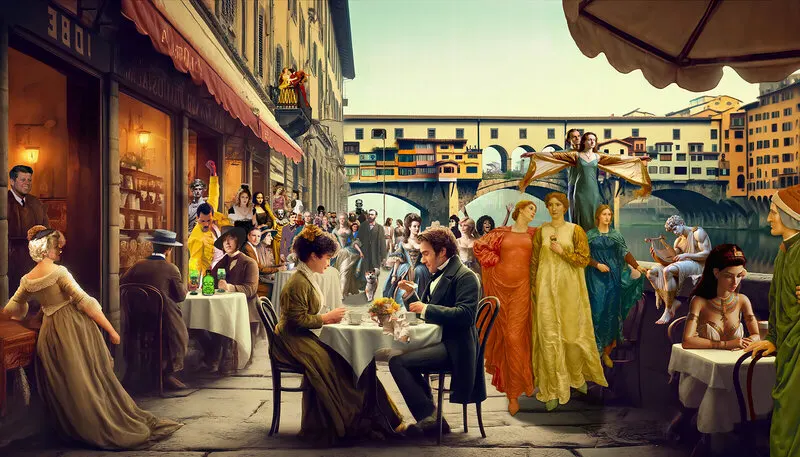
Eternal love, Ponte Vecchio in Florence, 2023
Digital
140 x 80 cm
7 200 kr
My picture gathers Time-Travellers from all eras, witnessing various aspects of love. The image depicts the spurned love, the abused; the unhappy or happy, the self-sacrificing; those who received too much or too little love; stolen love, taken by force, the violent; romantic love; platonic love; maternal and paternal love; and familial and physical love, as Catullus (ca 84–54 BC) described passion, bursting and burning with desire. All varieties are included in the picture in a place known to attract lovers. All these Time-Travelers have their own story to tell. That is the picture. Here is a summary. After that, a longer novella delves deeper into these individuals' lives. The story accompanies the image printed on special paper.
John Keats and Fanny Brawne's love story, a testament to the resilience of love, was marked by deep affection and tragedy. Despite the formidable obstacles of Keats's poor health and financial struggles, their love remained steadfast, inspiring us all with its unwavering strength.
Oscar Wilde and Lord Alfred Douglas. Their forbidden relationship ended in scandal and heartbreak. Despite the costly price of their love, they found solace and strength in each other's company. However, after losing his life's love, Wilde's vibrant spirit was dimmed, and he became a shadow of his former self, a poignant reflection of the devastating impact of love and loss.
Freddie Mercury experienced the passion and pain of love as an openly gay man during a time of prejudice and discrimination. Despite losing his life to AIDS, his love for music and his courage to be true to himself continue to serve as an inspiring example.
Dante Alighieri and Beatrice Portinari. Dante found inspiration and guided his soul through his love for Beatrice, a symbol of purity and beauty. Their love transcended the earthly and became a source of enlightenment and spiritual deepening for Dante.
President John F. Kennedy and Marilyn Monroe represent a forbidden love story that ended in tragedy. Despite their public positions and Marilyn Monroe's naive hopes of becoming his only one, their relationship led to her premature death.
Cleopatra sacrificed everything for her love for Marcus Antonius and lost him and her kingdom. Her passion for Antonius became her downfall, and she returned alone to the earth after losing everything.
Orpheus, the unfortunate demigod from Greek mythology, lost his beloved Eurydice to the underworld and carried the pain of loss through his music and eternal suffering.
Madame de Pompadour and Lady Diana represent two women from different eras who struggled with unhappy love. Despite their influence and success, they struggled with loneliness and expectations from their respective societies.
Whitney Houston's life was marked by success and adversity, including an unhappy love story with Bobby Brown. Despite their tumultuous relationship, Houston continued to shine with her talent and strength despite falling victim to personal demons and heartache.
Mick Jagger’s and Marianne Faithfull’s relationship was marked by turmoil and personal crises, but their unexpected reunion in Florence opens the possibility of new encounters and reconciliation. Despite their difficulties, Faithfull continued to struggle and grow as an artist.
Apollo, the Greek god of the sun, poetry, music, healing, and prophecy, has had his tragedies in love. His loss of the wood nymph Daphne, who turned into a laurel tree to escape his intense courtship, shows that even gods can experience unhappy love and loss.
Greta Garbo, the iconic Hollywood star with a mysterious gaze and magnetic presence, lived a life of romantic adventures and secrecy. Her magnetism and sensual aura made her an object of admiration and desire from all quarters, and her love life continues to fascinate and inspire.
Gertrude Stein and Alice B. Toklas shared a profoundly loving and groundbreaking relationship transcending time and conventions. Their partnership was a love story and a collaboration in intellectual and creative pursuits, and their shared love continues to inspire and shape future generations.
Mona Lisa, man or woman? Leonardo da Vinci's enigmatic masterpiece has inspired many theories about its identity. An Italian researcher now suggests that the portrait may be based on a young man who served as Leonardo's apprentice and possibly his lover, adding a new dimension of interest and controversy to the art world.
The Homosexual Clown. Artists have sparked controversy by creating images of clowns with homosexual undertones, challenging stereotypes and commenting on society's prejudices. They have raised questions about sexuality, identity, and prejudices, highlighting the potential resistance and threat to homosexual individuals in particular cultures and professions.
Marcel Proust, known for his literary masterpiece "In Search of Lost Time," lived a life where his homosexuality was known to close friends and family but never openly acknowledged by himself. Despite public denials, his romantic relationships with men like Reynaldo Hahn and Alfred Agostinelli are documented. His sexual orientation and love life are also reflected in his literary works.
Marie Antoinette and Count Axel von Fersen shared a passionate and complicated love story against a backdrop of political intrigue and revolution. Despite their relationship being shrouded in secrecy and societal expectations, evidence suggests they were lovers. Their love continues to fascinate and inspire, shedding new light on the royal intrigues and passions of the time.
The dog Hachiko's story epitomises loyalty and devotion. This legendary Akita faithfully awaited his deceased master at Shibuya Train Station for years, showcasing a selfless love that touched hearts worldwide. Hachiko's unwavering commitment is a timeless reminder of the enduring power of love and loyalty, inspiring countless tributes and enduring in the annals of history as a symbol of pure devotion.
Anne Frank wrote a diary which depicts her life in hiding during World War II. In it, she also explores her romantic development and attraction to Peter van Pels. Her innermost thoughts and feelings illuminate the universal theme of teenage infatuation and longing for love, even amidst the horrors of war.
His genius characterised Alfred Nobel's life as an inventor and his pursuit of peace and reconciliation. Despite his scientific and business successes, his life was marked by loneliness and an unrealised longing for love. His relationship with Bertha von Suttner, an advocate for peace and disarmament, inspired the creation of the Nobel Peace Prize and reflects the complexity that characterised his life and legacy.
Helen of Troy was known as the most beautiful woman in the world. Helen was a central figure in Greek mythology and the legend of the Trojan War. She was the object of intense admiration and the cause of a long-standing war, but her character is the subject of many interpretations and controversies. She often played against her admirers; her beauty was her gift and curse.
Niccolò Acciaioli was an Italian nobleman and member of an influential banking family. Despite wealth and influence, he suffered from unrequited love for the exiled Empress Catherine II of Constantinople. After her death, he married another woman but remained a patron of art and literature.
Dalai Lama, the spiritual leader of Tibetans, is known for his message of peace and compassion. Despite living in celibacy, he has managed to spread love and guidance to people around the world. His loving nature and deep wisdom have made him a symbol of peace and reconciliation.
Desmond Tutu, a South African Anglican archbishop and human rights activist, represented love and compassion through his life's work. Despite having a happy marriage and family, he was beloved by many for his commitment to justice and peace.
Evita Perón, a prominent figure in Argentine politics and society, was loved by her people for her work for the less fortunate. Despite her tragic death, her legacy lives on and continues to inspire women and leaders around the world.
Kurt Cobain, the guitarist of Nirvana, and Amy Winehouse, the English singer-songwriter, both symbolise tragic fates due to heartbreak and personal struggles. Their lives and deaths are reminders of the high price of emotional pain and the deadly consequence of unfulfilled love.
Romeo and Juliet are reunited in eternity. In this poignant retelling, the tale of Romeo and Juliet takes on a new dimension as we learn about the real-life couple Mariotto and Ganozza, whose love story inspired Shakespeare's masterpiece. Their clandestine romance, born from rival families in Florence, mirrors the tragic fate of literature's most famous star-crossed lovers. Despite the passage of centuries, their story remains a timeless symbol of passion, forbidden love, and the cruel hand of destiny. Through the lens of history, we gain a deeper appreciation for the enduring power and beauty of true love, even in the face of impossible odds.
Fidel Castro and Genghis Khan, the molesters. In this chilling juxtaposition, the narratives of Fidel Castro and Genghis Khan shed light on the dark underbelly of history's most notorious figures. Castro's insatiable sexual appetite and Khan's ruthless exploitation of women paint a stark picture of abuse and power. Their actions serve as a sobering reminder of the pervasive nature of sexual violence throughout history and the enduring impact it has had on countless lives. As their stories unfold, we are confronted with the uncomfortable truth that even the most celebrated figures are not immune to the stain of human cruelty.
Napoleon was defeated in many ways, including in love. The complex legacy of Napoleon Bonaparte comes into focus as we explore his tumultuous romantic relationships and their impact on his larger-than-life persona. Despite his military prowess and political acumen, Napoleon's personal life was marked by betrayal, infidelity, and unrequited love. His obsession with Josephine de Beauharnais reveals a vulnerable side to the French emperor, challenging our perceptions of his ironclad facade. Through the lens of history, we gain a deeper understanding of Napoleon's humanity and the tragic irony of his romantic conquests.
Jesus and Mary Magdalene, a devoted couple, together at last. In a poignant reimagining, Jesus and Mary Magdalene emerge as a dedicated couple whose love transcends the boundaries of time and space. Amidst the grandeur of Florence's architectural marvels, their union is a beacon of hope and redemption, challenging centuries of misconceptions and misinterpretations. As they walk hand in hand, their presence reminds us of the transformative power of love and the enduring legacy of their shared journey. Through their story, we find inspiration to embrace love in all its forms and to seek forgiveness and understanding in a world often consumed by division and discord.
The tragic tale of Frankenstein's monster unfolds with poignant introspection, challenging our preconceived notions of being human. Through the lens of Mary Shelley's timeless classic, we confront themes of isolation, alienation, and the consequences of societal rejection. The monster's quest for acceptance and understanding mirrors our universal longing for connection and belonging. As we grapple with the complexities of creator-creation relationships and existential questions of identity and purpose, we are reminded of the enduring relevance of Shelley's masterpiece in today's age of artificial intelligence and ethical dilemmas.
"Rose and Jack from Titanic" transports readers to the iconic love story of Rose and Jack, immortalised in the film Titanic. Against the setting sun and the river Arno, the Time-Travellers rekindle their forbidden love, defying social norms and familial expectations. Their hearts intertwine as they gaze westward, finding solace in each other's arms amidst the unforgiving world. Despite the passage of time, their love endures, transcending the boundaries of time and space, symbolised by their eternal embrace along the shores of eternity.
"The Sad Winged Lion" introduces readers to the melancholy figure of the Winged Lion, a marble sculpture mourning the fate of Venice and humanity. Carved by the great sculptor Antonio Canova, the lion symbolises the fleeting nature of love and the impending doom of climate change. Canova's journey from humble beginnings to artistic prominence is intertwined with the tragic fate of the lion, culminating in the creation of a butter sculpture that captures the essence of his talent and resilience.
"Mother Canada weeping" shifts the focus to the sculpture of Mother Canada, standing amidst the Ponte Vecchio, shedding tears for the countless lives lost in wars throughout history. From the devastation wrought by Genghis Khan to the horrors of World War II, the sculpture serves as a sad reminder of the staggering human cost of conflict. As war continues to ravage nations and claim lives, Mother Canada stands as a symbol of collective grief, her tears merging with those of mothers and sisters around the world, threatening to overflow the river below.
"Laocoon’s and his sons’ grisly end" recounts Laocoon's warning against the Trojan horse, which his fellow Trojans ignored. Divine retribution ensues as Poseidon and Athena send serpents to kill Laocoon and his sons, serving as a cautionary tale against defying the gods.
"Rapunzel Has Let Down Her Hair" tells the tale of Rapunzel, who recounts her captivity in a tower and forbidden romance with a prince. Themes of love, resilience, and self-discovery emerge as Rapunzel confronts the sorceress and embraces her destiny.
"What is love?" Haddaway sang. Ancient Greek wisdom identifies eight types of love, extending beyond romance. These insights enrich our understanding of human relationships. Love is intertwined with life and happiness, but often, we seek it in the wrong places. While fairy tales end with "happily ever after," real love evolves and manifests in various forms.
Eros, or romantic love, is thrilling but needs nurturing. Philia, or friendship love, is deep and spiritual. Storge, or familial love, is comforting. Ludus, or playful love, keeps the spark alive. Pragma, or enduring love, requires commitment. Mania, or obsessive love, is unhealthy. Agape, or unconditional love, is selfless. Philautia, or self-love, is foundational.
Understanding these nuances helps foster joy and contentment in relationships. Chapman's concept of love languages further elucidates how individuals express and perceive love differently. Recognising and embracing each other's love languages is crucial for nurturing healthy and fulfilling relationships.
Ultimately, love, in its various forms, is the ultimate source of joy in life.
Please read on if you have the time and lust.
A picture vibrating with desire and longing. The image of Lungarno degli Acciaiuoli, the stretch of street between Ponte Santa Trinita and the world's most beautiful bridge, Ponte Vecchio, shows how, on this particular day, a small café has attracted a gathering of individuals who, despite being from different times and places, share a common thread-they all belong to eternity. These 'Time-Travelers ', apart from Mick Jagger and Marianne Faithful, have in common longing, unhappy or unfulfilled love, or the choice to forsake it; their earthly love relationships were painful and sometimes fatally so. That's why they've come to one of the most romantic cities to remember, often with the one who betrayed them or whom they betrayed. After they left Earth, many could reunite, and their love in eternity was fulfilled. Not all, unfortunately; some have had to continue their loneliness beyond the vault of heaven.
Fanny Brawne and John Keats
In the foreground, Fanny Brawne and John Keats are having breakfast. The renowned English Romantic poet shared a poignant love story with Miss Brawne. Their relationship was marked by intense passion but also tinged with tragedy.
Keats met Fanny Brawne in 1818 when he moved into a house neighbouring hers in Hampstead, London. Despite initial misunderstandings and differences in social backgrounds, they soon fell deeply and passionately in love. Their romance, a testament to the power of love and longing, blossomed amidst Keats's creative enthusiasm and Brawne's lively spirit. They exchanged numerous letters, many of which are considered literary treasures today, showcasing their profound affection and longing for each other.
However, their love faced significant challenges, including Keats's precarious financial situation and declining health. Keats was struggling with tuberculosis, a disease that would ultimately claim his life at a tragically young age.
Despite the obstacles, Keats and Brawne's love remained steadfast. Their love story was not just a tale of passion but also of inspiration. With her vibrant spirit, Brawne served as both muse and confidante to Keats, nurturing his poetic endeavours and enriching their love with creativity.
Tragically, their time together was cut short. Keats's health deteriorated rapidly, and in 1821, he left for Italy for a better climate. He bid farewell to Brawne, knowing they might never meet again. Keats died in Rome the following year, at 25, far from his beloved Fanny.
The love story of John Keats and Fanny Brawne is immortalised in Keats's poetry and letters, reflecting both the joy and sorrow of their relationship. Their love story remains a poignant symbol of romance and enduring passion despite its brevity.
Their contented appearance stems from their forever living together on a star they named 'Bright Star,' like Keats' poem to her.
Oscar Wilde and Lord Alfred Douglas
Oscar Wilde licks his wounds at the neighbouring table with his boyfriend, Lord Alfred Douglas, after the scandal erupted back home in England about their forbidden relationship. What better way than a long-forbidden drink, Absinthe, the murky green devil's brew? Freddie Mercury serves them the drink with an exaggerated gesture, Freddie whose love cost the singer his life. In a way, they share fates, he and Wilde, even though Oscar Wilde faded away after his life's love was taken from him.
Freddie Mercury
Freddie Mercury, the legendary frontman of Queen, captivated the world with his unparalleled voice, electrifying stage presence, and unapologetic flamboyance. Behind the glitz and glamour, however, lay a complex story of love and loss.
Mercury's journey was one of unbridled passion and exploration in his music and personal life. As an openly gay man in an era marked by prejudice and discrimination, he fearlessly challenged societal norms and embraced his identity with unwavering pride.
Yet, it was this same love that ultimately cost him his life. Amid the AIDS epidemic, Mercury became one of its most high-profile victims, succumbing to the disease in 1991 at the age of 45. His untimely death sent shockwaves through the music world and beyond, shining a spotlight on the devastating impact of HIV/AIDS and the urgent need for awareness and acceptance.
Despite the tragic circumstances of his passing, Mercury's legacy endures as a beacon of hope and resilience. His music continues to inspire and uplift millions around the globe, reminding us that love knows no bounds and that even in the face of adversity, our spirits can soar.
In the end, Freddie Mercury's life may have been cut short, but his spirit is a testament to the power of love, creativity, and the indomitable human spirit.
Dante Alighieri and Beatrice Portinari
A few steps away from Oscar and his boyfriend by the river Arno, just after the bridge, as you see in the picture, where the shadows whisper tales of love and tragedy, Dante Alighieri, the revered poet, found his muse in Beatrice Portinari, a vision of purity and grace. Their encounter was not one of earthly passion but of divine inspiration.
For Dante, Beatrice embodied the ideal of beauty and virtue, a beacon guiding his soul through the tumultuous journey of life. Their meeting, immortalised in Dante's "La Vita Nuova," sparked a flame that ignited his most excellent work, "The Divine Comedy."
With her radiant presence and ethereal essence, Beatrice became Dante's guide through the circles of Hell and Purgatory and finally to the gates of Paradise. She revealed to him the mysteries of love, redemption, and the universe's divine order in each realm.
Their reunion in the afterlife, depicted in the "Paradiso," transcended mortal limitations as Dante beheld Beatrice in her celestial glory, surrounded by the splendour of heaven. Their purified and sanctified love symbolised the eternal quest for truth and salvation.
Dante and Beatrice never had each other in their lifetime. Their meetings were few and brief. Beatrice was also married to another man, Simone dei Bardi, which further limited the possibility. Despite this, Dante developed a deep love and devotion to Beatrice, and she became a central figure in his life and poetry. Their relationship flourished and became legendary primarily through his writing and spiritual bond with her.
The union of Dante and Beatrice is a tale of earthly romance and a testament to the transformative power of love and the enduring legacy of the human spirit.
President John F. Kennedy next to Marilyn Monroe
In the doorway just to the left in the picture stands, half-obscured, President John F. Kennedy next to Marilyn Monroe dressed in a Renaissance gown and a whimsical hat atop her blonde hair. He wasn't eager to be seen, a president married with two children, and Marilyn naively believed he would leave Mrs. Kennedy for her sake. Marilyn was exploited by many, not least by the film mogul Louis B. Mayer, making #Metoo's pig Harvey Weinstein seem innocent as a choirboy. But it was the unfortunate love for Kennedy that ultimately cost Marilyn her life, whether she received help or succumbed to an overdose.
Cleopatra, Egypt's last pharaoh
Cleopatra, Egypt's last pharaoh, sits alone at her café table, contemplating how her love for Marcus Antonius took her life, how she brought the poisonous serpent to her bosom and let it inject its venom. She had lost everything, her love and her land. From her star, Cleopatra has returned to Earth alone; Mark was preoccupied with an interstellar meeting with the ancient triumvirate.
Orpheus playing his lyre.
Had she wished, she could have made the acquaintance of Orpheus. On top of the wall behind Cleopatra, facing the river, sits the unhappy demigod, playing his lyre.
Orpheus, a figure from Greek mythology, is often unhappy due to the tragic events surrounding his life—the tragic tale of his wife, Eurydice. When Eurydice died, Orpheus, profoundly grieving, journeyed to the Underworld to plead with Hades, the god of the dead, to allow her to return to the world of the living. Hades agreed, under the condition that Orpheus not look back at Eurydice until they reached the surface. However, overcome with doubt and longing, Orpheus couldn't resist the urge to glance back, losing Eurydice forever as she faded back into the shadows of the Underworld.
This loss and the subsequent sorrow define much of Orpheus's story. Additionally, Orpheus's exceptional musical talents and his ability to charm all living creatures with his music often serve as a bittersweet reminder of the beauty and love he lost. His melancholy is thus a result of profound love and the pain of irrevocable loss.
Madame de Pompadour and Lady Diana
Behind Beatrice and her friend walk two strong women with more in common than one might initially realise. These two, Madame de Pompadour and Lady Diana, each represent an iconic and influential historical figure. Despite living in different eras and under different social conditions, they shared many similar traits that made them noteworthy in their societies and the memory of posterity.
Madame de Pompadour, born Jeanne Antoinette Poisson, occupied a central place at the French court as the mistress of King Louis XV during the 1740s and 1750s. Her beauty, elegance, and intelligence made her a significant figure as the king's mistress and a political and cultural power at the court. Madame de Pompadour actively promoted art, literature, and science, and she was a prominent patroness for many artists and writers of her time. Despite her position as a mistress, she could influence politics and foreign policy through her sway over the king.
Similarly, Lady Diana Spencer was a central figure in the British royal family during the late 20th century. As the Princess of Wales and through her marriage to Prince Charles, she became one of the British royal family's most beloved and admired members. Lady Diana's charm, kindness, and commitment to charity made her a beloved figure worldwide. She was known for her work in raising awareness of and combating the stigma surrounding HIV/AIDS and for her work supporting charities that worked with children, single parents, and people affected by war and conflict.
Madame de Pompadour and Lady Diana were known for influencing fashion and style. Madame de Pompadour set trends and became a style icon in her time. At the same time, Lady Diana was known for her distinctive style, which combined elegance with modernity and inspired many people worldwide.
Although Madame de Pompadour and Lady Diana lived in different historical and social contexts, they shared many similar traits that made them significant historical figures. Their influence extended beyond their periods and has continued to inspire and fascinate people long after their deaths.
Both Madame de Pompadour and Lady Diana experienced elements of unhappy love in their lives.
Fluctuations and challenges characterised Madame de Pompadour's relationship with King Louis XV despite her influential position as his mistress. While she held considerable sway over the king and played a pivotal role in the French court, her romantic entanglement with Louis XV was complex. Their liaison was subject to the complexities and intrigues of court politics, and Madame de Pompadour often had to contend with rivals and detractors. Additionally, her longing for genuine love and emotional fulfilment beyond the confines of her role as the king's mistress is a recurring theme in historical accounts of her life.
Similarly, Lady Diana's marriage to Prince Charles was marked by strains and eventual estrangement, culminating in their highly publicised divorce in 1996. Despite the fairy-tale image projected by their union, their relationship faced challenges, including differences in temperament, incompatible interests, and extramarital affairs on both sides. Lady Diana's struggles with loneliness, depression, and the feeling of being unfulfilled in her marriage became increasingly evident over time, contributing to the narrative of her unhappy love life.
Thus, while Madame de Pompadour and Lady Diana occupied vastly different roles and lived in different eras, they grappled with the complexities and disappointments of romantic relationships, adding a layer of tragedy to their otherwise illustrious lives.
Houston rejoices in being free.
Right behind, Whitney Houston rejoices in being free from the burdens of earthly life and from partners like Brown. Whitney, one of the most iconic singers in music history, lived a life filled with brilliant successes and deep trials, including an unhappy love story that affected her in many ways.
Houston was a star from a young age, and her powerful voice and charisma made her one of the most prominent artists of the 1980s and 1990s. Despite her professional successes, Houston struggled with personal demons, including drug abuse and tumultuous romantic relationships.
One of Houston's most well-known and unhappy love stories was her marriage to Bobby Brown, another prominent artist. Despite initially being seen as a glamorous and powerful duo within the entertainment industry, their marriage was characterised by conflicts, drug abuse, and public scandals. For Houston, her marriage to Brown meant a budding career that gradually became overshadowed by personal and professional problems.
The unhappy love story between Houston and Brown became part of their public image and was closely followed by fans and the media. Despite their talents and successes, their relationship seemed unable to overcome the challenges they faced, and their marriage ended in a painful divorce in 2007.
Whitney Houston showed strength and vulnerability throughout her life and career, and her struggle with unhappy love often reflected her deeper battles. Despite encountering many difficulties in her personal life, Houston continued to be one of the most admired and beloved artists in music history, and her legacy lives on through her timeless music and indelible impact on popular culture.
Mick Jagger’s and Marianne Faithfull’s reunion
Mick Jagger’s and Marianne Faithfull’s reunion in Florence happened by chance, but perhaps it could lead to more encounters. The vibrations from the surroundings were strong, even though they only recognised a few faces. A dark-skinned woman in front of them could have sworn it was Whitney Houston, but since she was deceased, they laughed at how eyes and imagination can deceive. A couple resembling the late President Kennedy and Marilyn Monroe also caught their attention.
Marianne Faithfull's journey through the 1970s was marked by tumultuous personal struggles that significantly impacted her career and well-being. Her relationship with Mick Jagger came to an end in May 1970 when she began an affair with Anglo-Irish nobleman "Paddy" Rossmore, leading to a loss of custody of her son and a subsequent suicide attempt. This period of her life saw Faithfull grappling with addiction, homelessness, and a decline in her musical output.
Living on the streets of London's Soho, Faithfull battled heroin addiction and anorexia nervosa for two years. Despite efforts from friends to intervene, her addiction persisted, and she struggled to stabilise her life. In 1971, producer Mike Leander attempted to revive her career by producing part of her album Rich Kid Blues, although the album remained shelved until 1985.
The effects of severe laryngitis combined with ongoing drug abuse permanently altered Faithfull's voice, resulting in a cracked and lower pitch. Despite these challenges, she released albums such as Dreamin' My Dreams (1975) and Faithless (1978), experiencing varying degrees of success. Faithfull's personal life continued to be turbulent, marked by brushes with the law and ongoing substance abuse.
In 1979, Faithfull's career experienced a resurgence with the critically acclaimed album Broken English, influenced by the punk movement and her marriage to Ben Brierly. The album showcased her raw vocals and addressed themes such as terrorism and personal turmoil. However, her struggles with addiction persisted, culminating in a disastrous appearance on Saturday Night Live in 1980.
Transitioning to New York City in the 1980s, Faithfull continued to battle addiction while maintaining her musical career. Despite setbacks, she released albums such as Strange Weather (1987), which received critical acclaim for its jazz and blues influences. Throughout the decade, Faithfull's personal life remained tumultuous, marked by failed relationships and ongoing struggles with substance abuse.
Faithfull's career experienced highs and lows in the following decades, with notable releases such as Blazing Away (1990) and Before the Poison (2005). Despite ongoing challenges, including health issues and personal losses, Faithfull continued to create music and garner recognition for her contributions to the industry.
Faithfull's resilience and artistic evolution testify to her enduring legacy in the music world. Despite facing numerous obstacles throughout her career, she remains a revered figure and continues to inspire audiences with her distinctive voice and candid storytelling. Through triumphs and tribulations, Marianne Faithfull's journey is a testament to the power of perseverance and artistic expression.
2
The Greek god Apollo has had his tragedies.
Behind the pop deity Mercury, a god past his prime, the Greek god Apollo is glimpsed. Despite being associated with the sun, poetry, music, healing, and prophecy, Apollo has had his tragedies and appears grim.
The one who has pained him the most is the story of Daphne. Apollo fell in love with the young forest nymph Daphne, but she rejected his love and fled from him. He refused to give up and subjected her to what is now called stalking. To escape Apollo's intense pursuit, Daphne was transformed into a laurel tree by her father, the river god Peneus. Apollo was devastated to lose his beloved but honoured her by making the laurel leaf a symbol of victory and success. Although Apollo has not suffered from a troubled love life to the same extent as Orpheus, the story of Apollo and Daphne shows that even gods can experience unhappy love and loss. The laurel wreath he wears is a homage to the love forever lost.
The divine Greta Garbo
If he reached out his hand, he would touch the divine Greta Garbo, who sought but never found love and trust, preferring to live alone. The Hollywood star Garbo never got over losing her life's passion – actress Mimi Pollak. Greta couldn't know they would reunite in eternity and be partners on a brightly shining star.
Greta Garbo, the iconic Hollywood star with the enigmatic gaze and magnetic presence, was not only known for her talent on the silver screen but also sought solace in many love affairs spanning the entire gender spectrum. Garbo maintained a mysterious persona outside of film, and her love life was a subject gossip columnists struggled to grasp—Corpus delicti.
Garbo had a knack for fascinating both men and women. Her magnetism and sensual aura made her an object of admiration and desire from all quarters, and it was no surprise that she attracted interest among people in and out of Hollywood. The president tried to get her into bed during a private dinner at the White House with the Kennedy couple. She resisted, blaming her age for such things.
With many famous admirers, including male and female stars, Garbo had a reputation for being romantically involved and secretive about her private life. From her alleged relationship with actress Marlene Dietrich to her romances with men like John Gilbert and women like Mercedes de Acosta, Garbo wasn't afraid to explore different aspects of her sexuality and love life.
It was somewhat startling for the society of the time to see such a prominent star as Garbo surrounded by male and female admirers. Still, her outspokenness and independence made her a pioneer of sexual freedom and self-expression. Despite her attempts to keep her private life out of the public eye, Garbo couldn't avoid being the subject of gossip and speculation.
In the end, perhaps Garbo's enigmatic charm and magnetism drew people from all walks of life, regardless of gender. Her love life and romantic adventures continue to fascinate and inspire, and her place in Hollywood history is cemented as one of the most iconic stars ever.
Gertrude Stein’s and Alice B. Toklas’ enduring love story
Beneath Greta, there is a couple whose journey has spanned many years. Gertrude Stein and Alice B. Toklas shared an enduring love story. The renowned writer found steadfast companionship and unwavering support from her fellow American expatriates in Paris.
Gertrude Stein and Alice B. Toklas shared a remarkable bond transcending time and convention. Their partnership was not only one of love but also of intellectual and creative collaboration.
Gertrude Stein, a pioneering American writer and art collector, found Alice B. Toklas not only a romantic partner but also a muse and confidante. Toklas, known for her wit and intelligence, gave Stein unwavering support in her literary and artistic endeavours.
Their home in Paris became a vibrant hub for artists, writers, and intellectuals during the early 20th century. Here, Stein famously hosted salons that attracted luminaries such as Pablo Picasso, Ernest Hemingway, and F. Scott Fitzgerald.
Their relationship was marked by mutual respect, admiration, and a deep emotional connection. Toklas played a crucial role in Stein's life, serving as her editor, manager, and companion.
Their love story and partnership were groundbreaking for their time, challenging societal norms and expectations. Together, they defied convention and created a life that was uniquely their own.
Beyond their relationship, Stein and Toklas left a lasting impact on the literary and artistic world. Stein's experimental writing style and Toklas's literary contributions continue influencing generations of writers and thinkers.
In essence, Gertrude Stein and Alice B. Toklas embodied a love that was both enduring and transformative, leaving behind a legacy that extends far beyond their years together. Now they were back and had revisited Venice along the way, where the couple had fed pigeons together during a romantic trip in 1908. This time, however, they had discreetly fed the birds. In the UNESCO-listed Italian city, feeding these birds has been banned since 2008—and with good reason: Acidic excrement left behind by pigeons damages the delicate mosaics that adorn historic buildings and monuments. Fines for feeding pigeons in Venice can reach up to €700, which is not a problem for a Time-Traveller. They print their euros, impossible to distinguish from genuine ones, so Venice's pigeons had received a hearty meal when Gertrude and Alice were there.
Mona Lisa, man or woman?
Mona Lisa, standing in the doorway behind, looks a bit concerned. Lisa has reason to be. The truth about Mona Lisa's identity is creeping closer with modern technology. Speculation about the person with the enigmatic smile has persisted since da Vinci's death. Initially, it was primarily women who were pointed out, but lately, there has been doubt about the gender. The Mona Lisa is androgynous—half man and half woman. The female influence could be from Gherardini or perhaps Beatrice D'Este, wife of Milanese duke Ludovico Sforza, whose court Leonardo worked at during the late 15th century. But much indicates that it could be a feminine man or a clever combination. Leonardo could write in reverse; perhaps it's the same as Mona Lisa in the painting; it should be Mona Salai instead.
Little is known about Leonardo's sexuality, as he left behind hundreds of pages of writing, but very little of it pertains to his personal life. He did not leave any letters, poetry, or diary entries indicating romantic interests. Leonardo never married, and there is no definitive evidence of his intimate relationships with either men or women. However, art historian Raymond Stites suggested that Leonardo may have been romantically involved with Cecilia Gallerani, the subject of his painting 'Lady with an Ermine'. Leonardo could be described as bisexual but with a clear preference for men. In his youth, he faced anonymous accusations of sodomy and had to defend himself publicly. The trauma of this accusation made him cautious for the rest of his life, although he did engage in a few affairs with women, which helped maintain his reputation.
Maybe it wasn’t a woman, but the ‘Mona Lisa’ is based on Leonardo’s Male Lover. Leonardo da Vinci's enigmatic masterpiece has captivated audiences for centuries, yet the true identity of the Renaissance artist's most famous subject remains a mystery. In a fascinating twist, an Italian researcher has proposed a theory that the image was primarily inspired by a young man who served as Leonardo's apprentice and possibly his lover, sparking a new wave of intrigue in the art world.
The Mona Lisa exhibits striking similarities to Gian Giacomo Caprotti, also known as Salai. This conclusion is not drawn lightly but after meticulous examination of infrared scans of the renowned artwork and comparison to other works by Leonardo, for which Salai was known to have posed.
Particularly significant are the similarities in the nose, forehead, and smile of the Mona Lisa—furthermore, a rarely displayed drawing by Leonardo, 'St. John the Baptist and Angel Incarnate,' depicting a young boy with an erection, is believed to be another work inspired by Salai, adding a new layer of depth to our understanding of Leonardo's art and personal life.
Salai began his apprenticeship with Leonardo around the age of 10 in 1490 and was known for his mischievous nature—his nickname, "little devil," reflects this. He worked closely with the Renaissance master for two decades, and their relationship is widely believed to have been romantic, at least sexual.
While the most accepted theory is that Lisa Gherardini, the wife of an Italian silk merchant, served as the model for the Mona Lisa, others have suggested alternative theories, including the possibility of a self-portrait, a depiction of Leonardo's mother, or an enslaved Chinese person.
While the possibility of Salai posing for the iconic portrait is gaining traction among scholars, it is not without its detractors. Critics argue that such theories may blur the lines between fact, speculation, and fantasy, but few are willing to dismiss the possibility, altogether adding to the ongoing debate.
Salai's influence on the canvas was significant but not exclusive. Some experts believe that the Mona Lisa embodies both male and female traits, suggesting that the female influence part could have come from Gherardini or Beatrice D'Este, the wife of Milanese duke Ludovico Sforza, under whose patronage Leonardo worked during the late 15th century. While most historians date the creation of the Mona Lisa to 1503, some suggest that Leonardo may have started the masterpiece during his time in Milan in the 1490s.
In other words, Lisa del Giocondo, known as the Mona Lisa, has reason to be nervous because the truth is troubling for a woman who has been hailed as a faithful wife for half a millennium. Lisa was a mother to six children and had many grandchildren when she died at the convent of Sant'Orsola. For four hundred and fifty years, Lisa has enjoyed the honour of being the Mona Lisa, Leonardo's masterpiece. That reputation has served her well among the stars. For understandable reasons, da Vinci has remained silent for just as long. No one living in eternity can claim that "seeing is believing." That privilege is reserved for those who breathe on earth. Although time is infinite, the truth will eventually come to light and reach even there. Hence Lisa's troubled expression.
The gay clown
It's not just Lisa who looks worried. But the clown next to her seems not only concerned but also furious. Photographer Dusti Cunningham has turned clowns into full-blooded gays with bare chests and explicit sexual innuendos. You might call them leather gays! Most people find clowns funny or terrifying, but now Cunningham has made them arousing, half-naked with their pants halfway down and their faces smeared with a big, lewd grin. Care to join the circus? The macho Putin hates being depicted as a gay clown. Putin has overseen oppressive laws curbing LGBTQ rights in Russia. Déjà vu!
What worries our clown in the picture is that the clown’s private life will be exposed. Many are, in fact, gay but haven't come out of the closet. It would probably be devastating for their career.
Have you ever heard of the clown that hides from gay people? If you haven't seen the clown, that's probably because he's hiding from you. But the clown only hides from gay people, they say. What good does it do that it's an expression of black humour? Humour to comment on prejudices or stereotypes. It ironically suggests that if someone hasn't seen a certain clown, it might be because the clown is avoiding them due to their sexual orientation. It's a way to highlight and challenge homophobia by using an absurd and exaggerated premise. But it's important to remember that this saying, like all jokes, can be interpreted differently and may not necessarily be appropriate or acceptable for everyone. It does not make our clown happier but instead prompts him to raise his clenched fist in protest.
3
Marcel Proust never came out of the closet.
He lived in the same century as Marcel Proust, the man next to him in the picture, with whom he had a secret relationship. Still, they live together openly on a star in the Magellanic Clouds, conveniently distant from Earth, just 160,000 light-years away.
Proust never came out of the closet and openly acknowledged his homosexuality, although it was widely known or suspected by his family and close friends. In 1897, he even duelled with writer Jean Lorrain, who publicly questioned the nature of Proust's relationship with his lover Lucien Daudet; both duelists survived the encounter. Despite Proust's public denials, his romantic involvement with composer Reynaldo Hahn and his infatuation with his chauffeur and secretary, Alfred Agostinelli, are well-documented.
On a January night in 1918, Proust was among the men identified by police in a raid on a male brothel operated by Albert Le Cuziat. Proust's friend, the poet Paul Morand, openly teased him about his visits to male prostitutes. In his journal, Morand describes Proust and Gide as "constantly hunting, never satiated by their adventures ... eternal prowlers, tireless sexual adventurers."
The precise impact of Proust's sexuality on his writing remains a subject of debate. However, "In Search of Lost Time" extensively discusses homosexuality and features several main characters, including Baron de Charlus, Robert de Saint-Loup, Odette de Crécy, and Albertine Simonet, who are either homosexual or bisexual. Homosexuality also emerges as a theme in "Les plaisirs et les jours" and his unfinished novel, "Jean Santeuil".
Proust's disdainful look at the man next to him is not surprising, not just because of the powdered wig. Despite all the powder, he was a faithful and ladies' man, in many ways the opposite of Marcel. Count Axel von Fersen the Younger from Sweden was a manly man and a defender of the monarchy. At the same time, Proust inherited his mother's liberal streak and was a republican. Proust knew very well who the woman in the count's company was, Marie Antoinette, the beheaded queen of France. It fascinated him that the beheaded of all time did not appear among the stars with their severed heads under their arms. They were in their place just as they were in the glory days of these time travellers.
Marie Antoinette and lover Count Axel von Fersen.
Marie Antoinette was a beautiful woman, dressed as she was when she was still queen and lived in the Versailles palace. She walked proudly with her head held high and a wig that obstructed the view of the girl behind her, Anne Frank. Her presence here was not due to misunderstood love but because she was hardly loved by anyone other than Count Fersen. The king lived his life; their marriage was convenient, and the children were for the sake of succession, whom she barely saw—there were servants for that. Her people hated their queen, who lived among the clouds while the French crawled in the dust and starved. The Austrian, they called her. Imagine being so hated.
Her lover, the Count, was no more beloved than his girlfriend and was murdered by the mob in Stockholm in 1810. I will tell you a juicy and amusing tale about the count’s and the queen's affair, suggesting that her second son was the count's and not the king's. In the annals of romantic intrigue, there exists a tale of tangled affections that transcends the bounds of ordinary courtly dalliances. It is a tale woven with threads of desire, secrecy, and the capricious whims of fate, set against the backdrop of the opulent courts of 18th-century Europe, where societal expectations and political pressures often dictated the course of love.
Axel was a figure whose amorous escapades would make even the most scandalous gossipmongers blush with envy. In a letter to his sister Sophie Piper, Axel famously declared, "I have made my decision. I shall never marry." His rationale? "I cannot belong to the one woman I truly desire, the only one who truly loves me, and thus I refuse to bind myself to another." This "one woman" happened to be none other than the Queen of France herself, Marie Antoinette, a woman who stirred his heart and challenged his convictions.
Fersen was a man of strong erotic nature. In his diary, we encounter a lifelong parade of married women. He was a seducer on par with the infamous Casanova. He loved many, but it is doubtful whether the high-born women loved more than what he had between his legs. Rumours of his prowess in the bedroom had even reached the other side of the Atlantic. During the revolutionary years, he bedded both Indian princesses and the wives and daughters of revolutionaries.
The literature surrounding Axel F.'s relationship with Marie Antoinette has been the subject of much debate. Were they lovers in the truest sense of the word? In 1783, both were 28 years old, and despite the queen having borne children, her happiness with the shy, feeble, and decidedly mediocre Louis XVI seemed lacking. He lived his life mostly hunting ducks. Their bond, already tested by societal expectations, strengthened amidst the turmoil of the revolution, with Axel becoming her steadfast support in a world turned upside down.
Upon Axel's return in 1783, it appears that the flames of passion were reignited in the queen's heart, and "le beau F." emerged as the great love of her life. However, Axel's feelings towards Marie Antoinette were more complex. A man of strong erotic inclinations, Axel's diary reads like a catalogue of romantic conquests, with married women featuring prominently. While undoubtedly enamoured with Marie Antoinette in 1783, she was not his sole paramour, even during his time in France.
His second grand love affair occurred in Paris with the Italian Eleonore Sullivan, a woman of dubious reputation who flitted from one scandalous liaison to another. Despite Axel's disdain for her, he entertained thoughts of marrying her, a testament to his convoluted romantic entanglements. Yet, amidst it all, Marie Antoinette remained the central figure in his life.
Evidence of Axel and Marie Antoinette's love abounds, though the strict etiquette and surveillance of the French court made their liaison anything but straightforward. While Axel's relationship with Eleonore is documented extensively in his diary, his interactions with the queen are marked by discretion. However, numerous indicators suggest that he was indeed her lover, a perception many of their contemporaries shared.
The censorship and destruction of Marie Antoinette's letters to Axel and his responses point to a relationship far more intimate than mere friendship. One preserved note from the queen to Axel ends with the words, "Farewell, the most beloved and loving of men. I embrace you with all my heart," hardly the language of platonic affection.
The birth of Marie Antoinette's son, Louis Charles, on March 27, 1785, sparked speculation that he was Axel's progeny, a rumour eagerly seized upon by revolutionaries. Axel remained silent on the matter, leaving historians to ponder the nature of their love affair. While concrete evidence may be lacking, the abundance of clues suggests that Axel F. was indeed the queen's genuine paramour.
In the annals of history, Axel F. and Marie Antoinette's romance is a testament to the enduring power of passion amidst political upheaval. Though hidden from the world, their love continues to echo through the corridors of time, a tantalising glimpse into a world where desire knows no bounds.
The Unwavering Devotion of Hachiko is a testament to selfless love.
Next to Marie Antoinette, a loveful dog. In the bustling heart of Tokyo, amidst the chaos of daily life, lies a tale that transcends time and culture—a story of unwavering devotion and undying love. This is the story of Hachiko, the legendary Japanese Akita whose loyalty to his master knew no bounds. It's a story that resonates with people from all walks of life, regardless of their cultural background or geographical location.
Hachiko's tale unfolds in the early 1920s when Japan underwent rapid modernisation and societal changes. During this period, Professor Hidesaburo Ueno, a revered figure at the University of Tokyo, welcomed him into his life. From the instant they crossed paths, a unique bond of love and companionship was forged between man and dog, a bond that would transcend the boundaries of mortality.
Every morning, Hachiko faithfully accompanied his master to the Shibuya Train Station, where Professor Ueno would catch the train to work. And every evening, like clockwork, Hachiko returned to the station to greet his master upon his return. This routine continued unfalteringly until one fateful day in May 1925 when Professor Ueno suffered a fatal stroke while at work and never returned home.
Even in the absence of his cherished master, Hachiko continued his vigil at the train station, day after day, week after week. As time passed, Hachiko's loyalty became a beacon of hope, touching the hearts of the station staff and commuters alike. They were moved and inspired by the sight of the faithful Akita patiently awaiting his master's return, a testament to the power of unwavering devotion.
Hachiko's story spread far and wide, symbolising loyalty and devotion across Japan and beyond. His unwavering commitment to his master touched the hearts of millions, inspiring countless books, films, and tributes to his remarkable tale. His story is not just a fad but a timeless testament to the power of love and loyalty that resonates with people today.
What makes Hachiko's story so poignant is not just his loyalty to his master but the depth of his selflessness and sacrifice. Despite the passage of time and the inevitability of loss, Hachiko chose to remain steadfast in his love, finding solace in the simple act of waiting, even in the face of despair.
In a world often marked by fleeting relationships and transient affections, Hachiko's story shines as a symbol of enduring love—a reminder that true devotion knows no bounds. His tale is a powerful lesson in selfless love, teaching us that the most precious gift we can offer is the gift of unwavering loyalty and unconditional affection. Hachiko's story also teaches us the importance of patience and resilience and the value of cherishing every moment with our loved ones.
As we reflect on the tale of Hachiko, let us strive to emulate his example in our own lives—to love fiercely, remain faithful in the face of adversity, and cherish each moment we are blessed to spend with those we hold dear. I remember the first time I heard Hachiko's story; I was moved to tears by his unwavering love. His story taught me that it's not the length of time we spend together that matters but the depth of the love that binds us, transcending time and space and forever uniting kindred souls in the eternal embrace of devotion.
The beloved Anne Frank
The hidden girl is named Anne Frank and is, after the war and being murdered by the Nazis, loved by millions of righteous people around the world who have read her diary and shared her innermost thoughts. She never fulfilled her dreams, for the teenage girl was in love, and the Nazies came in between.
Anne Frank remains an emblem of resilience, courage, and hope amidst unfathomable adversity. Her diary, penned while in hiding during the Holocaust, offers a poignant window into the inner workings of a young girl grappling with the horrors of war and the challenges of adolescence.
Yet, within the pages of her diary, amidst the profound reflections on human nature and the longing for freedom, Anne's writings also touch upon a more controversial aspect of her inner world—her emerging sexuality and romantic desires. As she navigates the confines of the Secret Annex, Anne candidly shares her thoughts and feelings about her budding romantic attraction to Peter van Pels, another inhabitant of their hiding place.
Initially, Anne expresses annoyance towards Peter, finding him dull and uninteresting. However, as time passes and they share the intimate space of their hiding spot, Anne's feelings towards Peter begin to evolve. She confides in her diary about her growing fondness for him, describing moments of intimacy and longing that she experiences in his presence.
These revelations have sparked debate and controversy among scholars and readers alike. Some view Anne's exploration of her romantic feelings as a natural and relatable aspect of her adolescence, adding depth to her portrayal as a multifaceted individual. Others, however, criticise the focus on Anne's romantic inclinations, arguing that it detracts from the broader significance of her diary and the lessons to be learned from her experiences during the Holocaust.
Nevertheless, Anne's examination of her sexuality and romantic yearnings reminds us of the universal nature of human experience. Amid unspeakable suffering and loss, Anne's diary illuminates the resilience of the human spirit and the enduring power of love and connection.
Alfred Nobel's life with a life of Innovation and a Legacy of Peace
Ahead of Anne walks a man who never got to fulfil his love, both by his own will and by the force of circumstances. Alfred Nobel looks at the queen's head, for he has naturally recognised her. Alfred was an educated man, not a socialist, but also not an admirer of the upper class.
Alfred Nobel's life and work can be summarised in a short sentence - A Life of Innovation and a Legacy of Peace. Nobel, a pioneering inventor and industrial titan, stands as a symbol of progress and peace. His life and achievements have left a profound impact on the world, and his creation of the Nobel Prize has become one of the most prestigious awards globally, with significance stretching far beyond Sweden's borders.
Nobel, born in Stockholm in 1833, was a prodigy in science and technology. His revolutionary inventions, such as dynamite, transformed warfare and industry and had a profound global impact. Despite his scientific and business triumphs, Nobel's personal life was marked by a constant yearning for love and an unsuccessful quest for a life partner.
One of Alfred Nobel's most poignant aspects is his relationship with Bertha von Suttner, an Austrian writer and peace activist. Their meeting in Paris in the 1870s sparked a deep friendship and intellectual bond. Despite Nobel's yearning for love and happiness with von Suttner, their relationship remained unfulfilled and platonic.
However, von Suttner's passion for peace and her work for disarmament and international reconciliation profoundly influenced Nobel and inspired the creation of the Nobel Peace Prize. The year before Alfred died in 1896, von Suttner published her novel "Lay Down Your Arms!" a powerful depiction of the horrors of war and a call for peace. After Alfred's death, she became the first woman to be awarded the Nobel Peace Prize in 1905.
Nobel's longing for love and personal failures contrasted with his efforts to promote peace and reconciliation through the Nobel Prize. Since its establishment in 1901, the Nobel Prize has celebrated and rewarded outstanding achievements in literature, science, peace, and economics. For Sweden, the Nobel Prize has become a symbol of national pride and international recognition, with its ceremonies and announcements being annual highlights that gather leading scholars, writers, and activists to Stockholm and Oslo.
Alfred Nobel's life and legacy remind us of humanity's complexity. He was a master of innovation and progress and an individual whose pursuit of love and happiness was never fully realised. Through the Nobel Prize, his spirit lives on, and his desire for a better and more peaceful world inspires and guides future leaders and visionaries. Alfred remains alone on his star and likely will stay so for eternity, for if he doesn't get Bertha, no one else is good enough.
4
Helen of Troy, the woman with many names
Behind the angry clown in a doorway stands Helen of Troy, the woman with many names, including beautiful Helen, Helen of Argos, or Helen of Sparta, who is said to have been the most beautiful woman in the world. She was aware of this and cynically played one suitor against the other.
Homer depicts her ambivalently, both regretful of her choice and cunning in her attempts to redeem her public image. Other accounts portray a treacherous Helen who engaged in Bacchic rites and rejoiced in the chaos she caused.
A competition among her suitors for her hand in marriage saw Menelaus emerge victorious. All suitors were required to swear an oath (known as the Oath of Tyndareus) promising to provide military assistance to the winning suitor if Helen were ever stolen from him. The obligations of this oath precipitated the exceedingly bloody Trojan War. When she married Menelaus, she was still very young; whether her subsequent departure with Paris was an abduction or an elopement remains ambiguous (probably deliberately so).
Ultimately, Paris is killed in action, and in Homer's account, Helen is reunited with Menelaus, though other versions of the legend recount her ascending to Olympus instead.
Helen of Troy had many suitors. According to Greek mythology, numerous suitors vied for her hand in marriage, including prominent figures such as Menelaus, Odysseus, Ajax, and Achilles. Hundreds of young men had their lives changed and manipulated into a war, and many met an untimely, violent death. It meant a highly perilous journey back home after the war for Odysseus.
The fact that she looks at herself in the mirror is no coincidence. She was a narcissist who loved herself. That became the only love she received, for no one can love someone who only loves themselves.
Florentine Niccolò Acciaioli, the banker
In the door next to her stands the Florentine Niccolò Acciaioli, an Italian nobleman and an influential banking family member. He was the grand seneschal of the Kingdom of Naples and count of Melfi, Malta, and Gozo in the mid-fourteenth century. He couldn't get much further without being royal. Materially, he had everything, but what he desired most, he did not receive. It was widely known that he and the exiled Empress Catherine II of Constantinople were lovers, but the queen died, leaving a shattered Niccolò behind on earth. He married another woman for the sake of convention and had four sons. He transferred his love to culture, being a lover of art and literature. He was a friend and protector of poets and writers such as Petrarch and Boccaccio. This narrative, however, is not about Niccolò but the Dalai Lama, who stands below him in the narrative, ready to show that one can be loved by millions and be a symbol of love without physically loving.
Dalai Lama, a symbol of love
Below the nobleman with empty eyes looking in the distance for his love stands the Dalai Lama, who is here to show that one can be loved by millions and be a symbol of love without physically loving. Right next to him is Desmond Tutu, a man loved by many and had the privilege of loving himself. Both are influential figures, but their approaches to love and compassion are unique.
Dalai Lama, the spiritual leader of the Tibetan people, is a captivating figure whose life and message have inspired millions worldwide. Despite living in celibacy, he has become a beloved and respected figure transcending cultural and religious boundaries.
Born Tenzin Gyatso in 1935 in a small village in Tibet, the Dalai Lama was recognised as the fourteenth incarnation of the Buddhist bodhisattva Avalokiteshvara at a very young age. This recognition marked the beginning of his spiritual journey and his role as the symbolic and spiritual leader of the Tibetan people. Since then, he has been an advocate for nonviolence, peace, and compassion, embodying the teachings of Avalokiteshvara in his leadership and life.
One of Dalai Lama's most striking aspects is his decision to live celibacy and abstain from personal relationships and family life. This choice, deeply rooted in his spiritual beliefs, has not prevented him from forming meaningful and profound relationships with people worldwide. Despite this, he has a magnetic ability to attract people's love and admiration. His kind, humble nature and profound spiritual wisdom have made him an icon of peace and compassion.
The Dalai Lama's message of peace and harmony has transcended borders, making him a global advocate for reconciliation and understanding. His relentless efforts to champion hum
7 200 kr

Jörgen Thornberg
Malmö
Lite om bilder och mig. Translation in English at the end.
Jag är en nyfiken person som ser allt i bilder, även det jag fäster i ord, gärna tillsammans för bakom alla mina bilder finns en berättelse. Till vissa bilder hör en kortare eller längre novell som följer med bilden.
Bilder berättar historier. Jag omges av naturlig skönhet, intressanta människor och historia var jag än går. Jag använder min kamera för att dokumentera världen och blanda det jag ser med vad jag känner för att fånga den dolda magin.
Mina bilder berättar mina historier. Genom mina bilder, tryck och berättelser. Jag bjuder in dig att ta del av dessa berättelser, in i ditt liv och hem och dela min mycket personliga syn på vår värld. Mer än vad ögat ser. Jag tänker i bilder, drömmer och skriver och pratar om dem; följaktligen måste jag också skapa bilder. De blir vad jag ser, inte nödvändigtvis begränsade till verkligheten. Det finns en bild runt varje hörn. Jag hoppas att du kommer att se vad jag såg och gilla det.
Jag är också en skrivande person och till många bilder hör en kortare eller längre essay. Den följer med tavlan, tryckt på fint papper och med en personlig hälsning från mig.
Flertalet bilder startar sin resa i min kamera. Enkelt förklarat beskriver jag bilden jag ser i mitt inre, upplevd eller fantiserad. Bilden uppstår inom mig redan innan jag fått okularet till ögat. På bråkdelen av ett ögonblick ser jag vad jag vill ha och vad som kan göras med bilden. Här skall jag stoppa in en giraff, stålmannen, Titanic eller vad det är min fantasi finner ut. Ännu märkligare är att jag kommer ihåg minnesbilden långt efteråt när det blir tid att skapa verket. Om jag lyckas eller inte, är upp till betraktaren, oftast präglat av en stråk av svart humor – meningen är att man skall bli underhållen. Mina bilder blir ofta en snackis där de hänger.
Jag föredrar bilder som förmedlar ett budskap i flera lager. Vid första anblicken fylld av feel-good, en vacker utsikt, fint väder, solen skiner, blommor på ängen eller vattnet som ligger förrädiskt spegelblankt. I en sådan bild kan jag gömma min egentliga berättelse, mitt förakt för förtryckare och våldsverkare, rasister och fördomsfulla människor - ett gärna återkommande motiv mer eller mindre dolt i det vackra motivet. Jag försöker förena dem i ett gemensamt narrativ.
Bild och formgivning har löpt som en röd tråd genom livet. Fotokonst känns som en värdig final som jag gärna delar med mig.
Min genre är vid som framgår av mina bilder, temat en blandning av pop- och gatukonst i kollage som kan bestå av hundratals lager. Vissa bilder kan ta veckor, andra någon dag innan det är dags att överlämna resultatet till printverkstaden. Fine Art Prints är digitala fotocollage. I dessa kollage sker rivandet, klippandet, pusslandet, målandet, ritandet och sprayningen digitalt. Det jag monterar in kan vara hundratals år gamla bilder som jag omsorgsfullt frilägger så att de ser ut att vara en del av tavlan men också bilder skapade av mig själv efter min egen fantasi. Därefter besöks printstudion och för vissa bilder numrera en limiterad upplaga (oftast 7 exemplar) och signera för hand. Vissa bilder kan köpas i olika format. Det är bara att fråga efter vilka. Gillar man en bild som är 70x100 men inte har plats på väggen, går den kanske att få i 50x70 cm istället. Frågan är fri.
Metoden Giclée eller Fine Art Print som det också kallas är det moderna sättet för framställning av grafisk konst. Villkoret för denna typ av utskrifter är att en högkvalitativ storformatskrivare används med åldersbeständigt färgpigment och konstnärspapper eller i förekommande fall på duk. Pappret som används möter de krav på livslängd som ställs av museer och gallerier. Normalt säljer jag mina bilder oinramade så att den nya ägaren själv kan bestämma hur de skall se ut, med eller utan passepartout färg på ram, med eller utan glas etc..
Under många år ställde jag bara ut på nätet, i valda grupper och på min egen Facebooksida - https://www.facebook.com/jorgen.thornberg.9
Jag finns också på en egen hemsida som tyvärr inte alltid är uppdaterad – https://www.jth.life/ Där kan du också läsa en del av de berättelser som följer med bilden.
UTSTÄLLNINGAR
Luftkastellet, oktober 2022
Konst i Lund, november 2022
Luftkastellet, mars 2023
Engleson Galleri Caroli, april 2023
Hydra, Greece June 2023
Engleson Galleri Caroli, oktober 2023
Toppen, Höllviken december 2023
Luftkastellet, mars 2024
Torups Galleri, mars 2024
Venice, May 2024
Luftkastellet, oktober 2024
Konst i Advent, December 2024
Galleri Engleson, Caroli December 2024
Jäger & Jansson Galleri, april 2025
A bit about pictures and me.
I'm a curious person who sees everything in pictures, even what I express in words, often combining them, for behind all my pictures lies a story. These narratives, some as short as a single image and others as long as a novel, are the heart and soul of my work.
Pictures tell stories. Wherever I go, I'm surrounded by natural beauty, exciting people, and history. I use my camera to document the world and blend what I see with what I feel to capture the hidden magic.
My images tell my stories. Through my pictures, prints, and narratives, I invite you to partake in these stories in your life and home and share my deeply personal perspective of our world. More than meets the eye. I think in pictures, dream, write, and talk about them; consequently, I must create images too. They become what I see, not necessarily confined to reality. There's a picture around every corner. I hope you'll see what I saw and enjoy it.
I'm also a writer, and many images come with a shorter or longer essay. It accompanies the painting, printed on fine paper with my personal greeting.
Many pictures start their journey on my camera. Simply put, I describe the image I see in my mind, experienced or imagined. The image arises within me even before I bring the eyepiece to my eye. In a fraction of a moment, I see what I want and what can be done with the picture. Here, I'll insert a giraffe, Superman, the Titanic, or whatever my imagination conjures up. Even stranger is that I remember the mental image long after it's time to create the work. Whether I succeed is up to the observer, often imbued with a streak of black humour – the aim is to entertain. My pictures usually become a talking point wherever they hang.
I prefer pictures that convey a message in multiple layers. At first glance, they're filled with feel-good vibes, a beautiful view, lovely weather, the sun shining, flowers in the meadow, or the water lying deceptively calm. But beneath this surface beauty, I often conceal a deeper story, a narrative that challenges societal norms or explores the human condition. I invite you to delve into these hidden narratives and discover the layers of meaning within my work.
Picture and design have been a thread running through my life. Photographic art feels like a fitting finale, and I'm happy to share it.
My genre is varied, as seen in my pictures; the theme is a blend of pop and street art in collages that can consist of hundreds of layers. Some images can take weeks, others just a day before it's time to hand over the result to the print workshop. Fine Art Prints are digital photo collages. In these collages, tearing, cutting, puzzling, painting, drawing, and spraying happen digitally. What I insert can be images hundreds of years old that I carefully extract so they appear to be part of the painting, but also images created by myself, now also generated from my imagination. Next, visit the print studio and, for certain images, number a limited edition (usually 7 copies) and sign them by hand. Some images may be available in other formats. Just ask which ones. If you like an image that's 70x100 but doesn't have space on the wall, you might be able to get it in 50x70 cm instead. The question is open.
The Giclée method, or Fine Art Print as it's also called, is the modern way of producing graphic art. This method ensures the highest quality and longevity of the artwork, using a high-quality large-format printer with archival pigment inks and artist paper or, in some cases, canvas. The paper used meets the longevity requirements set by museums and galleries. I sell my pictures unframed, allowing the new owner to personalise their artwork, confident in the lasting value and quality of the piece.
For many years, I only exhibited online, in selected groups, and on my Facebook page - https://www.facebook.com/jorgen.thornberg.9. I also have my website, which unfortunately is not constantly updated - https://www.jth.life/. You can also read some of the stories accompanying the pictures there.
EXHIBITIONS
Luftkastellet, October 2022
Art in Lund, November 2022
Luftkastellet, March 2023
Engleson Gallery Caroli, April 2023
Hydra, Greece June 2023
Engleson Gallery Caroli, October 2023
Toppen, Höllviken December 2023
Luftkastellet, March 2024
Torup Gallery, March 2024
Venice, May 2024
UTSTÄLLNINGAR
Luftkastellet, oktober 2022
Konst i Lund, november 2022
Luftkastellet, mars 2023
Engleson Galleri Caroli, april 2023
Hydra, Greece June 2023
Engleson Galleri Caroli, oktober 2023
Toppen, Höllviken december 2023
Luftkastellet, mars 2024
Torups Galleri, mars 2024
Venice, May 2024
Luftkastellet, October 2024
Konst i Advent, December 2024
Galleri Engleson, Caroli December 2024
Jäger & Jansson Galleri, April 2025
Utbildning
Autodidakt
Medlem i konstnärsförening
Öppna Sinnen
Med i konstrunda
Konstrundan i Skåne
Utställningar
Luftkastellet, October 2022
Art in Lund, November 2022
Luftkastellet, March 2023
Engleson Gallery Caroli, April 2023
Hydra, Greece June 2023
Engleson Gallery Caroli, October 2023
Toppen, Höllviken December 2023
Luftkastellet, March 2024
Torup Gallery, March 2024
Venice, May 2024