Vi använder cookies för att ge dig bästa möjliga upplevelse. Välj vilka cookies du tillåter.
Läs mer i vår integritetspolicy
Jörgen Thornberg
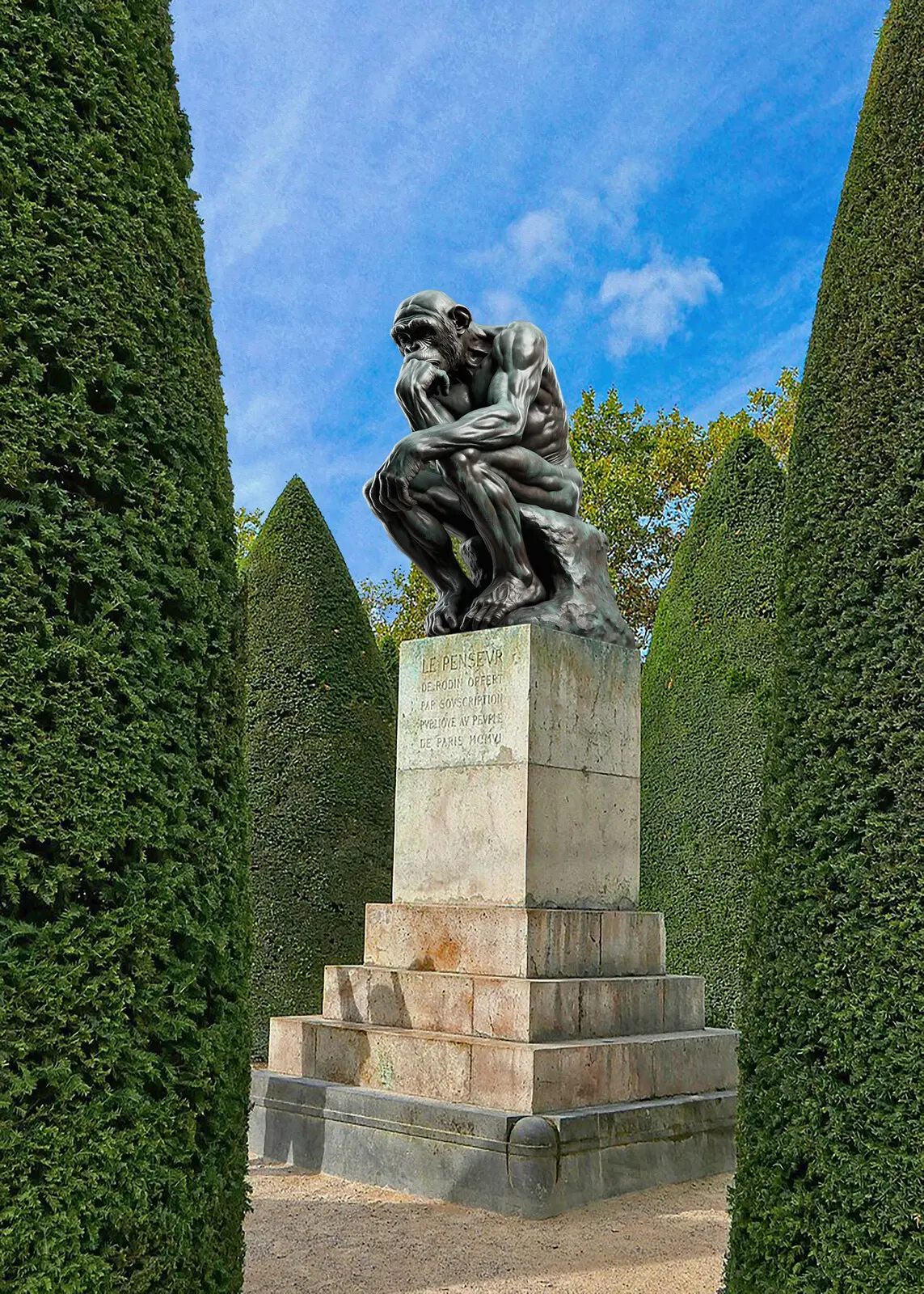
Second Thoughts - The Chimpanzee Who Contemplated, 2023
Digital
70 x 100 cm
5 200 kr
In the bustling art world, where sculptures stand like frozen echoes of human expression, one figure sits in contemplation, eternal and pensive — Auguste Rodin's "The Thinker." But behind this pensive posture lies a tale of intrigue, creativity, and, dare I say, a bit of cheekiness.
Auguste Rodin, a renowned sculptor of the late 19th century, crafted his masterpiece, 'The Thinker', as a pivotal part of a larger project known as 'The Gates of Hell '. This ambitious work was inspired by Dante Alighieri's 'Inferno', the first part of his epic poem 'Divine Comedy '. The gates depicted scenes from Dante's infernal journey, and 'The Thinker' was initially conceived as a representation of the poet himself, deeply contemplating the horrors of the underworld.
Yet, Rodin's vision for 'The Thinker' evolved, and it emerged as a standalone masterpiece, encapsulating humanity's perpetual struggle to comprehend the intricacies of existence. The figure, with its furrowed brow and clenched fists supporting its pensive chin, radiates an intellectual intensity that resonates with viewers of all generations.
However, let's not overlook the whimsical side of Rodin's creation. While 'The Thinker' projects a sense of gravity and solemnity, there's a discernible twinkle in his eye — or would be if he had one. Rodin, always one to provoke, placed his pensive protagonist atop 'The Gates of Hell', seemingly contemplating the chaos and folly unfolding below. It's as if he's saying, 'Ah, the human condition. Quite the spectacle, isn't it?'
Indeed, 'The Thinker' has become a symbol of intellectual pursuit and the human capacity for introspection and self-awareness. As viewers gaze upon this iconic sculpture, they're not just invited, but encouraged to contemplate their place in the universe, struggles, and aspirations. It's a reminder that moments of quiet reflection are not just precious, but necessary amidst the chaos and cacophony of life. This invitation to engage with the artwork is a testament to its power to inspire and provoke thought.
And so, dear reader, the next time you encounter Rodin's pensive ponderer, take a moment to join him in contemplation. Who knows what insights you might uncover or what mysteries of the universe you might unravel? After all, as "The Thinker" reminds us, pursuing knowledge and understanding is a journey without end but one well worth undertaking.
Auguste Rodin explored the complexity of humanity through his art, and it's evident that he was profoundly fascinated with humans as a species. His sculptures often capture the human body's movements, emotions, and thoughts in a way that provokes reflection and empathy in the viewer.
Rodin saw humans as physical and spiritual beings, and his works often delved into the depths of the inner life. By depicting human figures in various moments of emotional turmoil and reflection, he captured the rich diversity and beauty of the human soul.
Auguste Rodin had a complex view of Charles Darwin's evolutionary theories and the relationship between humans and apes. On the one hand, he admired Darwin for his scientific insights and revolutionary contributions to understanding life's development on Earth. On the other hand, Rodin was an artist and philosopher who perhaps did not necessarily see humans solely as a result of evolutionary processes.
Rodin deeply respected humans' unique abilities, especially their capacity for creativity, self-reflection, and spiritual striving. While he may have accepted that humans shared an evolutionary history with other primates, including apes, he was likely sceptical of the idea that humans were solely products of random evolutionary processes.
Instead of viewing humans solely as animals shaped by the forces of nature, Rodin tended to emphasise their uniqueness and transcendence. His art, including works like "The Thinker," reflects his belief in humanity's ability to transcend its animal origins through intelligence, creativity, and moral awareness.
In summary, Rodin had a nuanced view of the relationship between humans and apes and Darwin's evolutionary theories. He respected Darwin as a scientist and had a more nuanced view of human characteristics and potential.
It's unlikely that Rodin ever seriously entertained the idea that the thinker could be a chimpanzee or an ape instead of a human. However, the thought would surely have amused him once Darwin's theory of evolution had become more established. Rodin's early career in the late 19th century coincided with Darwin's theories gaining wider dissemination and acceptance within the scientific community.
Although they may not have had any direct meetings, Rodin must have been influenced by or had opinions about Darwin's theories and their implications for art and human understanding of themselves. However, it's important to note that Rodin's works and philosophical ideas are not directly about responding to or interpreting Darwin's theory of evolution but rather about exploring human emotions, experiences, and existential questions through artistic expression.
Auguste Rodin was a severe and intense artist, but some anecdotes suggest he had a certain sense of humour and could be playful in certain situations. He had a fondness for pranks.
An anecdote sometimes told is about an incident at the inauguration of one of his sculptures, "Balzac," where the artist is said to have arranged a playful incident. When the sculpture of Balzac, a controversial representation of the famous author, was unveiled, Rodin is said to have lit a cigar and placed it in the sculpture's mouth as a playful gesture.
There are also stories of how Rodin could be quick and sarcastic in his replies when confronted with questions about his art or personal life. His way of joking may not have been as prominent as in others, but there are signs that he had a humorous side that sometimes emerged in different situations. So, in retrospect, Rodin would probably have chuckled at placing a chimpanzee on the pedestal in Paris today. Not least considering all the apes that have emerged on the art scene. Like Pierre Brassau, the Monkey Artist
A Brush with Absurdity: The Brassau Affair
Few tales in the annals of art history are as tantalisingly absurd as the Brassau Affair of 1964. Picture it: a quaint art show in Göteborg, Sweden, where the avant-garde meets the unexpected and where the line between genius and, well, primates blurs into oblivion.
In the spotlight was Pierre Brassau, a mysterious French artist whose works elicited awe and admiration from critics and connoisseurs alike. But here's the kicker — Pierre Brassau wasn't your average beret-wearing, espresso-sipping artiste. No, he was something more extraordinary: a chimpanzee from the Boras Zoo named Peter. Move over, Monet; make way for the monkey.
The Brain Behind the Brush Behind this masterpiece of mischief was Åke "Dacke" Axelsson, a mischievous journalist with a penchant for pranks. With the stroke of a pen (and perhaps a stroke of madness), Axelsson concocted the ultimate art-world experiment: could critics distinguish between the strokes of a brush and the strokes of, well, a banana-munching primate?
Enter Peter, the unwitting simian savant. With a brush in hand (or instead, a brush awkwardly clutched in his paws), Peter set forth on his artistic odyssey. His preferred medium? Oil paints, of course. His preferred snack? Bananas, naturally. And thus, with a belly full of potassium and a canvas before him, Peter unleashed his inner Picasso.
Monkey Business, Masterpiece Edition As Peter daubed and dabbed, critics gazed in silent reverence, waxing poetic about the "powerful strokes" and "furious fastidiousness" of Brassau's work. Little did they know, they were heaping praise upon the work of a chimpanzee who, moments earlier, had been gleefully gobbling up cobalt blue.
But the pièce de résistance came when Axelsson revealed the ruse, pulling back the curtain on the primate Picasso. And yet, even in the wake of the revelation, some critics stood by their praise, insisting that Peter's paintings were still the cream of the artistic crop. Talk about a banana peel moment.
Legacy of Laughter In the aftermath of the Brassau Affair, the art world was left reeling, grappling with the realisation that perhaps, just perhaps, the line between genius and gibberish wasn't as clear-cut as they once thought. As for Peter, he hung up his brush and retired to the Chester Zoo in England, leaving behind a legacy that would be remembered in the annals of absurdity.
But Peter wasn't the only primate to leave his mark on the art world. From Banghi, the chimpanzee sensation, to the German zoo's brush with mistaken identity, it seemed that there was bound to be a splash of monkey madness wherever there were canvases and critters.
So the next time you find yourself pondering the profundity of a painting, spare a thought for the chimpanzees who dared to dip their toes (and their tails) into the world of art. After all, in a world where monkeys can masquerade as maestros, anything is possible — even the most absurd strokes of genius.
Brassau at work
When painting, Peter always had bananas close at hand. The rate at which he consumed them matched his level of creativity. During periods of great inspiration, he would eat as many as nine bananas in ten minutes.
After Peter had created several paintings, Axelsson chose what he considered to be the four best and arranged to have them exhibited in an art show at the Christina Gallery.
A Brassau original
After Axelsson revealed the hoax, Rolf Anderberg (the critic who had praised the work) insisted that Pierre's work was "still the best painting in the exhibition."
In 1969, Peter was transferred to the Chester Zoo in England, where he lived for the remainder of his life.
A Swedish businessman and art collector became the first to purchase a Brassau, a good investment.
Brassau’s peers among Monkey Artists
In December 2005, German newspapers reported that Dr. Kajta Schneider, director of the State Art Museum of Moritzburg in Saxony-Anhalt, was asked to identify the artist responsible for a painting. She responded that it looked like Ernst Wilhelm Nay. Nay is a Guggenheim Prize-winning artist famous for using blotches of colour.
In reality, the canvas was the work of Banghi, a 31-year-old female chimpanzee from Halle Zoo. When Dr. Schneider revealed her error, she said, "I did think it looked a bit rushed."
Banghi reportedly enjoyed painting, although most of her works were destroyed by her mate Satscho.
Art is a multifaceted and debatable term. It reflects human creativity, expression, and creation. But when art becomes an arena where beings other than humans are involved, the discussion becomes both complex and captivating. In the ever-expanding world of art, the participation of chimpanzees, particularly in painting and drawing, has evoked both fascination and controversy. Through this exciting borderland between human and non-human creativity, we can discover new insights about art and our understanding of other species.
Desmond Morris and his collaboration with the chimpanzee Kongo at the London Zoo provide a captivating insight into this boundary-crossing activity. Surprisingly, when first presented with a pen and paper, Kongo took the initiative and produced his first drawing. This paved the way for hundreds of paintings over several years, creating a pioneering depiction of non-human artistic creation.
While some critics have questioned the authenticity and significance of the chimpanzees' works, there is also a compelling argument for recognising their participation in the art world. Morris emphasises the joy and pleasure that Kongo exhibited in painting. For Kongo and other chimpanzees, artistic creation seems voluntary and enjoyable, affirming certain human ideals about creativity and expression. This joy and engagement observed in the chimpanzees highlight an essential aspect of art: its inherent value as a reward.
Another interesting question is whether chimpanzees' artworks can be considered abstract or if they have any form of mimesis or representation. While some argue that chimpanzees' paintings are abstract and random, others point to observed patterns and preferences suggesting a certain degree of intention behind their creations. This raises questions about the boundary between abstraction and representation in art and the extent of artistic expressiveness in other species.
It is also essential to examine the role of human intervention in the chimpanzees' artistic process. Morris's description of the carefully staged sessions with Kongo raises questions about autonomy and agency in the artist. While chimpanzees actively participate in painting, humans provide tools, colours, and structured sessions. This raises questions about human control over artistic creation and the boundaries of non-human creativity.
Ultimately, the chimpanzees' artistic creation challenges traditional notions of art and creativity. It forces us to consider new definitions of art and to recognise the potential for creativity and expression in other species. By exploring this borderland between human and non-human creativity, we can enrich our understanding of the nature of art and our relationship with other beings on our planet.
Jörgen Thornberg
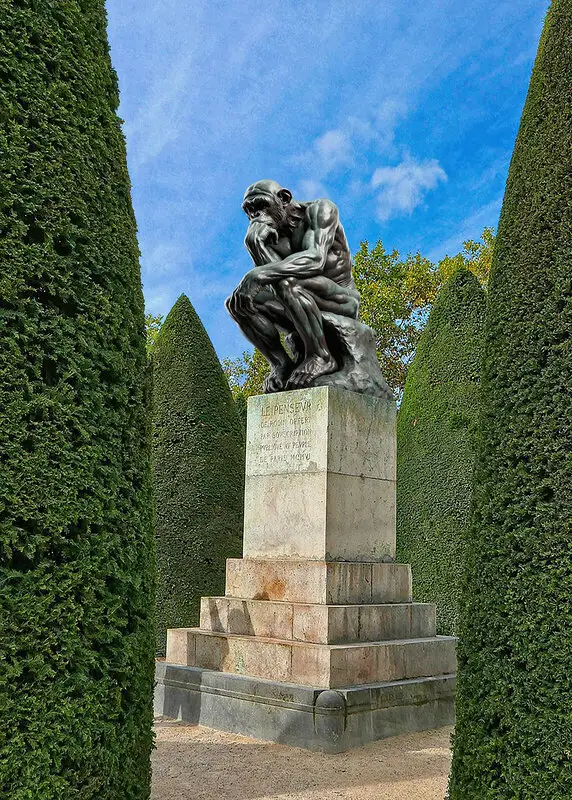
Second Thoughts - The Chimpanzee Who Contemplated, 2023
Digital
70 x 100 cm
5 200 kr
In the bustling art world, where sculptures stand like frozen echoes of human expression, one figure sits in contemplation, eternal and pensive — Auguste Rodin's "The Thinker." But behind this pensive posture lies a tale of intrigue, creativity, and, dare I say, a bit of cheekiness.
Auguste Rodin, a renowned sculptor of the late 19th century, crafted his masterpiece, 'The Thinker', as a pivotal part of a larger project known as 'The Gates of Hell '. This ambitious work was inspired by Dante Alighieri's 'Inferno', the first part of his epic poem 'Divine Comedy '. The gates depicted scenes from Dante's infernal journey, and 'The Thinker' was initially conceived as a representation of the poet himself, deeply contemplating the horrors of the underworld.
Yet, Rodin's vision for 'The Thinker' evolved, and it emerged as a standalone masterpiece, encapsulating humanity's perpetual struggle to comprehend the intricacies of existence. The figure, with its furrowed brow and clenched fists supporting its pensive chin, radiates an intellectual intensity that resonates with viewers of all generations.
However, let's not overlook the whimsical side of Rodin's creation. While 'The Thinker' projects a sense of gravity and solemnity, there's a discernible twinkle in his eye — or would be if he had one. Rodin, always one to provoke, placed his pensive protagonist atop 'The Gates of Hell', seemingly contemplating the chaos and folly unfolding below. It's as if he's saying, 'Ah, the human condition. Quite the spectacle, isn't it?'
Indeed, 'The Thinker' has become a symbol of intellectual pursuit and the human capacity for introspection and self-awareness. As viewers gaze upon this iconic sculpture, they're not just invited, but encouraged to contemplate their place in the universe, struggles, and aspirations. It's a reminder that moments of quiet reflection are not just precious, but necessary amidst the chaos and cacophony of life. This invitation to engage with the artwork is a testament to its power to inspire and provoke thought.
And so, dear reader, the next time you encounter Rodin's pensive ponderer, take a moment to join him in contemplation. Who knows what insights you might uncover or what mysteries of the universe you might unravel? After all, as "The Thinker" reminds us, pursuing knowledge and understanding is a journey without end but one well worth undertaking.
Auguste Rodin explored the complexity of humanity through his art, and it's evident that he was profoundly fascinated with humans as a species. His sculptures often capture the human body's movements, emotions, and thoughts in a way that provokes reflection and empathy in the viewer.
Rodin saw humans as physical and spiritual beings, and his works often delved into the depths of the inner life. By depicting human figures in various moments of emotional turmoil and reflection, he captured the rich diversity and beauty of the human soul.
Auguste Rodin had a complex view of Charles Darwin's evolutionary theories and the relationship between humans and apes. On the one hand, he admired Darwin for his scientific insights and revolutionary contributions to understanding life's development on Earth. On the other hand, Rodin was an artist and philosopher who perhaps did not necessarily see humans solely as a result of evolutionary processes.
Rodin deeply respected humans' unique abilities, especially their capacity for creativity, self-reflection, and spiritual striving. While he may have accepted that humans shared an evolutionary history with other primates, including apes, he was likely sceptical of the idea that humans were solely products of random evolutionary processes.
Instead of viewing humans solely as animals shaped by the forces of nature, Rodin tended to emphasise their uniqueness and transcendence. His art, including works like "The Thinker," reflects his belief in humanity's ability to transcend its animal origins through intelligence, creativity, and moral awareness.
In summary, Rodin had a nuanced view of the relationship between humans and apes and Darwin's evolutionary theories. He respected Darwin as a scientist and had a more nuanced view of human characteristics and potential.
It's unlikely that Rodin ever seriously entertained the idea that the thinker could be a chimpanzee or an ape instead of a human. However, the thought would surely have amused him once Darwin's theory of evolution had become more established. Rodin's early career in the late 19th century coincided with Darwin's theories gaining wider dissemination and acceptance within the scientific community.
Although they may not have had any direct meetings, Rodin must have been influenced by or had opinions about Darwin's theories and their implications for art and human understanding of themselves. However, it's important to note that Rodin's works and philosophical ideas are not directly about responding to or interpreting Darwin's theory of evolution but rather about exploring human emotions, experiences, and existential questions through artistic expression.
Auguste Rodin was a severe and intense artist, but some anecdotes suggest he had a certain sense of humour and could be playful in certain situations. He had a fondness for pranks.
An anecdote sometimes told is about an incident at the inauguration of one of his sculptures, "Balzac," where the artist is said to have arranged a playful incident. When the sculpture of Balzac, a controversial representation of the famous author, was unveiled, Rodin is said to have lit a cigar and placed it in the sculpture's mouth as a playful gesture.
There are also stories of how Rodin could be quick and sarcastic in his replies when confronted with questions about his art or personal life. His way of joking may not have been as prominent as in others, but there are signs that he had a humorous side that sometimes emerged in different situations. So, in retrospect, Rodin would probably have chuckled at placing a chimpanzee on the pedestal in Paris today. Not least considering all the apes that have emerged on the art scene. Like Pierre Brassau, the Monkey Artist
A Brush with Absurdity: The Brassau Affair
Few tales in the annals of art history are as tantalisingly absurd as the Brassau Affair of 1964. Picture it: a quaint art show in Göteborg, Sweden, where the avant-garde meets the unexpected and where the line between genius and, well, primates blurs into oblivion.
In the spotlight was Pierre Brassau, a mysterious French artist whose works elicited awe and admiration from critics and connoisseurs alike. But here's the kicker — Pierre Brassau wasn't your average beret-wearing, espresso-sipping artiste. No, he was something more extraordinary: a chimpanzee from the Boras Zoo named Peter. Move over, Monet; make way for the monkey.
The Brain Behind the Brush Behind this masterpiece of mischief was Åke "Dacke" Axelsson, a mischievous journalist with a penchant for pranks. With the stroke of a pen (and perhaps a stroke of madness), Axelsson concocted the ultimate art-world experiment: could critics distinguish between the strokes of a brush and the strokes of, well, a banana-munching primate?
Enter Peter, the unwitting simian savant. With a brush in hand (or instead, a brush awkwardly clutched in his paws), Peter set forth on his artistic odyssey. His preferred medium? Oil paints, of course. His preferred snack? Bananas, naturally. And thus, with a belly full of potassium and a canvas before him, Peter unleashed his inner Picasso.
Monkey Business, Masterpiece Edition As Peter daubed and dabbed, critics gazed in silent reverence, waxing poetic about the "powerful strokes" and "furious fastidiousness" of Brassau's work. Little did they know, they were heaping praise upon the work of a chimpanzee who, moments earlier, had been gleefully gobbling up cobalt blue.
But the pièce de résistance came when Axelsson revealed the ruse, pulling back the curtain on the primate Picasso. And yet, even in the wake of the revelation, some critics stood by their praise, insisting that Peter's paintings were still the cream of the artistic crop. Talk about a banana peel moment.
Legacy of Laughter In the aftermath of the Brassau Affair, the art world was left reeling, grappling with the realisation that perhaps, just perhaps, the line between genius and gibberish wasn't as clear-cut as they once thought. As for Peter, he hung up his brush and retired to the Chester Zoo in England, leaving behind a legacy that would be remembered in the annals of absurdity.
But Peter wasn't the only primate to leave his mark on the art world. From Banghi, the chimpanzee sensation, to the German zoo's brush with mistaken identity, it seemed that there was bound to be a splash of monkey madness wherever there were canvases and critters.
So the next time you find yourself pondering the profundity of a painting, spare a thought for the chimpanzees who dared to dip their toes (and their tails) into the world of art. After all, in a world where monkeys can masquerade as maestros, anything is possible — even the most absurd strokes of genius.
Brassau at work
When painting, Peter always had bananas close at hand. The rate at which he consumed them matched his level of creativity. During periods of great inspiration, he would eat as many as nine bananas in ten minutes.
After Peter had created several paintings, Axelsson chose what he considered to be the four best and arranged to have them exhibited in an art show at the Christina Gallery.
A Brassau original
After Axelsson revealed the hoax, Rolf Anderberg (the critic who had praised the work) insisted that Pierre's work was "still the best painting in the exhibition."
In 1969, Peter was transferred to the Chester Zoo in England, where he lived for the remainder of his life.
A Swedish businessman and art collector became the first to purchase a Brassau, a good investment.
Brassau’s peers among Monkey Artists
In December 2005, German newspapers reported that Dr. Kajta Schneider, director of the State Art Museum of Moritzburg in Saxony-Anhalt, was asked to identify the artist responsible for a painting. She responded that it looked like Ernst Wilhelm Nay. Nay is a Guggenheim Prize-winning artist famous for using blotches of colour.
In reality, the canvas was the work of Banghi, a 31-year-old female chimpanzee from Halle Zoo. When Dr. Schneider revealed her error, she said, "I did think it looked a bit rushed."
Banghi reportedly enjoyed painting, although most of her works were destroyed by her mate Satscho.
Art is a multifaceted and debatable term. It reflects human creativity, expression, and creation. But when art becomes an arena where beings other than humans are involved, the discussion becomes both complex and captivating. In the ever-expanding world of art, the participation of chimpanzees, particularly in painting and drawing, has evoked both fascination and controversy. Through this exciting borderland between human and non-human creativity, we can discover new insights about art and our understanding of other species.
Desmond Morris and his collaboration with the chimpanzee Kongo at the London Zoo provide a captivating insight into this boundary-crossing activity. Surprisingly, when first presented with a pen and paper, Kongo took the initiative and produced his first drawing. This paved the way for hundreds of paintings over several years, creating a pioneering depiction of non-human artistic creation.
While some critics have questioned the authenticity and significance of the chimpanzees' works, there is also a compelling argument for recognising their participation in the art world. Morris emphasises the joy and pleasure that Kongo exhibited in painting. For Kongo and other chimpanzees, artistic creation seems voluntary and enjoyable, affirming certain human ideals about creativity and expression. This joy and engagement observed in the chimpanzees highlight an essential aspect of art: its inherent value as a reward.
Another interesting question is whether chimpanzees' artworks can be considered abstract or if they have any form of mimesis or representation. While some argue that chimpanzees' paintings are abstract and random, others point to observed patterns and preferences suggesting a certain degree of intention behind their creations. This raises questions about the boundary between abstraction and representation in art and the extent of artistic expressiveness in other species.
It is also essential to examine the role of human intervention in the chimpanzees' artistic process. Morris's description of the carefully staged sessions with Kongo raises questions about autonomy and agency in the artist. While chimpanzees actively participate in painting, humans provide tools, colours, and structured sessions. This raises questions about human control over artistic creation and the boundaries of non-human creativity.
Ultimately, the chimpanzees' artistic creation challenges traditional notions of art and creativity. It forces us to consider new definitions of art and to recognise the potential for creativity and expression in other species. By exploring this borderland between human and non-human creativity, we can enrich our understanding of the nature of art and our relationship with other beings on our planet.
5 200 kr

Jörgen Thornberg
Malmö
Lite om bilder och mig. Translation in English at the end.
Jag är en nyfiken person som ser allt i bilder, även det jag fäster i ord, gärna tillsammans för bakom alla mina bilder finns en berättelse. Till vissa bilder hör en kortare eller längre novell som följer med bilden.
Bilder berättar historier. Jag omges av naturlig skönhet, intressanta människor och historia var jag än går. Jag använder min kamera för att dokumentera världen och blanda det jag ser med vad jag känner för att fånga den dolda magin.
Mina bilder berättar mina historier. Genom mina bilder, tryck och berättelser. Jag bjuder in dig att ta del av dessa berättelser, in i ditt liv och hem och dela min mycket personliga syn på vår värld. Mer än vad ögat ser. Jag tänker i bilder, drömmer och skriver och pratar om dem; följaktligen måste jag också skapa bilder. De blir vad jag ser, inte nödvändigtvis begränsade till verkligheten. Det finns en bild runt varje hörn. Jag hoppas att du kommer att se vad jag såg och gilla det.
Jag är också en skrivande person och till många bilder hör en kortare eller längre essay. Den följer med tavlan, tryckt på fint papper och med en personlig hälsning från mig.
Flertalet bilder startar sin resa i min kamera. Enkelt förklarat beskriver jag bilden jag ser i mitt inre, upplevd eller fantiserad. Bilden uppstår inom mig redan innan jag fått okularet till ögat. På bråkdelen av ett ögonblick ser jag vad jag vill ha och vad som kan göras med bilden. Här skall jag stoppa in en giraff, stålmannen, Titanic eller vad det är min fantasi finner ut. Ännu märkligare är att jag kommer ihåg minnesbilden långt efteråt när det blir tid att skapa verket. Om jag lyckas eller inte, är upp till betraktaren, oftast präglat av en stråk av svart humor – meningen är att man skall bli underhållen. Mina bilder blir ofta en snackis där de hänger.
Jag föredrar bilder som förmedlar ett budskap i flera lager. Vid första anblicken fylld av feel-good, en vacker utsikt, fint väder, solen skiner, blommor på ängen eller vattnet som ligger förrädiskt spegelblankt. I en sådan bild kan jag gömma min egentliga berättelse, mitt förakt för förtryckare och våldsverkare, rasister och fördomsfulla människor - ett gärna återkommande motiv mer eller mindre dolt i det vackra motivet. Jag försöker förena dem i ett gemensamt narrativ.
Bild och formgivning har löpt som en röd tråd genom livet. Fotokonst känns som en värdig final som jag gärna delar med mig.
Min genre är vid som framgår av mina bilder, temat en blandning av pop- och gatukonst i kollage som kan bestå av hundratals lager. Vissa bilder kan ta veckor, andra någon dag innan det är dags att överlämna resultatet till printverkstaden. Fine Art Prints är digitala fotocollage. I dessa kollage sker rivandet, klippandet, pusslandet, målandet, ritandet och sprayningen digitalt. Det jag monterar in kan vara hundratals år gamla bilder som jag omsorgsfullt frilägger så att de ser ut att vara en del av tavlan men också bilder skapade av mig själv efter min egen fantasi. Därefter besöks printstudion och för vissa bilder numrera en limiterad upplaga (oftast 7 exemplar) och signera för hand. Vissa bilder kan köpas i olika format. Det är bara att fråga efter vilka. Gillar man en bild som är 70x100 men inte har plats på väggen, går den kanske att få i 50x70 cm istället. Frågan är fri.
Metoden Giclée eller Fine Art Print som det också kallas är det moderna sättet för framställning av grafisk konst. Villkoret för denna typ av utskrifter är att en högkvalitativ storformatskrivare används med åldersbeständigt färgpigment och konstnärspapper eller i förekommande fall på duk. Pappret som används möter de krav på livslängd som ställs av museer och gallerier. Normalt säljer jag mina bilder oinramade så att den nya ägaren själv kan bestämma hur de skall se ut, med eller utan passepartout färg på ram, med eller utan glas etc..
Under många år ställde jag bara ut på nätet, i valda grupper och på min egen Facebooksida - https://www.facebook.com/jorgen.thornberg.9
Jag finns också på en egen hemsida som tyvärr inte alltid är uppdaterad – https://www.jth.life/ Där kan du också läsa en del av de berättelser som följer med bilden.
UTSTÄLLNINGAR
Luftkastellet, oktober 2022
Konst i Lund, november 2022
Luftkastellet, mars 2023
Engleson Galleri Caroli, april 2023
Hydra, Greece June 2023
Engleson Galleri Caroli, oktober 2023
Toppen, Höllviken december 2023
Luftkastellet, mars 2024
Torups Galleri, mars 2024
Venice, May 2024
Luftkastellet, oktober 2024
Konst i Advent, December 2024
Galleri Engleson, Caroli December 2024
Jäger & Jansson Galleri, april 2025
A bit about pictures and me.
I'm a curious person who sees everything in pictures, even what I express in words, often combining them, for behind all my pictures lies a story. These narratives, some as short as a single image and others as long as a novel, are the heart and soul of my work.
Pictures tell stories. Wherever I go, I'm surrounded by natural beauty, exciting people, and history. I use my camera to document the world and blend what I see with what I feel to capture the hidden magic.
My images tell my stories. Through my pictures, prints, and narratives, I invite you to partake in these stories in your life and home and share my deeply personal perspective of our world. More than meets the eye. I think in pictures, dream, write, and talk about them; consequently, I must create images too. They become what I see, not necessarily confined to reality. There's a picture around every corner. I hope you'll see what I saw and enjoy it.
I'm also a writer, and many images come with a shorter or longer essay. It accompanies the painting, printed on fine paper with my personal greeting.
Many pictures start their journey on my camera. Simply put, I describe the image I see in my mind, experienced or imagined. The image arises within me even before I bring the eyepiece to my eye. In a fraction of a moment, I see what I want and what can be done with the picture. Here, I'll insert a giraffe, Superman, the Titanic, or whatever my imagination conjures up. Even stranger is that I remember the mental image long after it's time to create the work. Whether I succeed is up to the observer, often imbued with a streak of black humour – the aim is to entertain. My pictures usually become a talking point wherever they hang.
I prefer pictures that convey a message in multiple layers. At first glance, they're filled with feel-good vibes, a beautiful view, lovely weather, the sun shining, flowers in the meadow, or the water lying deceptively calm. But beneath this surface beauty, I often conceal a deeper story, a narrative that challenges societal norms or explores the human condition. I invite you to delve into these hidden narratives and discover the layers of meaning within my work.
Picture and design have been a thread running through my life. Photographic art feels like a fitting finale, and I'm happy to share it.
My genre is varied, as seen in my pictures; the theme is a blend of pop and street art in collages that can consist of hundreds of layers. Some images can take weeks, others just a day before it's time to hand over the result to the print workshop. Fine Art Prints are digital photo collages. In these collages, tearing, cutting, puzzling, painting, drawing, and spraying happen digitally. What I insert can be images hundreds of years old that I carefully extract so they appear to be part of the painting, but also images created by myself, now also generated from my imagination. Next, visit the print studio and, for certain images, number a limited edition (usually 7 copies) and sign them by hand. Some images may be available in other formats. Just ask which ones. If you like an image that's 70x100 but doesn't have space on the wall, you might be able to get it in 50x70 cm instead. The question is open.
The Giclée method, or Fine Art Print as it's also called, is the modern way of producing graphic art. This method ensures the highest quality and longevity of the artwork, using a high-quality large-format printer with archival pigment inks and artist paper or, in some cases, canvas. The paper used meets the longevity requirements set by museums and galleries. I sell my pictures unframed, allowing the new owner to personalise their artwork, confident in the lasting value and quality of the piece.
For many years, I only exhibited online, in selected groups, and on my Facebook page - https://www.facebook.com/jorgen.thornberg.9. I also have my website, which unfortunately is not constantly updated - https://www.jth.life/. You can also read some of the stories accompanying the pictures there.
EXHIBITIONS
Luftkastellet, October 2022
Art in Lund, November 2022
Luftkastellet, March 2023
Engleson Gallery Caroli, April 2023
Hydra, Greece June 2023
Engleson Gallery Caroli, October 2023
Toppen, Höllviken December 2023
Luftkastellet, March 2024
Torup Gallery, March 2024
Venice, May 2024
UTSTÄLLNINGAR
Luftkastellet, oktober 2022
Konst i Lund, november 2022
Luftkastellet, mars 2023
Engleson Galleri Caroli, april 2023
Hydra, Greece June 2023
Engleson Galleri Caroli, oktober 2023
Toppen, Höllviken december 2023
Luftkastellet, mars 2024
Torups Galleri, mars 2024
Venice, May 2024
Luftkastellet, October 2024
Konst i Advent, December 2024
Galleri Engleson, Caroli December 2024
Jäger & Jansson Galleri, April 2025
Utbildning
Autodidakt
Medlem i konstnärsförening
Öppna Sinnen
Med i konstrunda
Konstrundan i Skåne
Utställningar
Luftkastellet, October 2022
Art in Lund, November 2022
Luftkastellet, March 2023
Engleson Gallery Caroli, April 2023
Hydra, Greece June 2023
Engleson Gallery Caroli, October 2023
Toppen, Höllviken December 2023
Luftkastellet, March 2024
Torup Gallery, March 2024
Venice, May 2024